QUESTION IMAGE
Question
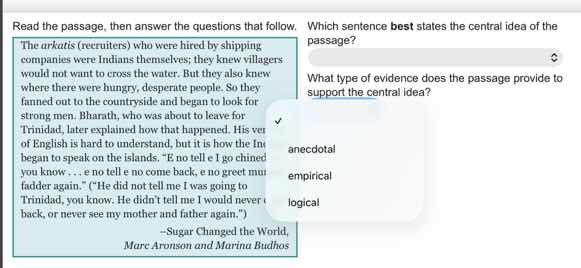
read the passage, then answer the questions that follow. the arkats (recruiters) who were hired by shipping companies were not indians themselves; they knew villagers would want to cross the water. but they also knew where there were hungry, desperate people. so they fanned out to the countryside and began to look for strong men. bharath, who was about to leave for trinidad, later explained how that happened. his ver of english is hard to understand, but it is how the in began to speak on the islands. “to tell e i go chined you know... e no tell me was going to fadder again.” (“he did not tell me i was going to trinidad, you know. he didnt tell me i would never back, or never see my mother and father again.”) —marc aronson and marina budhos which sentence best states the central idea of the passage? what type of evidence does the passage provide to support the central idea? anecdotal empirical logical
Question 1: Which sentence best states the central idea of the passage?
The passage describes how recruiters (artists) for shipping companies found desperate people in India to work in Trinidad, using Bharath's anecdote to illustrate the deception in the recruitment process. A central idea sentence would capture this: "Recruiters for shipping companies deceived desperate Indians into going to Trinidad by not fully disclosing the truth about their journey and future." (This is a constructed central idea sentence based on the passage content; if options were provided, we'd analyze them, but since none are here, this is the central idea summary.)
Question 2: What type of evidence does the passage provide to support the central idea?
The passage uses Bharath's personal account (his story about being recruited, what was/not told to him) to support the central idea about recruitment deception. Anecdotal evidence is based on personal stories/experiences, which matches here. Empirical evidence is based on systematic observation/experiment, and logical is reasoning; neither fit as well as anecdotal.

Snap & solve any problem in the app
Get step-by-step solutions on Sovi AI
Photo-based solutions with guided steps
Explore more problems and detailed explanations
anecdotal