QUESTION IMAGE
Question
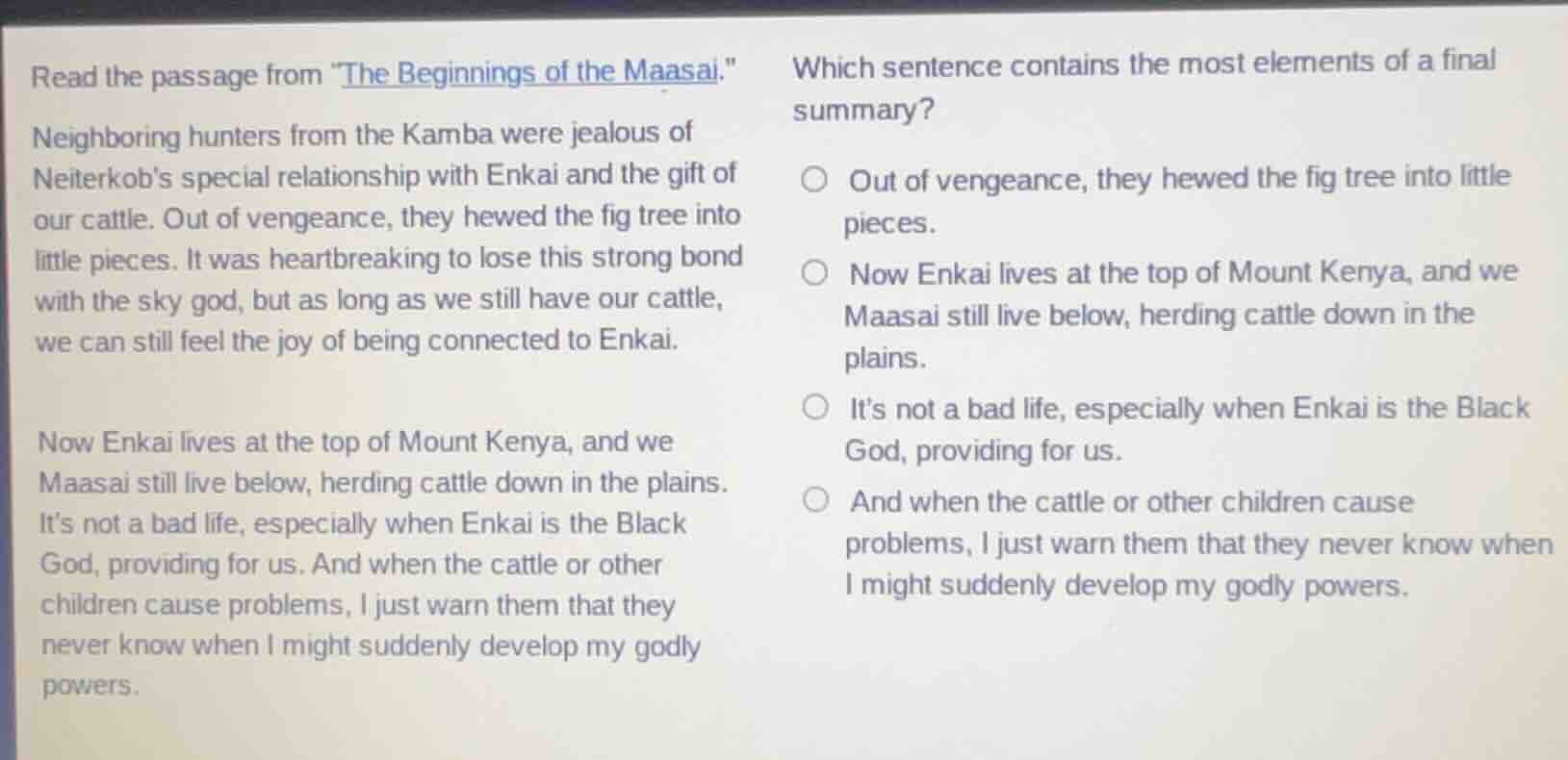
read the passage from \the beginnings of the maasai.\ neighboring hunters from the kamba were jealous of neiterkobs special relationship with enkai and the gift of our cattle. out of vengeance, they hewed the fig tree into little pieces. it was heartbreaking to lose this strong bond with the sky god, but as long as we still have our cattle, we can still feel the joy of being connected to enkai. now enkai lives at the top of mount kenya, and we maasai still live below, herding cattle down in the plains. its not a bad life, especially when enkai is the black god, providing for us. and when the cattle or other children cause problems, i just warn them that they never know when i might suddenly develop my godly powers. which sentence contains the most elements of a final summary? out of vengeance, they hewed the fig tree into little pieces. now enkai lives at the top of mount kenya, and we maasai still live below, herding cattle down in the plains. its not a bad life, especially when enkai is the black god, providing for us. and when the cattle or other children cause problems, i just warn them that they never know when i might suddenly develop my godly powers.
A final summary should capture the core, resolved state of the narrative, including the key relationship between the Maasai and Enkai, their current way of life, and the central connection to cattle. The first option only covers a single vengeful act, not a concluding state. The third option is partial, missing the key detail of their living arrangement. The fourth option is a minor, personal aside, not a core summary. The second option includes the final location of Enkai, the Maasai's home and their traditional herding life, which encapsulates the main resolved elements of the passage.

Snap & solve any problem in the app
Get step-by-step solutions on Sovi AI
Photo-based solutions with guided steps
Explore more problems and detailed explanations
Now Enkai lives at the top of Mount Kenya, and we Maasai still live below, herding cattle down in the plains.