QUESTION IMAGE
Question
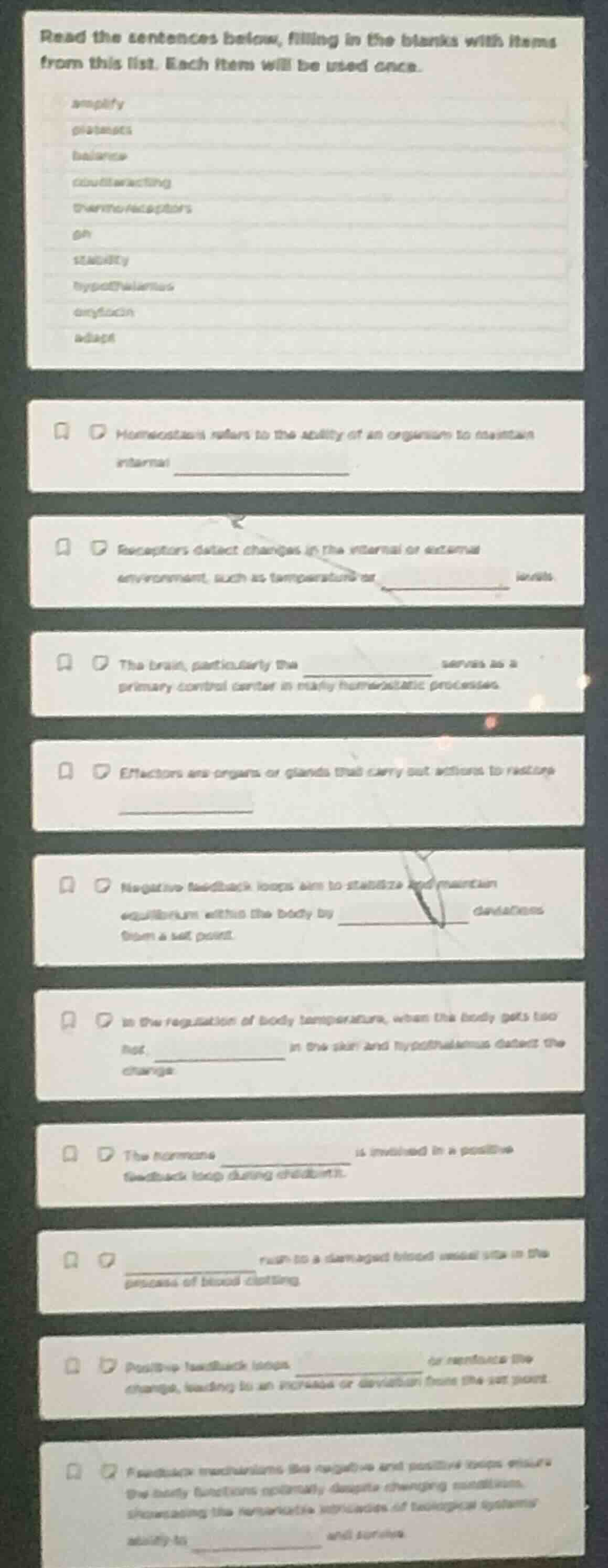
read the sentences below, filling in the blanks with items from this list. each item will be used once.
amplify
hormones
balance
cloudwatching
thermoreceptors
gh
stability
hypothalamus
disruption
adapt
homeostasis refers to the ability of an organism to maintain internal __________.
receptors detect changes in the internal or external environment, such as temperature or __________ levels.
the brain, particularly the __________ serves as a primary control center in many homeostatic processes.
effectors are organs or glands that carry out actions to reduce __________.
negative feedback loops aim to stabilize and maintain equilibrium within the body by __________ deviations from a set point.
in the regulation of body temperature, when the body gets too hot, __________ in the skin and hypothalamus detect the change.
the hormone __________ is involved in a positive feedback loop during childbirth.
__________ rush to a damaged blood vessel site in the process of blood clotting.
positive feedback loops __________ or reinforce the change, leading to an increase or deviation from the set point.
feedback mechanisms (negative and positive loops) ensure the body functions optimally despite changing conditions, increasing the homeostatic intricacies of biological systems’ ability to __________ and survive.
- Homeostasis is defined as maintaining internal steady conditions.
- Receptors monitor factors like pH alongside temperature.
- The hypothalamus is the brain's main homeostatic control center.
- Effectors act to restore steady internal conditions (balance).
- Negative feedback works to offset deviations from set points.
- Thermoreceptors specifically detect temperature changes.
- Oxytocin drives positive feedback during childbirth.
- Platelets are the cells that gather at damaged blood vessels for clotting.
- Positive feedback increases or amplifies initial changes.
- Homeostatic mechanisms let organisms adjust (adapt) to conditions.

Snap & solve any problem in the app
Get step-by-step solutions on Sovi AI
Photo-based solutions with guided steps
Explore more problems and detailed explanations
- Homeostasis refers to the ability of an organism to maintain internal stability
- Receptors detect changes in the internal or external environment, such as temperature or pH levels.
- The brain, particularly the hypothalamus serves as a primary control center in many homeostatic processes.
- Effectors are organs or glands that carry out actions to restore balance
- Negative feedback loops aim to stabilize and maintain equilibrium within the body by counteracting deviations from a set point.
- In the regulation of body temperature, when the body gets too hot, thermoreceptors in the skin and hypothalamus detect the change.
- The hormone oxytocin is involved in a positive feedback loop during childbirth.
- Platelets rush to a damaged blood vessel site in the process of blood clotting.
- Positive feedback loops amplify or reinforce the change, leading to an increase or deviation from the set point.
- Feedback mechanisms like negative and positive loops ensure the body functions optimally despite changing conditions, showcasing the remarkable intricacies of biological systems' ability to adapt and survive.