QUESTION IMAGE
Question
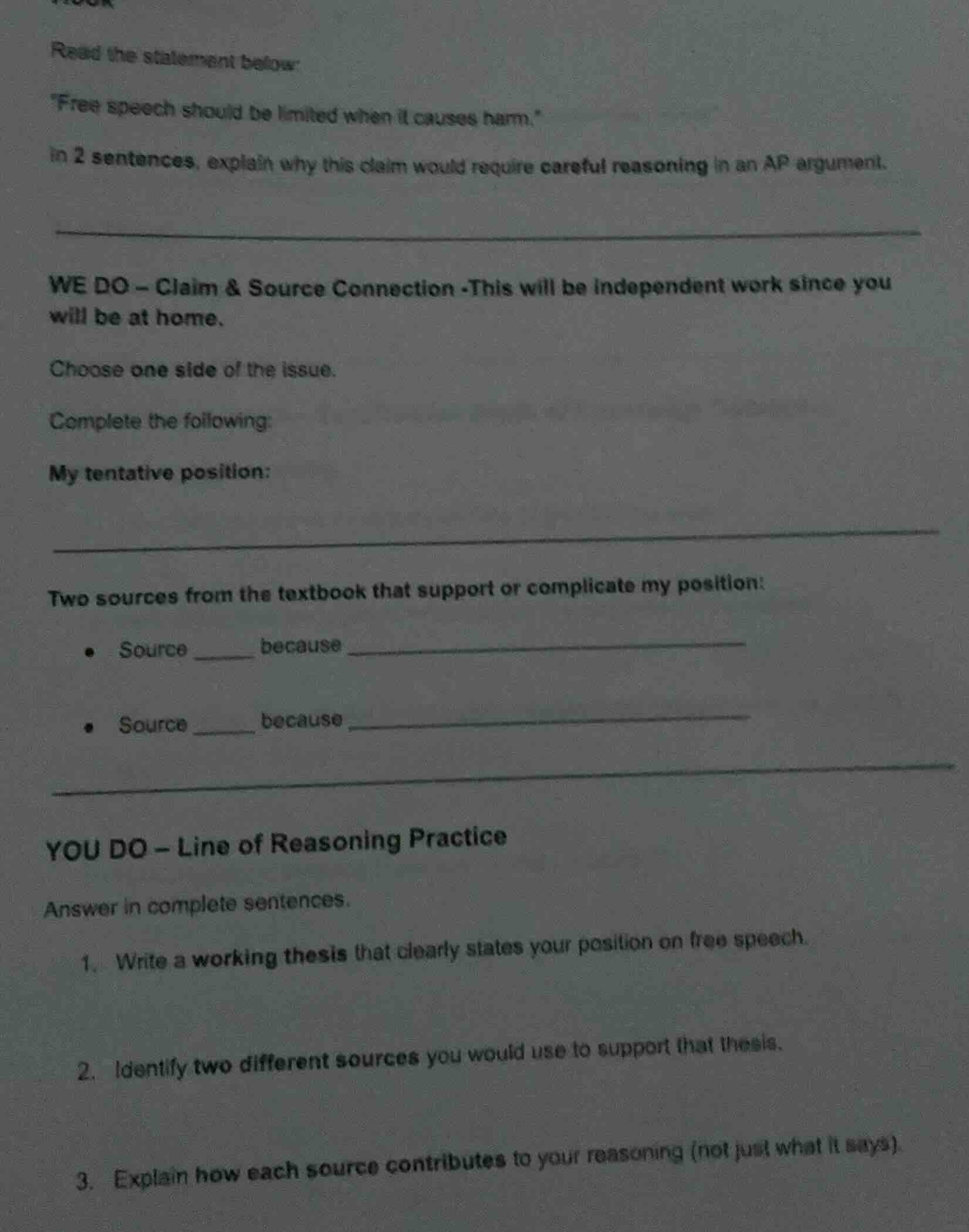
read the statement below:
\free speech should be limited when it causes harm.\
in 2 sentences, explain why this claim would require careful reasoning in an ap argument.
we do – claim & source connection -this will be independent work since you will be at home.
choose one side of the issue.
complete the following:
my tentative position:
two sources from the textbook that support or complicate my position:
- source ____ because _____________
- source ____ because _____________
you do – line of reasoning practice
answer in complete sentences.
- write a working thesis that clearly states your position on free speech.
- identify two different sources you would use to support that thesis.
- explain how each source contributes to your reasoning (not just what it says)
Part 1: Explanation for Careful Reasoning
First, defining "harm" is subjective—what one group deems harmful (e.g., hate speech) another might see as valid expression, so reasoning must clarify this term. Second, balancing free speech (a core democratic value) with limitations requires weighing competing principles, so the argument must justify when and how restrictions are ethical without undermining civil liberties.

Snap & solve any problem in the app
Get step-by-step solutions on Sovi AI
Photo-based solutions with guided steps
Explore more problems and detailed explanations
Free speech should be limited when it causes harm requires careful reasoning because defining “harm” is subjective (e.g., distinguishing hate speech from legitimate dissent) and because balancing speech rights with restrictions demands justifying where to draw the line without eroding democratic freedoms.
Part 2: Tentative Position, Sources (Example)
My tentative position:
Free speech should be limited when it causes direct, verifiable harm (e.g., inciting violence or spreading medical misinformation) to protect individuals and public welfare, while preserving speech that fosters debate.
Two sources from the textbook that support or complicate my position:
- Source 1 (e.g., a court case like Schenck v. United States) because it establishes the “clear and present danger” test, showing legal precedent for limiting speech that threatens harm, which supports the idea that harm-based restrictions are justified in extreme cases.
- Source 2 (e.g., an essay on hate speech) because it complicates the position by arguing that even “harmful” speech (like hate speech) can be protected to avoid slippery slopes in censorship, forcing reflection on how broadly to define “harm.”
Part 3: Line of Reasoning Practice
- Working Thesis: Free speech is a fundamental right, but it should be limited when it causes direct, demonstrable harm to individuals or society, as this balance protects both civil liberties and public safety.
- Two Different Sources:
- Schenck v. United States (legal precedent): This source provides a judicial framework (the “clear and present danger” test) to determine when speech crosses into harmful territory, supporting the thesis by showing legal systems already limit speech to prevent harm.
- A scholarly article on the impact of medical misinformation (e.g., during a pandemic): This source illustrates how unregulated speech can cause tangible harm (loss of life, public panic), justifying the need for restrictions in cases of provable harm to public health.
- Explanation of Each Source’s Contribution:
- The Schenck case contributes by offering a historical/legal lens to define “harm” as speech that poses an immediate threat, helping to operationalize the thesis’s “direct, demonstrable harm” standard.
- The medical misinformation article contributes by providing empirical evidence of harm from unregulated speech, strengthening the argument that restrictions are necessary to protect public welfare without relying solely on legal precedent.