QUESTION IMAGE
Question
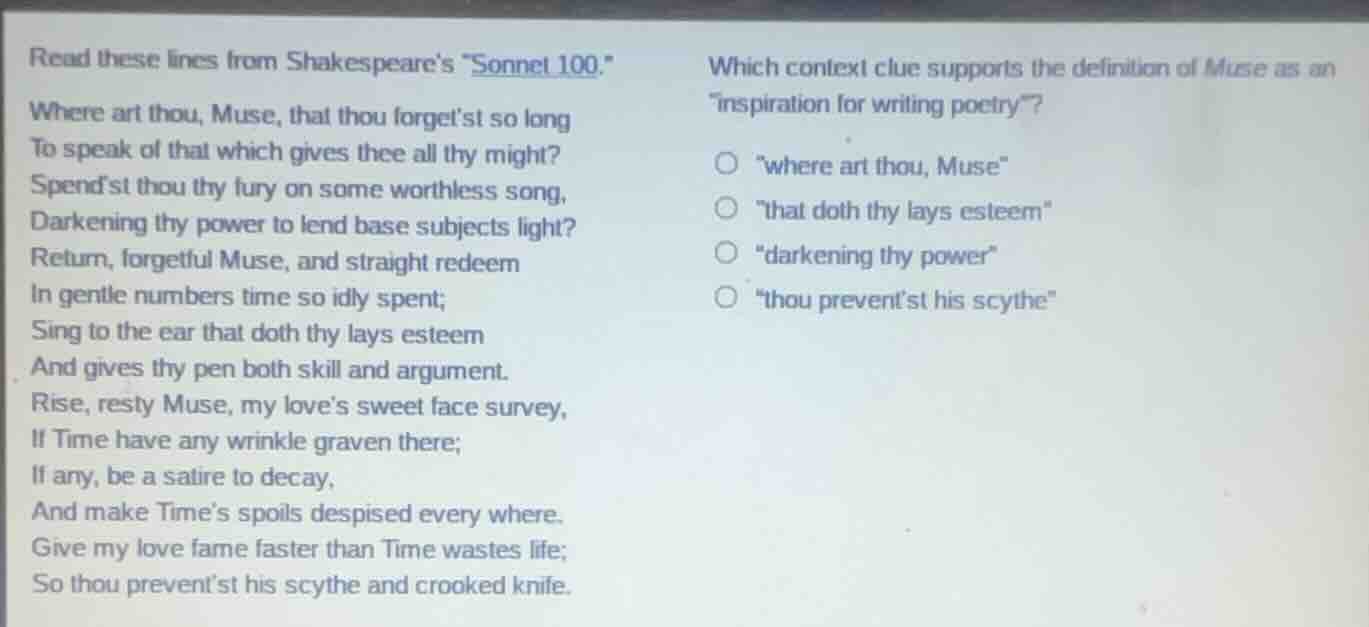
read these lines from shakespeare’s “sonnet 100.”
where art thou, muse, that thou forget’st so long
to speak of that which gives thee all thy might?
spend’st thou thy fury on some worthless song,
darkening thy power to lend base subjects light?
return, forgetful muse, and straight redeem
in gentle numbers time so idly spent;
sing to the ear that doth thy lays esteem
and gives thy pen both skill and argument.
rise, resty muse, my love’s sweet face survey,
if time have any wrinkle graven there;
if any, be a satire to decay,
and make time’s spoils despised every where.
give my love fame faster than time wastes life;
so thou prevent’st his scythe and crooked knife.
which context clue supports the definition of muse as an “inspiration for writing poetry”?
○ “where art thou, muse”
○ “that doth thy lays esteem”
○ “darkening thy power”
○ “thou prevent’st his scythe”
To determine the context clue for "Muse" as "inspiration for writing poetry", we analyze each option:
- "where art thou, Muse": Just asks about Muse's location, no info on inspiration.
- "that doth thy lays esteem": "Lays" refer to poems/songs. The line means there's an ear that values Muse's poems and gives the pen skill/argument. This shows Muse inspires writing (since it relates to poems and giving pen skill for writing).
- "darkening thy power": Talks about reducing power, not inspiration.
- "thou prevent’st his scythe": About defeating Time, not writing inspiration.

Snap & solve any problem in the app
Get step-by-step solutions on Sovi AI
Photo-based solutions with guided steps
Explore more problems and detailed explanations
B. "that doth thy lays esteem"