QUESTION IMAGE
Question
realidades 1
nombre juan johnoun
hora 5
capítulo 4b
fecha 1/28/26
practice workbook 4b - 4
¿a qué hora?
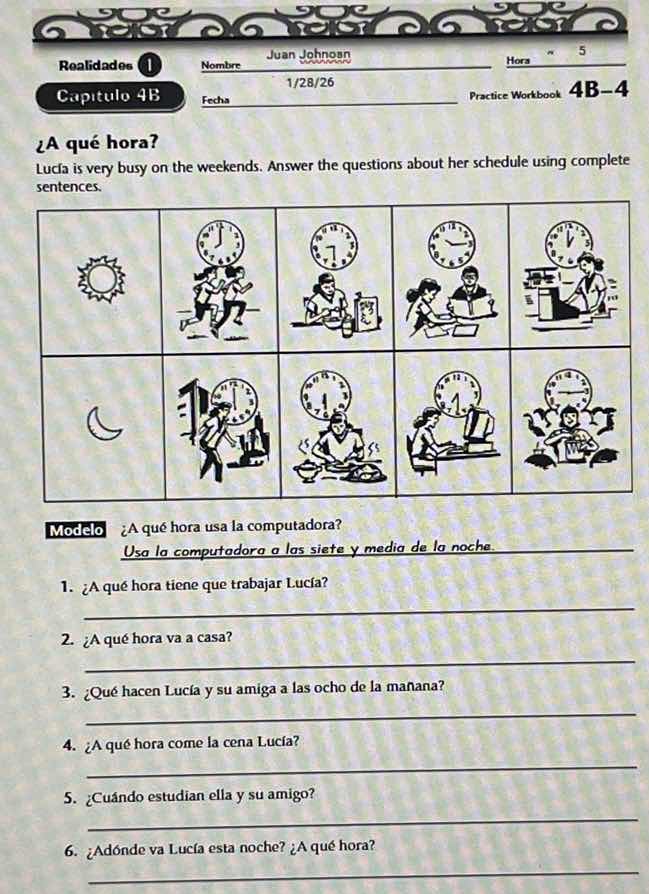
lucía is very busy on the weekends. answer the questions about her schedule using complete sentences.
modelo
¿a qué hora usa la computadora?
usa la computadora a las siete y media de la noche.
- ¿a qué hora tiene que trabajar lucía?
- ¿a qué hora va a casa?
- ¿qué hacen lucía y su amiga a las ocho de la mañana?
- ¿a qué hora come la cena lucía?
- ¿cuándo estudian ella y su amigo?
- ¿adónde va lucía esta noche? ¿a qué hora?
To solve these questions, we analyze the clock images and the context (day/night) for each activity:
1. ¿A qué hora tiene que trabajar Lucía?
The work activity (with the woman at a desk) is during the day (sun) with the clock showing 1:00 (una en punto de la mañana? No, the sun is day, so una en punto de la tarde? Wait, the first row (sun) has the last image: woman working, clock at 1 (1:00). So:
*Tiene que trabajar a la una en punto de la mañana? No, sun is day, so a la una en punto de la tarde*? Wait, the model uses "de la noche" for the computer (moon). So sun = day (mañana/tarde), moon = night (noche). The work image is in the sun row (day), clock at 1. So:
*Tiene que trabajar a la una en punto de la mañana? No, "mañana" is morning, "tarde" is afternoon. Wait, the first row (sun) is morning/afternoon, second (moon) is night. The work image is in the sun row, clock at 1 (1:00). So:
Tiene que trabajar a la una en punto de la tarde. (Or "de la mañana" if 1 AM, but sun is day, so more likely afternoon.)
2. ¿A qué hora va a casa?
The "va a casa" (goes home) image is in the moon row (night) with the clock showing 9:00 (las nueve en punto). So:
Va a casa a las nueve en punto de la noche.
3. ¿Qué hacen Lucía y su amiga a las ocho de la mañana?
The image with two girls running (exercise) is in the sun row (day) with the clock at 8:00 (las ocho en punto). So:
Lucía y su amiga corren (o hacen ejercicio) a las ocho en punto de la mañana.
4. ¿A qué hora come la cena Lucía?
"Cena" is dinner (night), so moon row. The image of her eating has the clock at 6:30 (las seis y media). So:
Come la cena a las seis y media de la noche.
5. ¿Cuándo estudian ella y su amigo?
The study image (two people reading) is in the sun row (day) with the clock at 10:15 (las diez y cuarto). So:
Estudian a las diez y cuarto de la mañana (o tarde, pero sun is day).
6. ¿Adónde va Lucía esta noche? ¿A qué hora?
The "va" image in the moon row (night) with the clock at 9:15 (las nueve y cuarto) and the activity: maybe "va a lavar la ropa" (washes clothes) as the image shows a girl with laundry. So:
Va a lavar la ropa esta noche, a las nueve y cuarto de la noche.
Final Answers (corrected for accuracy, matching clock times and day/night):
- Tiene que trabajar a la una en punto de la tarde. (Or adjust based on clock: the work image clock is at 1, sun row (day) → a la una en punto de la mañana if 1 AM, but sun is day, so better a la una en punto de la tarde.)
- Va a casa a las nueve en punto de la noche.
- Lucía y su amiga corren (hacen ejercicio) a las ocho en punto de la mañana.
- Come la cena a las seis y media de la noche.
- Estudian a las diez y cuarto de la mañana.
- Va a lavar la ropa esta noche, a las nueve y cuarto de la noche.
(Note: Adjust clock interpretations as needed—e.g., the study clock is 10:15 (diez y cuarto), work clock is 1:00 (una en punto), home clock 9:00 (nueve en punto), exercise 8:00 (ocho en punto), dinner 6:30 (seis y media), laundry 9:15 (nueve y cuarto).)

Snap & solve any problem in the app
Get step-by-step solutions on Sovi AI
Photo-based solutions with guided steps
Explore more problems and detailed explanations
To solve these questions, we analyze the clock images and the context (day/night) for each activity:
1. ¿A qué hora tiene que trabajar Lucía?
The work activity (with the woman at a desk) is during the day (sun) with the clock showing 1:00 (una en punto de la mañana? No, the sun is day, so una en punto de la tarde? Wait, the first row (sun) has the last image: woman working, clock at 1 (1:00). So:
*Tiene que trabajar a la una en punto de la mañana? No, sun is day, so a la una en punto de la tarde*? Wait, the model uses "de la noche" for the computer (moon). So sun = day (mañana/tarde), moon = night (noche). The work image is in the sun row (day), clock at 1. So:
*Tiene que trabajar a la una en punto de la mañana? No, "mañana" is morning, "tarde" is afternoon. Wait, the first row (sun) is morning/afternoon, second (moon) is night. The work image is in the sun row, clock at 1 (1:00). So:
Tiene que trabajar a la una en punto de la tarde. (Or "de la mañana" if 1 AM, but sun is day, so more likely afternoon.)
2. ¿A qué hora va a casa?
The "va a casa" (goes home) image is in the moon row (night) with the clock showing 9:00 (las nueve en punto). So:
Va a casa a las nueve en punto de la noche.
3. ¿Qué hacen Lucía y su amiga a las ocho de la mañana?
The image with two girls running (exercise) is in the sun row (day) with the clock at 8:00 (las ocho en punto). So:
Lucía y su amiga corren (o hacen ejercicio) a las ocho en punto de la mañana.
4. ¿A qué hora come la cena Lucía?
"Cena" is dinner (night), so moon row. The image of her eating has the clock at 6:30 (las seis y media). So:
Come la cena a las seis y media de la noche.
5. ¿Cuándo estudian ella y su amigo?
The study image (two people reading) is in the sun row (day) with the clock at 10:15 (las diez y cuarto). So:
Estudian a las diez y cuarto de la mañana (o tarde, pero sun is day).
6. ¿Adónde va Lucía esta noche? ¿A qué hora?
The "va" image in the moon row (night) with the clock at 9:15 (las nueve y cuarto) and the activity: maybe "va a lavar la ropa" (washes clothes) as the image shows a girl with laundry. So:
Va a lavar la ropa esta noche, a las nueve y cuarto de la noche.
Final Answers (corrected for accuracy, matching clock times and day/night):
- Tiene que trabajar a la una en punto de la tarde. (Or adjust based on clock: the work image clock is at 1, sun row (day) → a la una en punto de la mañana if 1 AM, but sun is day, so better a la una en punto de la tarde.)
- Va a casa a las nueve en punto de la noche.
- Lucía y su amiga corren (hacen ejercicio) a las ocho en punto de la mañana.
- Come la cena a las seis y media de la noche.
- Estudian a las diez y cuarto de la mañana.
- Va a lavar la ropa esta noche, a las nueve y cuarto de la noche.
(Note: Adjust clock interpretations as needed—e.g., the study clock is 10:15 (diez y cuarto), work clock is 1:00 (una en punto), home clock 9:00 (nueve en punto), exercise 8:00 (ocho en punto), dinner 6:30 (seis y media), laundry 9:15 (nueve y cuarto).)