QUESTION IMAGE
Question
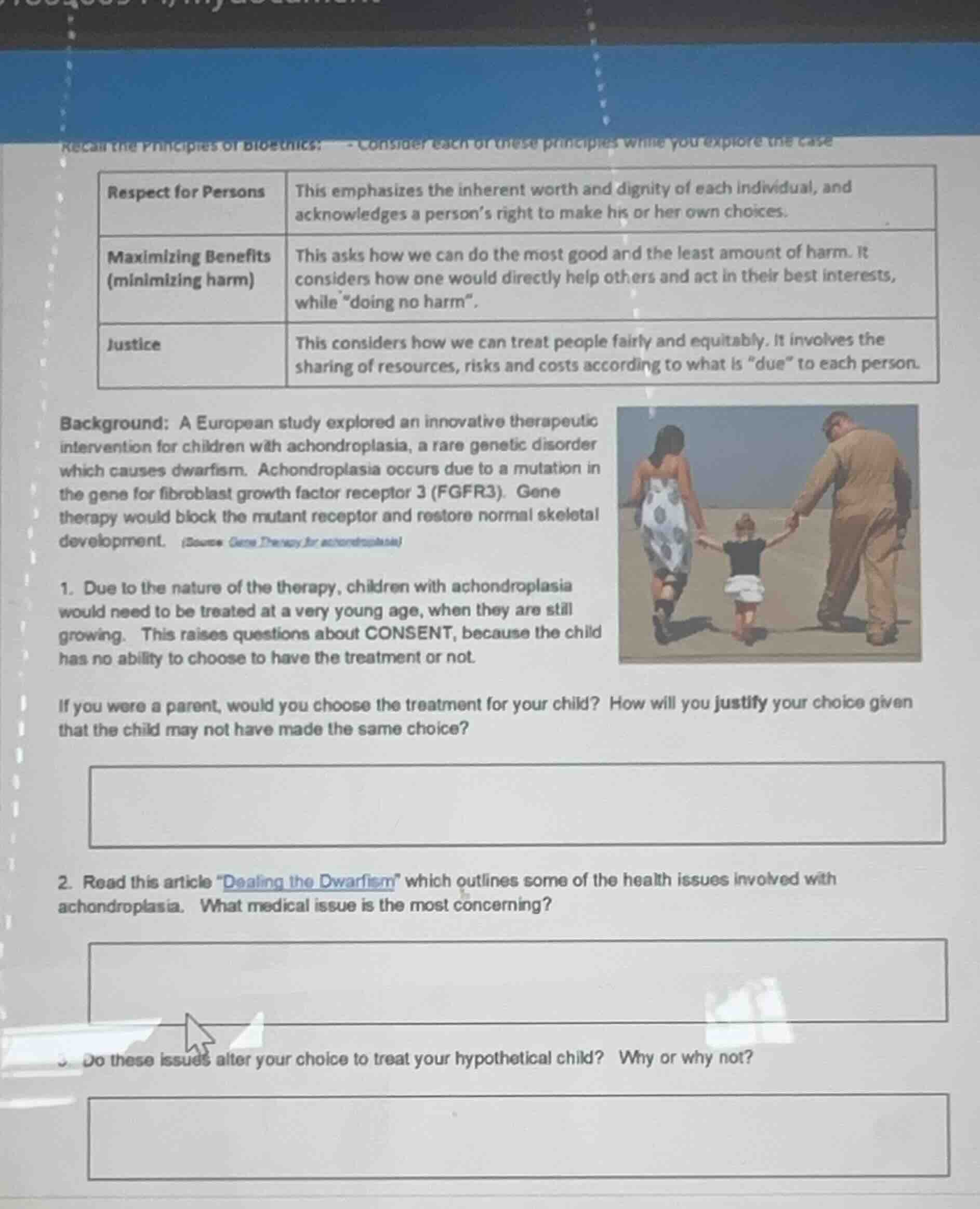
recall the principles of bioethics: - consider each of these principles while you explore the case
| respect for persons | this emphasizes the inherent worth and dignity of each individual, and acknowledges a person’s right to make his or her own choices. |
|---|---|
| justice | this considers how we can treat people fairly and equitably. it involves the sharing of resources, risks and costs according to what is \due\ to each person. |
background: a european study explored an innovative therapeutic intervention for children with achondroplasia, a rare genetic disorder which causes dwarfism. achondroplasia occurs due to a mutation in the gene for fibroblast growth factor receptor 3 (fgfr3). gene therapy would block the mutant receptor and restore normal skeletal development. (source: gene therapy for achondroplasia)
- due to the nature of the therapy, children with achondroplasia would need to be treated at a very young age, when they are still growing. this raises questions about consent, because the child has no ability to choose to have the treatment or not.
if you were a parent, would you choose the treatment for your child? how will you justify your choice given that the child may not have made the same choice?
answer box
- read this article \dealing the dwarfism\ which outlines some of the health issues involved with achondroplasia. what medical issue is the most concerning?
answer box
- do these issues alter your choice to treat your hypothetical child? why or why not?
answer box
Sub - Question 1
As a parent, choosing the treatment for a child with achondroplasia (a rare genetic disorder causing dwarfism) can be justified by the principle of "Maximizing Benefits (minimizing harm)". The therapy aims to restore normal skeletal development. Even though the child can't consent, the treatment has the potential to improve the child's quality of life, reduce future health complications associated with achondroplasia (like skeletal and respiratory issues), and help the child lead a more normal life. From the "Respect for Persons" principle, while the child can't choose, the parent is acting in the child's best interest, acknowledging the child's inherent worth and future autonomy by providing a treatment that could enhance their life. The "Justice" principle also applies as the child is due the opportunity to have a treatment that addresses their genetic disorder and reduces health disparities they might face. So, choosing the treatment is justified as it maximizes benefits, respects the child's dignity (through acting in their best interest), and provides a just opportunity for a better life.
Since the article "Dealing the Dwarfism" outlines health issues of achondroplasia, common serious issues include respiratory problems (due to narrow airways), skeletal abnormalities (like spinal stenosis, bowed legs, and problems with the skull base), and orthopedic issues. Among these, respiratory problems can be life - threatening, especially in infancy and childhood, as they can lead to breathing difficulties, sleep apnea, and even respiratory failure. Skeletal issues like spinal stenosis can cause chronic pain, neurological problems, and mobility issues. However, respiratory problems often have more immediate and potentially fatal consequences, making them a highly concerning medical issue. (Note: The actual most concerning issue would depend on the details in the article, but based on general knowledge of achondroplasia, respiratory or severe skeletal issues are top concerns.)
If the medical issues (like severe respiratory problems, spinal stenosis, or orthopedic complications) are very severe and the treatment has high risks (e.g., severe side - effects, low success rate), it might alter the choice. But if the medical issues are as expected (and the treatment has a reasonable success rate and low risk), it would not alter the choice. For example, if the article outlines that achondroplasia causes life - threatening respiratory failure in most cases without treatment, and the treatment has a high success rate with minor side - effects, the issues would reinforce the choice to treat. If the treatment has a high risk of serious complications (e.g., organ damage) and the medical issues of achondroplasia are relatively mild (which is not typical for achondroplasia), then it might alter the choice. But based on achondroplasia’s nature, the health issues (like respiratory and skeletal problems) usually make the treatment more necessary, so they likely won't alter the choice.

Snap & solve any problem in the app
Get step-by-step solutions on Sovi AI
Photo-based solutions with guided steps
Explore more problems and detailed explanations
Yes, I would choose the treatment. Justification: Using the bioethics principles, “Maximizing Benefits (minimizing harm)” supports it as the treatment can improve skeletal development and reduce future health issues. “Respect for Persons” is upheld as I act in the child’s best interest (acknowledging their inherent worth and future autonomy). “Justice” is met as the child deserves the opportunity to address their disorder and avoid health disparities. Even if the child might have a different choice later, the treatment’s potential to enhance their quality of life (reducing risks of skeletal/respiratory complications) outweighs this, as I am making a decision based on their long - term well - being.