QUESTION IMAGE
Question
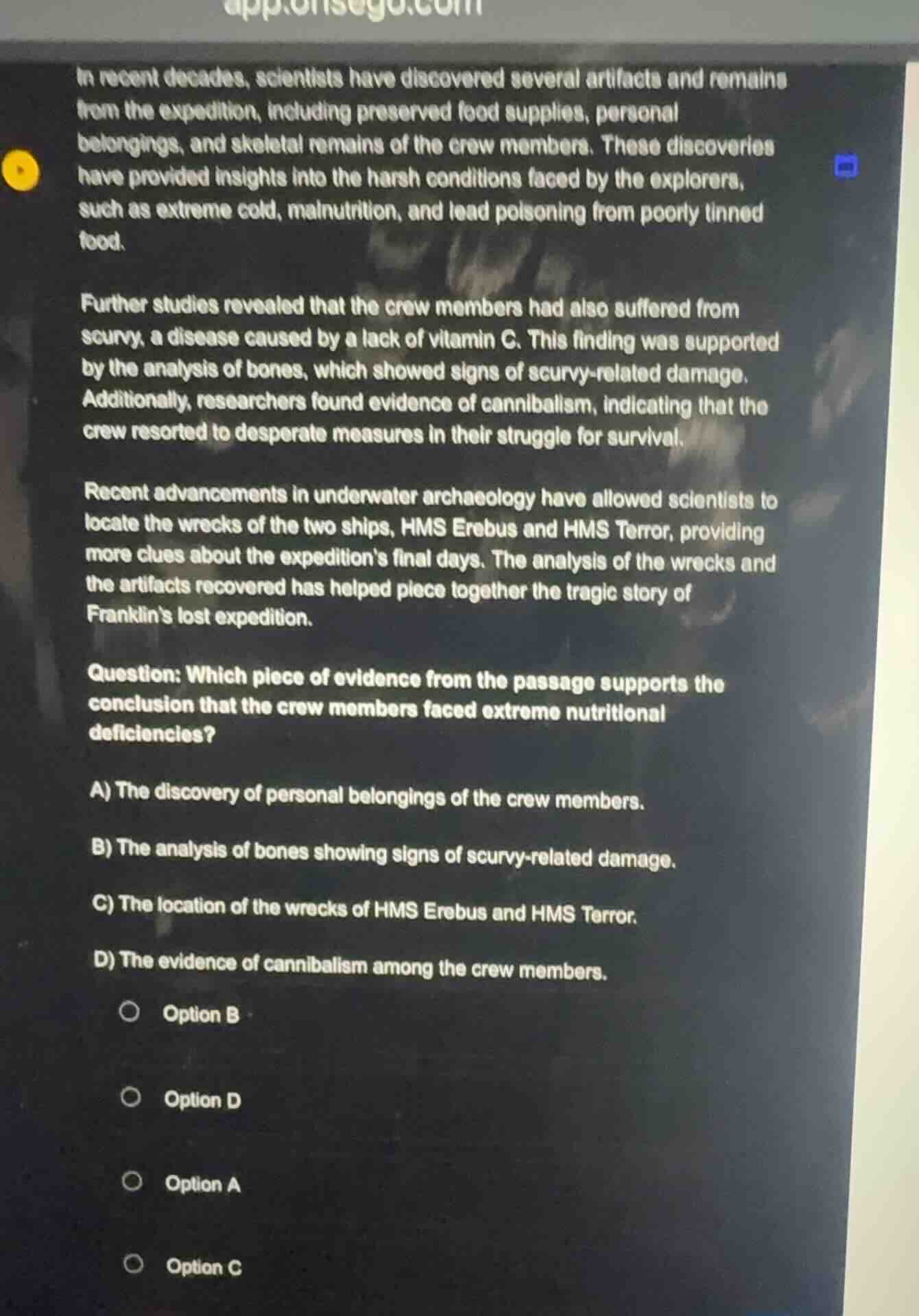
in recent decades, scientists have discovered several artifacts and remains from the expedition, including preserved food supplies, personal belongings, and skeletal remains of the crew members. these discoveries have provided insights into the harsh conditions faced by the explorers, such as extreme cold, malnutrition, and lead poisoning from poorly tinned food. further studies revealed that the crew members had also suffered from scurvy, a disease caused by a lack of vitamin c. this finding was supported by the analysis of bones, which showed signs of scurvy - related damage. additionally, researchers found evidence of cannibalism, indicating that the crew resorted to desperate measures in their struggle for survival. recent advancements in underwater archaeology have allowed scientists to locate the wrecks of the two ships, hms erebus and hms terror, providing more clues about the expeditions final days. the analysis of the wrecks and the artifacts recovered has helped piece together the tragic story of franklins lost expedition. question: which piece of evidence from the passage supports the conclusion that the crew members faced extreme nutritional deficiencies? a) the discovery of personal belongings of the crew members. b) the analysis of bones showing signs of scurvy - related damage. c) the location of the wrecks of hms erebus and hms terror. d) the evidence of cannibalism among the crew members.
To determine the evidence for extreme nutritional deficiencies, we analyze each option:
- Option A: Personal belongings don't relate to nutrition.
- Option B: Scurvy is caused by vitamin C deficiency (a nutritional issue), and bone analysis showing scurvy - related damage directly supports extreme nutritional deficiencies.
- Option C: Locating shipwrecks is about the expedition's end, not nutrition.
- Option D: Cannibalism shows survival measures, not direct nutritional deficiency evidence.

Snap & solve any problem in the app
Get step-by-step solutions on Sovi AI
Photo-based solutions with guided steps
Explore more problems and detailed explanations
B) The analysis of bones showing signs of scurvy - related damage.