QUESTION IMAGE
Question
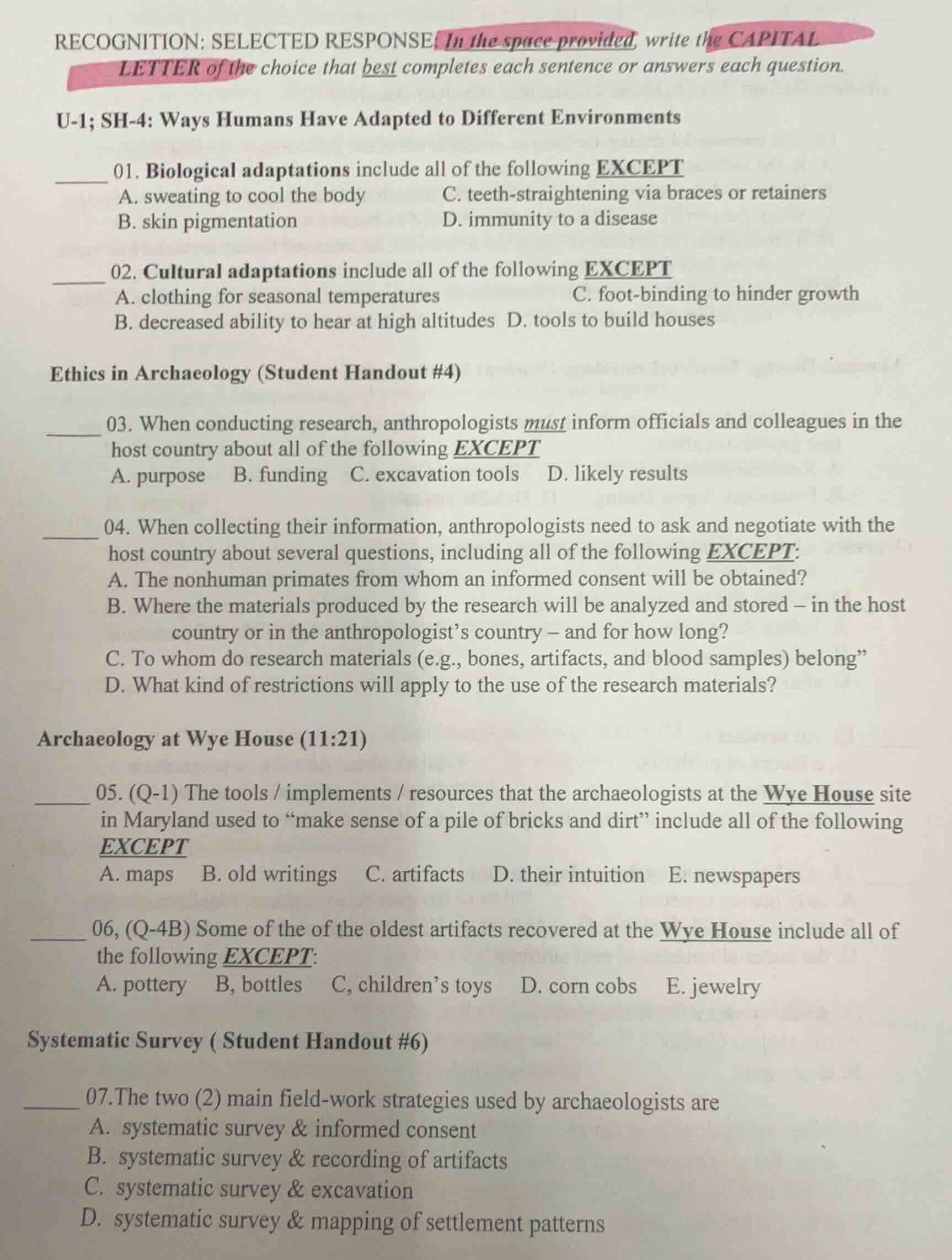
recognition: selected response: in the space provided, write the capital letter of the choice that best completes each sentence or answers each question.
u-1; sh-4: ways humans have adapted to different environments
- biological adaptations include all of the following except
a. sweating to cool the body c. teeth-straightening via braces or retainers
b. skin pigmentation d. immunity to a disease
- cultural adaptations include all of the following except
a. clothing for seasonal temperatures c. foot-binding to hinder growth
b. decreased ability to hear at high altitudes d. tools to build houses
ethics in archaeology (student handout #4)
- when conducting research, anthropologists must inform officials and colleagues in the host country about all of the following except
a. purpose b. funding c. excavation tools d. likely results
- when collecting their information, anthropologists need to ask and negotiate with the host country about several questions, including all of the following except:
a. the nonhuman primates from whom an informed consent will be obtained?
b. where the materials produced by the research will be analyzed and stored – in the host country or in the anthropologist’s country – and for how long?
c. to whom do research materials (e.g., bones, artifacts, and blood samples) belong?
d. what kind of restrictions will apply to the use of the research materials?
archaeology at wye house (11:21)
- (q-1) the tools / implements / resources that the archaeologists at the wye house site in maryland used to “make sense of a pile of bricks and dirt” include all of the following except
a. maps b. old writings c. artifacts d. their intuition e. newspapers
06, (q-4b) some of the of the oldest artifacts recovered at the wye house include all of the following except:
a. pottery b, bottles c, children’s toys d. corn cobs e. jewelry
systematic survey ( student handout #6)
- the two (2) main field-work strategies used by archaeologists are
a. systematic survey & informed consent
b. systematic survey & recording of artifacts
c. systematic survey & excavation
d. systematic survey & mapping of settlement patterns
- Biological adaptations are innate/evolutionary bodily traits. Teeth straightening is artificial, not biological.
- Cultural adaptations are learned human practices. Decreased high-altitude hearing is biological, not cultural.
- Anthropologists must disclose research purpose, funding, and expected results to hosts; excavation tools are not a required disclosure.
- Research negotiations focus on human/ethical, material storage, ownership, and use rules. Nonhuman primate consent is irrelevant here.
- Archaeologists use tangible/recorded evidence; intuition is not a formal analytical tool.
- Corn cobs are organic remains, not crafted artifacts like pottery, bottles, toys, or jewelry.
- The core archaeological field strategies are survey (locating sites) and excavation (uncovering sites).

Snap & solve any problem in the app
Get step-by-step solutions on Sovi AI
Photo-based solutions with guided steps
Explore more problems and detailed explanations
- C. teeth-straightening via braces or retainers
- B. decreased ability to hear at high altitudes
- C. excavation tools
- A. The nonhuman primates from whom an informed consent will be obtained?
- D. their intuition
- D. corn cobs
- C. systematic survey & excavation