QUESTION IMAGE
Question
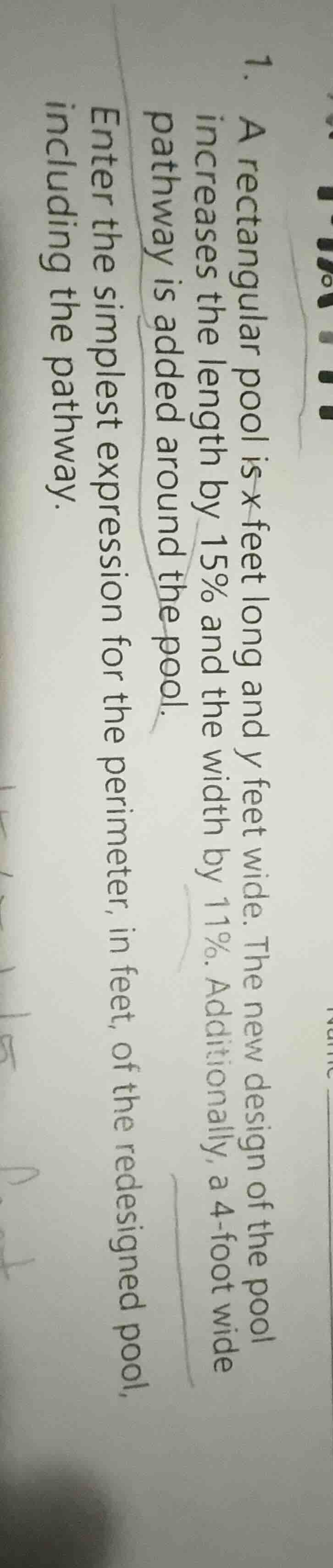
- a rectangular pool is x feet long and y feet wide. the new design of the pool increases the length by 15% and the width by 11%. additionally, a 4 - foot wide pathway is added around the pool. enter the simplest expression for the perimeter, in feet, of the redesigned pool, including the pathway.
Step1: Find new length
The original length is \( x \) feet. A 15% increase means the new length is \( x + 0.15x = 1.15x \) feet. Then, we add a 4 - foot pathway on both sides of the length? Wait, no, the pathway is around the pool, so for the length of the entire redesigned area (pool + pathway), the length of the pool is increased by 15%, and then we add the pathway. Wait, the problem says "the new design of the pool increases the length by 15% and the width by 11%. Additionally, a 4 - foot wide pathway is added around the pool." Wait, maybe the 15% and 11% are for the pool, and then the pathway is around the pool, so we need to add 4 feet on both sides of the length and 4 feet on both sides of the width? Wait, no, the pathway is 4 - foot wide, so for the length of the entire figure (pool + pathway), the length of the pool after 15% increase is \( 1.15x \), and then we add 4 feet on the left and 4 feet on the right, so total length \( L=1.15x + 4+4=1.15x + 8 \).
Step2: Find new width
The original width is \( y \) feet. A 11% increase means the new width of the pool is \( y+0.11y = 1.11y \) feet. Then, we add 4 feet on the top and 4 feet on the bottom (since the pathway is around the pool), so total width \( W = 1.11y+4 + 4=1.11y + 8 \).
Step3: Calculate perimeter
The perimeter \( P \) of a rectangle is \( P = 2(L + W) \). Substituting \( L = 1.15x + 8 \) and \( W=1.11y + 8 \) into the formula:
\[
\]
Wait, maybe I misinterpreted the pathway. Maybe the 4 - foot pathway is added to the length and width of the pool (after the percentage increase) on both sides? Wait, the problem says "the new design of the pool increases the length by 15% and the width by 11%. Additionally, a 4 - foot wide pathway is added around the pool." So the pool's length is \( 1.15x \), width is \( 1.11y \), and then the pathway is around the pool, so the length of the entire area (pool + pathway) is \( 1.15x+4 + 4 \) (4 feet on each side) and the width is \( 1.11y + 4+4 \) (4 feet on each side). Then the perimeter is \( 2\times[(1.15x + 8)+(1.11y + 8)]=2\times(1.15x + 1.11y+16)=2.3x + 2.22y+32 \).
Wait, maybe the 15% and 11% are for the pool, and the pathway is 4 - foot wide, so the length of the pool is \( 1.15x \), and the pathway adds 4 feet to the length (total, not on both sides)? No, a pathway around the pool would add to both sides. Let's re - read the problem: "the new design of the pool increases the length by 15% and the width by 11%. Additionally, a 4 - foot wide pathway is added around the pool." So the pool's length is \( 1.15x \), width is \( 1.11y \), and the pathway is 4 feet wide, so the outer length (pool + pathway) is \( 1.15x+4 + 4 \) (left and right) and outer width is \( 1.11y + 4+4 \) (top and bottom). Then perimeter \( P = 2\times( (1.15x + 8)+(1.11y + 8) )=2\times(1.15x+1.11y + 16)=2.3x+2.22y + 32 \).

Snap & solve any problem in the app
Get step-by-step solutions on Sovi AI
Photo-based solutions with guided steps
Explore more problems and detailed explanations
The perimeter of the redesigned pool (including pathway) is \( 2.3x + 2.22y+32 \) feet.