QUESTION IMAGE
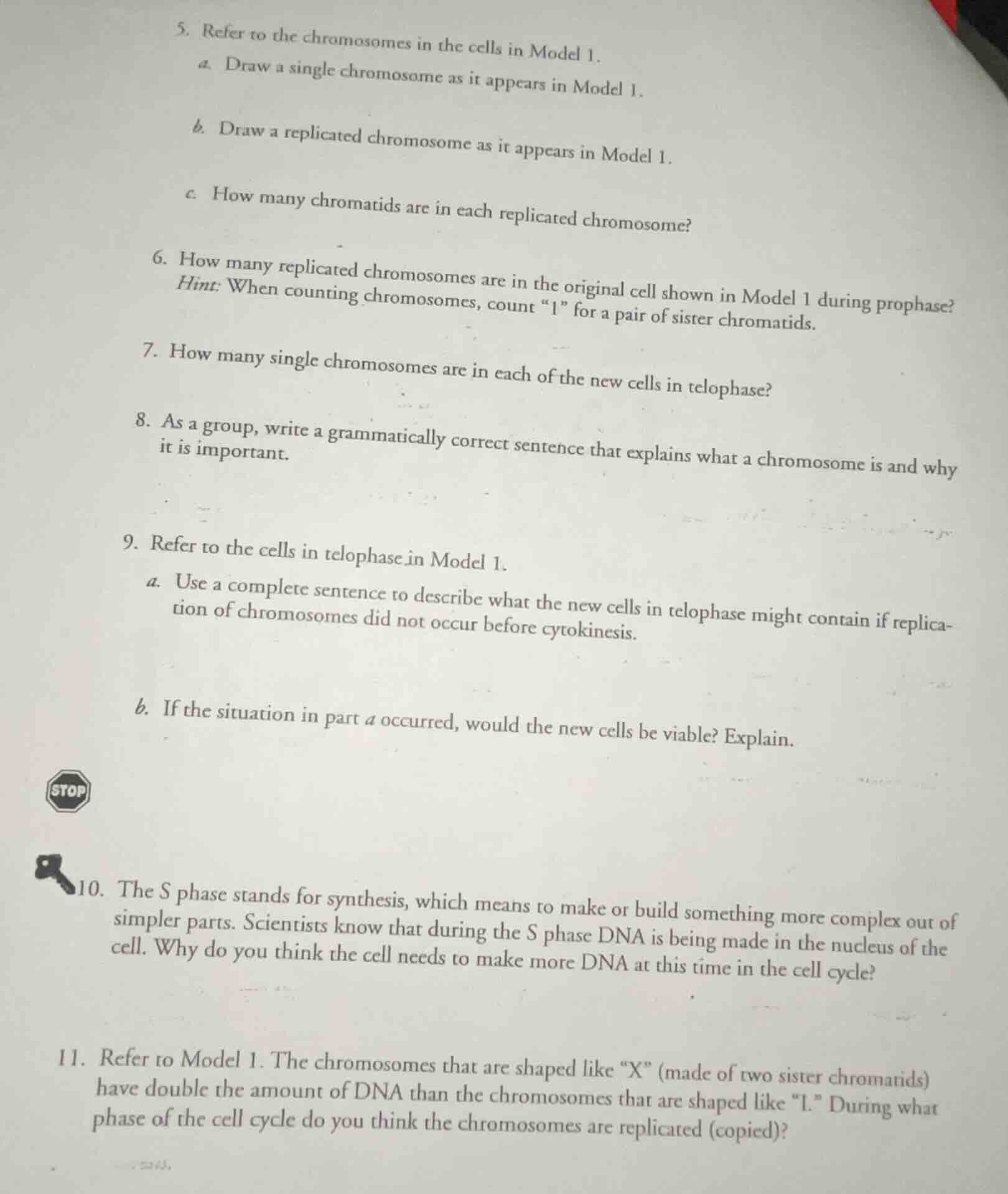
Question
- refer to the chromosomes in the cells in model 1.
a. draw a single chromosome as it appears in model 1.
b. draw a replicated chromosome as it appears in model 1.
c. how many chromatids are in each replicated chromosome?
- how many replicated chromosomes are in the original cell shown in model 1 during prophase?
hint: when counting chromosomes, count “1” for a pair of sister chromatids.
- how many single chromosomes are in each of the new cells in telophase?
- as a group, write a grammatically correct sentence that explains what a chromosome is and why it is important.
- refer to the cells in telophase in model 1.
a. use a complete sentence to describe what the new cells in telophase might contain if replication of chromosomes did not occur before cytokinesis.
b. if the situation in part a occurred, would the new cells be viable? explain.
- the s phase stands for synthesis, which means to make or build something more complex out of simpler parts. scientists know that during the s phase dna is being made in the nucleus of the cell. why do you think the cell needs to make more dna at this time in the cell cycle?
- refer to model 1. the chromosomes that are shaped like “x” (made of two sister chromatids) have double the amount of dna than the chromosomes that are shaped like “i.” during what phase of the cell cycle do you think the chromosomes are replicated (copied)?
(Note: For questions 5a and 5b, standard representations are provided as Model 1 is not visible)
5a: A single unreplicated chromosome is a linear (or rod-shaped) structure with a centromere.
5b: A replicated chromosome has two identical sister chromatids joined at the centromere, forming an X-shape.
5c: Replicated chromosomes consist of two identical sister chromatids.
6: In prophase, each replicated chromosome (X-shape) counts as 1; typical somatic cells have 46, but standard textbook models often use 4 replicated chromosomes for simplicity, matching the hint that a pair of chromatids = 1 chromosome.
7: After mitosis, new cells have the same number of single chromosomes as the parent cell's original unreplicated count; for a standard 4-chromosome model, this is 4.
8: A chromosome is a DNA-protein structure that carries an organism's genetic information, and it is critical for passing heritable traits to new cells and offspring during cell division and reproduction.
9a: If chromosome replication did not occur, each new telophase cell would contain only half the number of chromosomes that the original parent cell had.
9b: The new cells would not be viable because they would lack the full set of genetic information required to produce the proteins and carry out the functions necessary for cell survival and normal operation.
10: The cell synthesizes more DNA during S phase to ensure that each new daughter cell produced during cell division receives an exact, complete copy of the organism's genetic material.
11: Chromosome replication (which creates the X-shaped chromosomes with double the DNA) occurs during the S (Synthesis) phase of the cell cycle, before mitosis begins.

Snap & solve any problem in the app
Get step-by-step solutions on Sovi AI
Photo-based solutions with guided steps
Explore more problems and detailed explanations
5a:
          ●
──────────┼──────────
(Linear structure with centromere at the dot)
5b:
          ●
──────────┼──────────
          ●
──────────┼──────────
(Two identical chromatids joined at centromere, X-shape)
5c: 2
6: 4 (standard textbook model value; matches typical mitosis examples)
7: 4 (matches the parent cell's original unreplicated chromosome count)
8: A chromosome is a DNA-protein complex that stores an organism's genetic code, and it is essential for accurately transmitting heritable information to daughter cells during cell division.
9a: If chromosome replication did not occur before cytokinesis, each new telophase cell would contain only half the number of chromosomes present in the original parent cell.
9b: No, the new cells would not be viable. They would lack the full complement of genetic information needed to produce all required proteins and carry out essential cellular functions, leading to cell death or dysfunction.
10: The cell makes more DNA during S phase to ensure that each daughter cell resulting from mitosis receives a complete, identical copy of the organism's genome.
11: The S (Synthesis) phase of the cell cycle