QUESTION IMAGE
Question
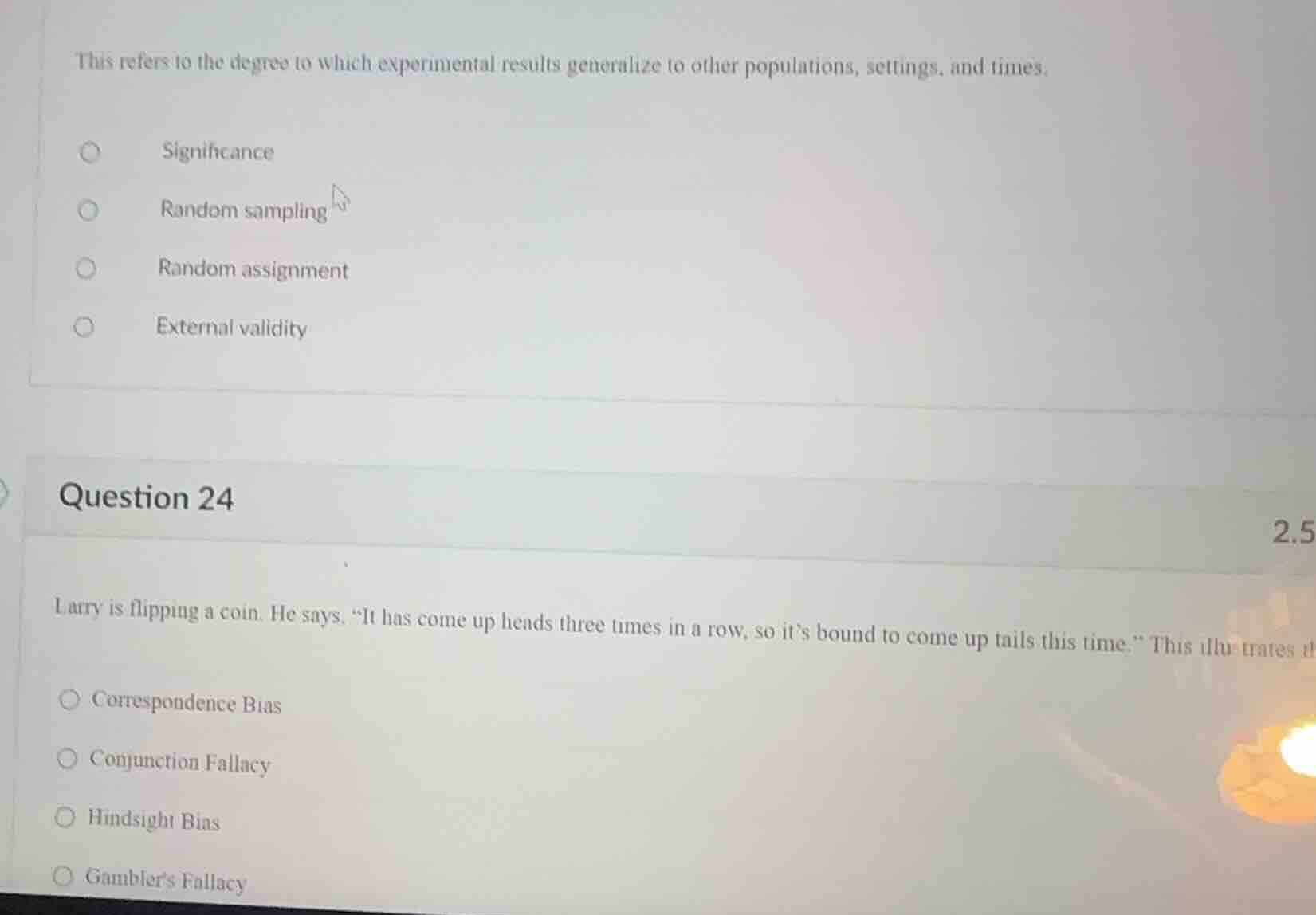
this refers to the degree to which experimental results generalize to other populations, settings, and times.
○ significance
○ random sampling
○ random assignment
○ external validity
question 24
2.5
larry is flipping a coin. he says, \it has come up heads three times in a row, so its bound to come up tails this time.\ this illustrates
○ correspondence bias
○ conjunction fallacy
○ hindsight bias
○ gamblers fallacy
Brief Explanations
For the first question:
- Significance relates to statistical confidence in results, not generalization.
- Random sampling is a method to select participants, not about result generalization.
- Random assignment allocates participants to groups, not generalization.
- External validity specifically describes how well experimental results apply to other populations, settings, and times.
For Question 24:
- Correspondence Bias is about overattributing behavior to personality, not probability misconceptions.
- Conjunction Fallacy is judging a combined event as more likely than a single one, which is not the case here.
- Hindsight Bias is believing an event was predictable after it happens, irrelevant to this probability error.
- Gambler's Fallacy is the false belief that past independent events affect future outcomes, which matches Larry's reasoning about coin flips.

Snap & solve any problem in the app
Get step-by-step solutions on Sovi AI
Photo-based solutions with guided steps
Explore more problems and detailed explanations
First question: D. External validity
Question 24: D. Gambler's Fallacy