QUESTION IMAGE
Question
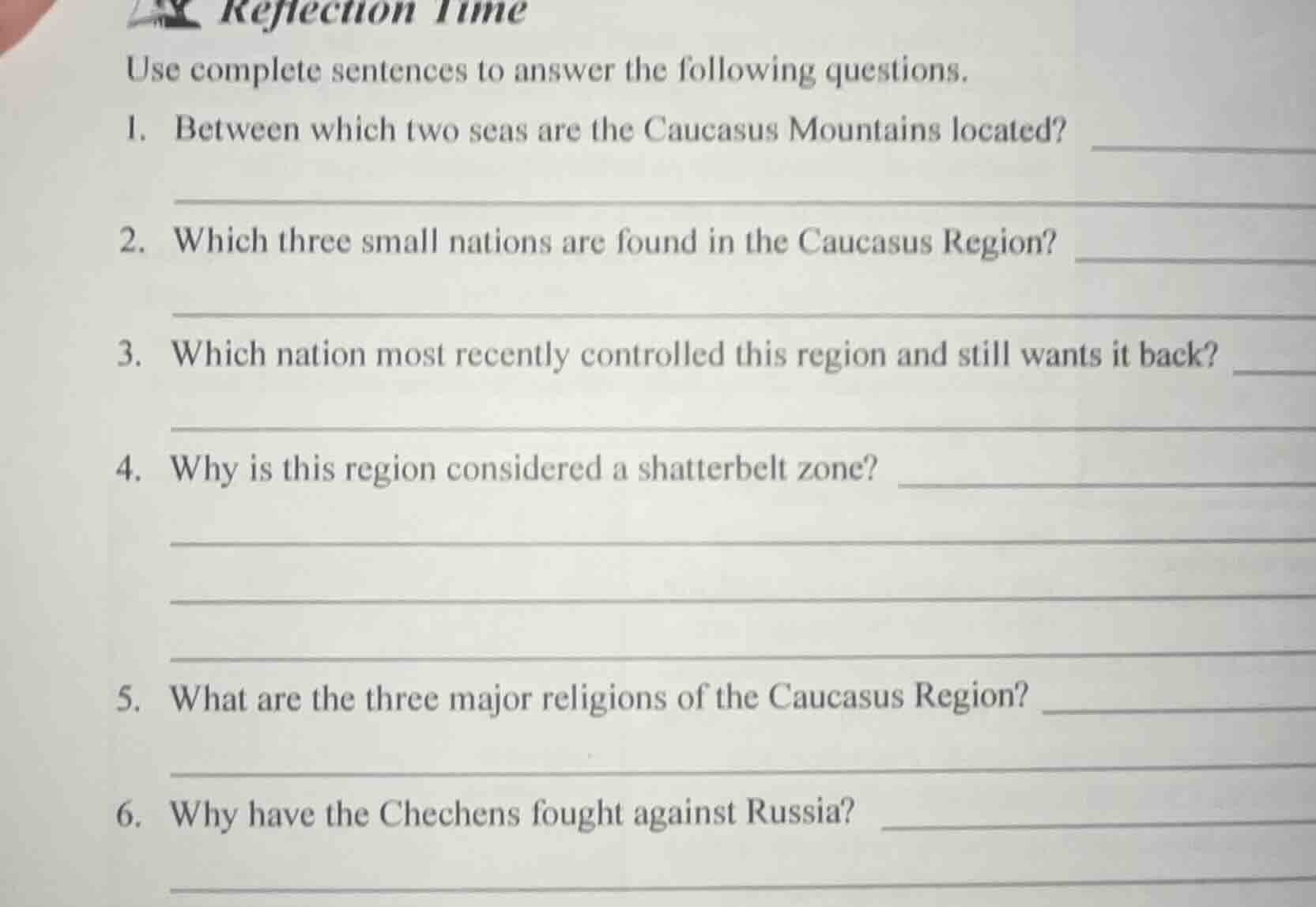
reflection time
use complete sentences to answer the following questions.
- between which two seas are the caucasus mountains located?
- which three small nations are found in the caucasus region?
- which nation most recently controlled this region and still wants it back?
- why is this region considered a shatterbelt zone?
- what are the three major religions of the caucasus region?
- why have the chechens fought against russia?
Brief Explanations
- The Caucasus Mountains are geographically positioned between two major inland seas of Eurasia.
- The South Caucasus is home to three independent small nations that emerged after the Soviet Union's collapse.
- The Soviet Union was the last major power controlling the region, and its primary successor, Russia, has sought to maintain influence and control over parts of it.
- A shatterbelt is a region marked by persistent political fragmentation and external great power competition.
- The Caucasus has a long history of religious diversity shaped by regional and external cultural influences.
- Chechens have a long-standing drive for self-determination, compounded by historical grievances with Russian rule.

Snap & solve any problem in the app
Get step-by-step solutions on Sovi AI
Photo-based solutions with guided steps
Explore more problems and detailed explanations
- The Caucasus Mountains are located between the Black Sea and the Caspian Sea.
- The three small nations in the Caucasus Region are Georgia, Armenia, and Azerbaijan.
- Russia (the successor state to the Soviet Union, which most recently controlled the region) still seeks to maintain influence and control over parts of the Caucasus.
- This region is considered a shatterbelt zone because it is a politically fragmented area where multiple external powers (like Russia, the West, and regional powers) compete for influence, and it has a history of ethnic, religious, and political conflicts.
- The three major religions of the Caucasus Region are Christianity, Islam, and Judaism.
- The Chechens have fought against Russia primarily to gain independence and self-determination, as well as to resist centuries of Russian imperial and Soviet control, along with grievances over human rights abuses and cultural suppression.