QUESTION IMAGE
Question
reflections on the coordinate plane
reflections
- a reflection __ a figure over a line of in order to create a __ image.
- each reflected point of the figure should be the same distance from the line of ____ on the opposite side.
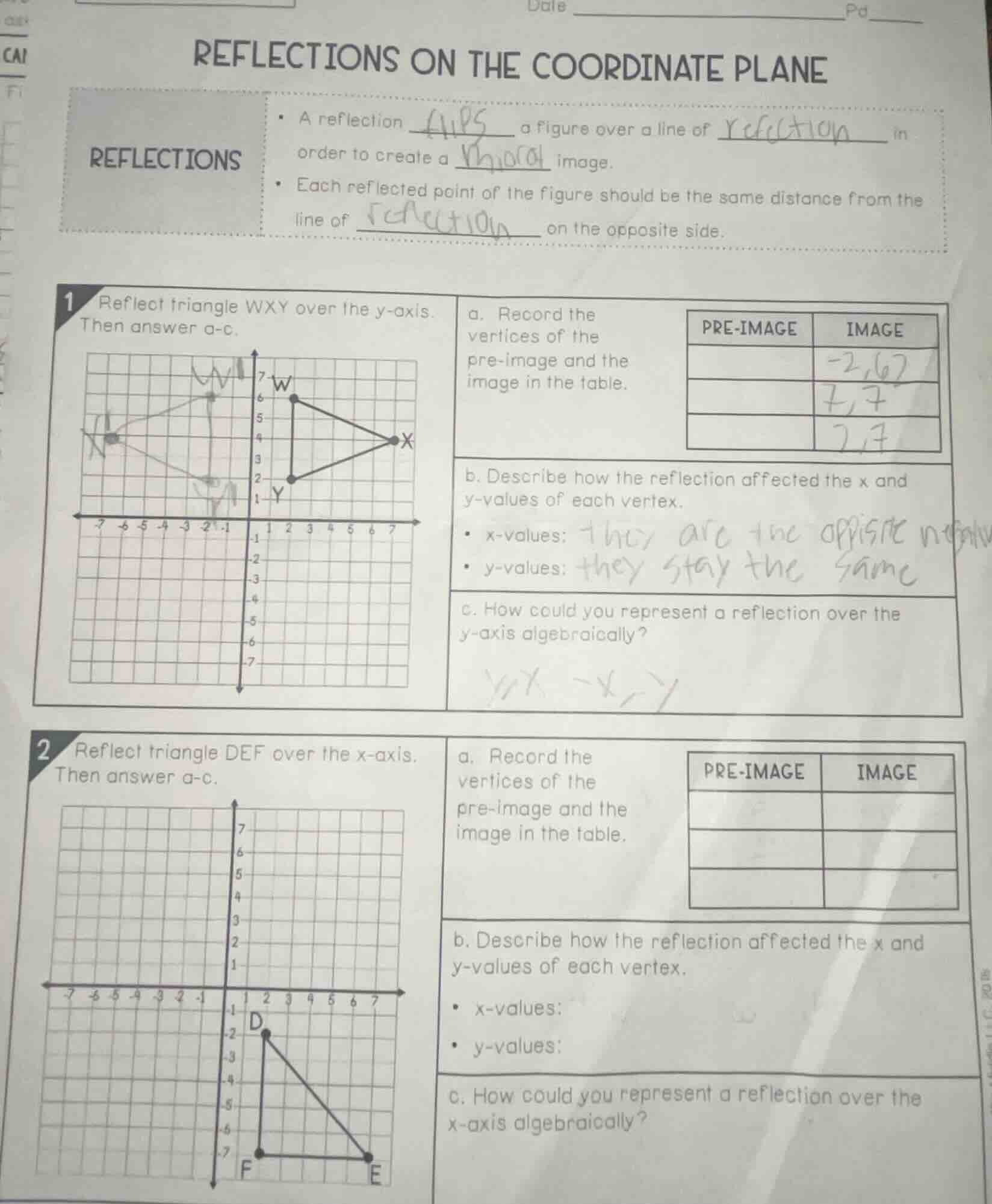
1 reflect triangle wxy over the y - axis. then answer a - c.
a. record the vertices of the pre - image and the image in the table.
b. describe how the reflection affected the x and y - values of each vertex.
- x - values:
- y - values:
c. how could you represent a reflection over the y - axis algebraically?
2 reflect triangle def over the x - axis. then answer a - c.
a. record the vertices of the pre - image and the image in the table.
b. describe how the reflection affected the x and y - values of each vertex.
- x - values:
- y - values:
c. how could you represent a reflection over the x - axis algebraically?
Step1: Identify pre-image vertices
From the graph, pre-image vertices: $D(2,-2)$, $F(2,-7)$, $E(6,-7)$
Step2: Reflect over x-axis rule
For a point $(x,y)$, reflection over x-axis is $(x,-y)$.
Step3: Calculate image vertices
- $D'(2, -(-2))=(2,2)$
- $F'(2, -(-7))=(2,7)$
- $E'(6, -(-7))=(6,7)$
Step4: Analyze coordinate changes
x-values stay unchanged; y-values sign flips.
Step5: Write algebraic representation
Use the reflection rule derived.

Snap & solve any problem in the app
Get step-by-step solutions on Sovi AI
Photo-based solutions with guided steps
Explore more problems and detailed explanations
2a.
| PRE-IMAGE | IMAGE |
|---|---|
| $(2,-7)$ | $(2,7)$ |
| $(6,-7)$ | $(6,7)$ |
2b.
- x-values: remain the same
- y-values: become the opposite sign
2c.
A reflection over the x-axis can be represented algebraically as $(x,y) \to (x,-y)$