QUESTION IMAGE
Question
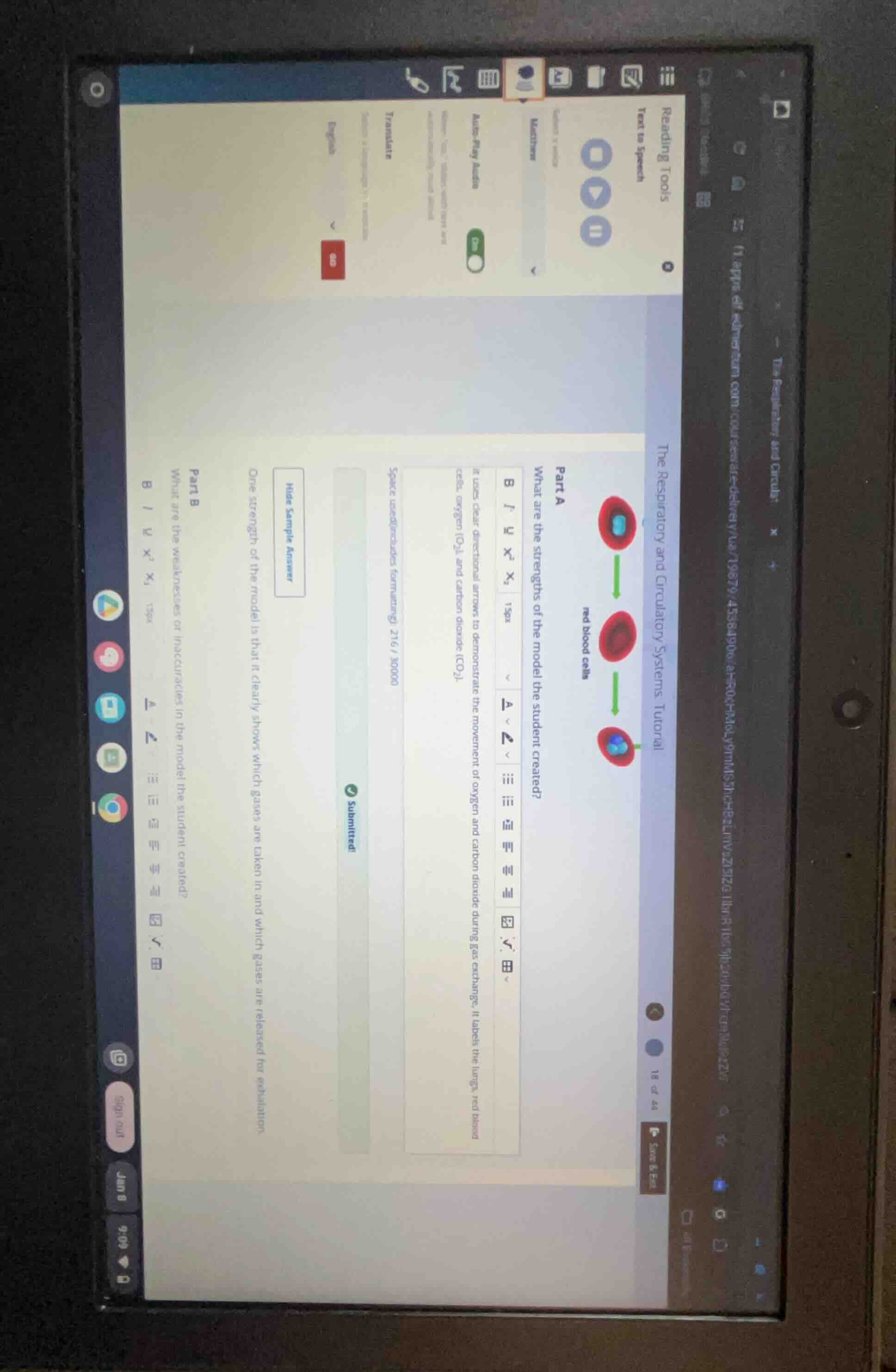
the respiratory and circulatory systems tutorial
part a
what are the strengths of the model the student created?
it uses clear directional arrows to demonstrate the movement of oxygen and carbon dioxide during gas exchange. it labels the lungs, red blood cells, oxygen (o₂), and carbon dioxide (co₂).
part b
what are the weaknesses or inaccuracies in the model the student created?
one strength of the model is that it clearly shows which gases are taken in and which gases are released for exhalation.
Part A:
The model uses clear directional arrows to show gas movement, labels key components (lungs, red blood cells, O₂, CO₂), which makes the gas exchange process easy to follow.
Part B:
The model is oversimplified: it does not show the full circulatory pathway (like arteries, veins, capillaries), ignores the role of the heart, and does not depict the actual physical process of gas diffusion across membranes, nor does it account for the volume of gas transported or the regulatory mechanisms involved.

Snap & solve any problem in the app
Get step-by-step solutions on Sovi AI
Photo-based solutions with guided steps
Explore more problems and detailed explanations
Part A:
It uses clear directional arrows to demonstrate the movement of oxygen and carbon dioxide during gas exchange. It labels the lungs, red blood cells, oxygen (O₂), and carbon dioxide (CO₂), making the key components and process of respiratory-circulatory gas exchange easy to visualize and understand.
Part B:
- It oversimplifies the system: it does not show the full circulatory route (such as arteries, veins, capillaries) or the role of the heart in pumping blood.
- It does not depict the actual mechanism of gas diffusion (how gases move across cell membranes).
- It ignores other factors like the amount of gas transported, or the regulatory processes that control gas exchange and blood flow.