QUESTION IMAGE
Question
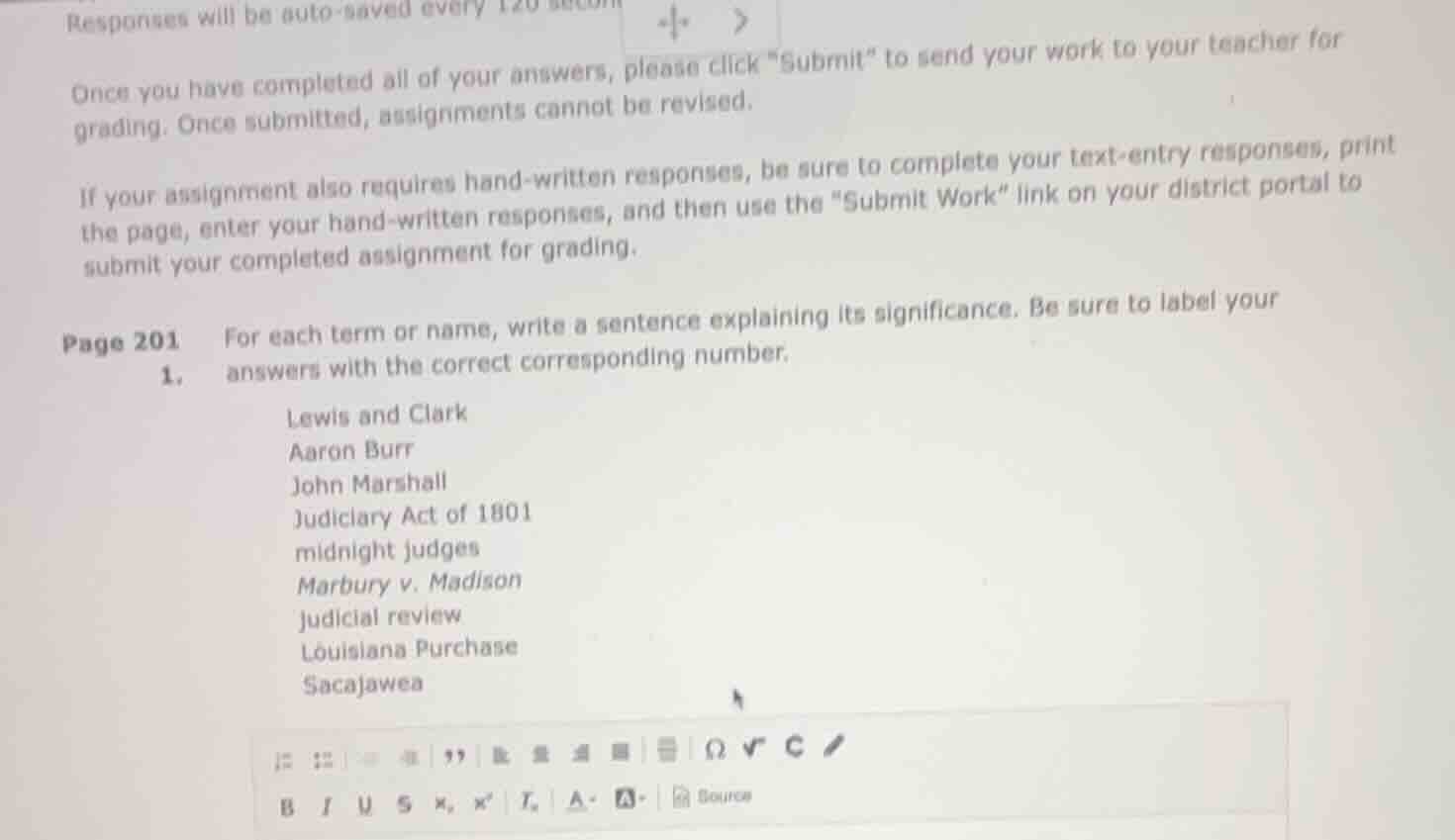
responses will be auto - saved every 120 secon once you have completed all of your answers, please click \submit\ to send your work to your teacher for grading. once submitted, assignments cannot be revised. if your assignment also requires hand - written responses, be sure to complete your text - entry responses, print the page, enter your hand - written responses, and then use the \submit work\ link on your district portal to submit your completed assignment for grading. page 201 1. for each term or name, write a sentence explaining its significance. be sure to label your answers with the correct corresponding number. lewis and clark aaron burr john marshall judiciary act of 1801 midnight judges marbury v. madison judicial review louisiana purchase sacajawea
- Lewis and Clark: Led the 1804-1806 US expedition to explore the Louisiana Territory, mapping lands, documenting species, and establishing relations with Indigenous nations, expanding American knowledge of the West.
- Aaron Burr: Served as US Vice President (1801-1805; killed Alexander Hamilton in an 1804 duel; was later acquitted of treason charges over a suspected plot to create a separate Western nation.
- John Marshall: Served as US Chief Justice (1801-1835); his rulings strengthened federal power and established the judiciary as a coequal branch of government.
- Judiciary Act of 1801: A federal law that created new federal courts and judicial positions, allowing outgoing President John Adams to appoint Federalist judges before Thomas Jefferson took office.
- midnight judges: Federalist judges appointed by John Adams in the final hours of his presidency, named for the rushed, late-night commissions issued to them.
- Marbury v. Madison (1803): A landmark Supreme Court case that established the principle of judicial review, granting the Court the power to strike down laws it deemed unconstitutional.
- judicial review: The power of the US Supreme Court (and other federal courts) to review and invalidate laws or government actions that conflict with the US Constitution.
- Louisiana Purchase (1803): A US acquisition of 828,000 square miles of land from France, doubling the size of the United States and opening vast Western territories for expansion.
- Sacajawea: A Shoshone woman who served as a guide and interpreter for the Lewis and Clark expedition, helping the team navigate unfamiliar lands and communicate with Indigenous groups.

Snap & solve any problem in the app
Get step-by-step solutions on Sovi AI
Photo-based solutions with guided steps
Explore more problems and detailed explanations
- Lewis and Clark: Led the 1804-1806 US expedition to explore the Louisiana Territory, mapping lands, documenting species, and establishing relations with Indigenous nations, expanding American knowledge of the West.
- Aaron Burr: Served as US Vice President (1801-1805; killed Alexander Hamilton in an 1804 duel; was later acquitted of treason charges over a suspected plot to create a separate Western nation.
- John Marshall: Served as US Chief Justice (1801-1835); his rulings strengthened federal power and established the judiciary as a coequal branch of government.
- Judiciary Act of 1801: A federal law that created new federal courts and judicial positions, allowing outgoing President John Adams to appoint Federalist judges before Thomas Jefferson took office.
- midnight judges: Federalist judges appointed by John Adams in the final hours of his presidency, named for the rushed, late-night commissions issued to them.
- Marbury v. Madison (1803): A landmark Supreme Court case that established the principle of judicial review, granting the Court the power to strike down laws it deemed unconstitutional.
- judicial review: The power of the US Supreme Court (and other federal courts) to review and invalidate laws or government actions that conflict with the US Constitution.
- Louisiana Purchase (1803): A US acquisition of 828,000 square miles of land from France, doubling the size of the United States and opening vast Western territories for expansion.
- Sacajawea: A Shoshone woman who served as a guide and interpreter for the Lewis and Clark expedition, helping the team navigate unfamiliar lands and communicate with Indigenous groups.