QUESTION IMAGE
Question
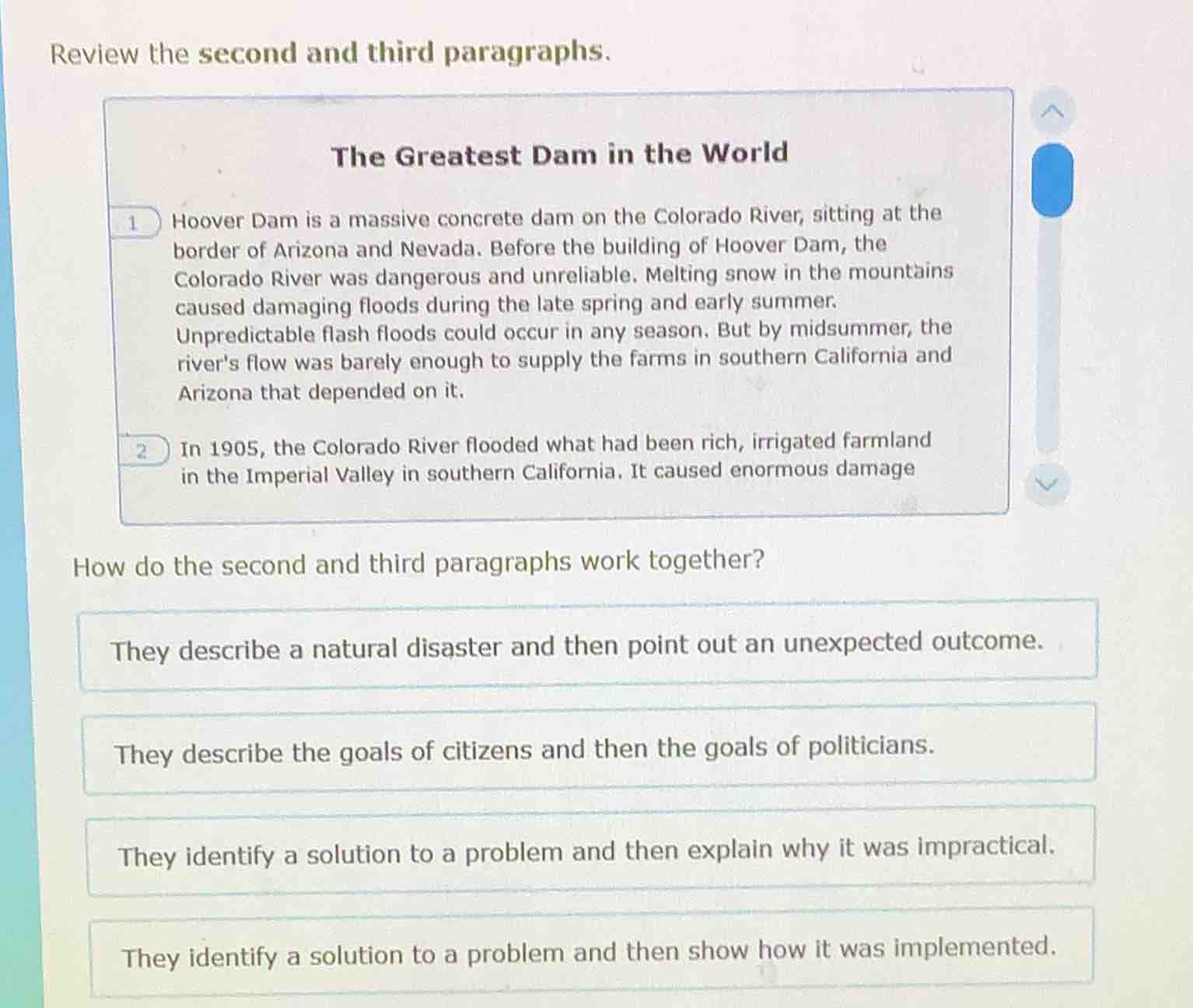
review the second and third paragraphs.
the greatest dam in the world
1 hoover dam is a massive concrete dam on the colorado river, sitting at the border of arizona and nevada. before the building of hoover dam, the colorado river was dangerous and unreliable. melting snow in the mountains caused damaging floods during the late spring and early summer. unpredictable flash floods could occur in any season. but by midsummer, the rivers flow was barely enough to supply the farms in southern california and arizona that depended on it.
2 in 1905, the colorado river flooded what had been rich, irrigated farmland in the imperial valley in southern california. it caused enormous damage
how do the second and third paragraphs work together?
they describe a natural disaster and then point out an unexpected outcome.
they describe the goals of citizens and then the goals of politicians.
they identify a solution to a problem and then explain why it was impractical.
they identify a solution to a problem and then show how it was implemented.
- Analyze the first option: The second paragraph (labeled 1) describes the problem of the Colorado River being dangerous (floods, unreliable flow), and the third paragraph (labeled 2) describes a specific natural disaster (1905 flood) and its outcome (enormous damage). Wait, no, let's re - check. Wait, the first paragraph (labeled 1) sets up the problem of the Colorado River being dangerous and unreliable (floods, insufficient flow). The second paragraph (labeled 2) describes a 1905 flood (a natural disaster) that was part of the problem, and then... Wait, maybe I mislabeled. Wait, the user says "second and third paragraphs", but in the image, there are two paragraphs labeled 1 and 2. Maybe a typo, but assuming the first (labeled 1) is the second and the second (labeled 2) is the third. The first (labeled 1) identifies the problem (Colorado River is dangerous: floods, unreliable flow). The second (labeled 2) describes a natural disaster (1905 flood) that is an example of the problem, and then... Wait, the options: The first option says "They describe a natural disaster and then point out an unexpected outcome." Wait, no, maybe the first paragraph (labeled 1) is the problem, the second (labeled 2) is a natural disaster (flood) and its outcome. Wait, no, let's look at the options again.
Option 1: "They describe a natural disaster and then point out an unexpected outcome." Wait, no, the first part (paragraph 1) describes the problem (river is dangerous: floods, unreliable flow), the second part (paragraph 2) gives a natural disaster (1905 flood) as an example of the problem, and then... Wait, maybe I got the paragraphs wrong. Wait, the first paragraph (labeled 1) is about the river's problems (floods, unreliable flow). The second paragraph (labeled 2) is about a 1905 flood (a natural disaster) and its outcome (enormous damage). But the option "They describe a natural disaster and then point out an unexpected outcome" – no, the flood's outcome is damage, which is expected from a flood. Wait, no, maybe the first paragraph is the problem, the second is a natural disaster (flood) and then... Wait, maybe the correct option is the first one? Wait, no, let's analyze each option:
Option 2: "They describe the goals of citizens and then the goals of politicians." There is no mention of citizens' or politicians' goals in the paragraphs. Eliminate.
Option 3: "They identify a solution to a problem and then explain why it was impractical." There is no solution identified in the two paragraphs. Eliminate.
Option 4: "They identify a solution to a problem and then show how it was implemented." There is no solution or implementation in the two paragraphs. Eliminate.
Option 1: Wait, maybe the first paragraph (labeled 1) describes the problem (river is dangerous: floods, unreliable flow), the second paragraph (labeled 2) describes a natural disaster (1905 flood) as an example of the problem, and then... Wait, no, the first paragraph (labeled 1) is the problem, the second (labeled 2) is a natural disaster (flood) and its outcome. But the option says "They describe a natural disaster and then point out an unexpected outcome" – no, the outcome of the flood is damage, which is expected. Wait, maybe I made a mistake. Wait, the first paragraph (labeled 1) is about the river's problems (floods in spring/summer, flash floods, low flow in midsummer). The second paragraph (labeled 2) is about a 1905 flood (a natural disaster) that happened in the Imperial Valley, causing enormous damage. So the two paragraphs: the first sets up the problem (river is dangerous)…

Snap & solve any problem in the app
Get step-by-step solutions on Sovi AI
Photo-based solutions with guided steps
Explore more problems and detailed explanations
A. They describe a natural disaster and then point out an unexpected outcome.