QUESTION IMAGE
Question
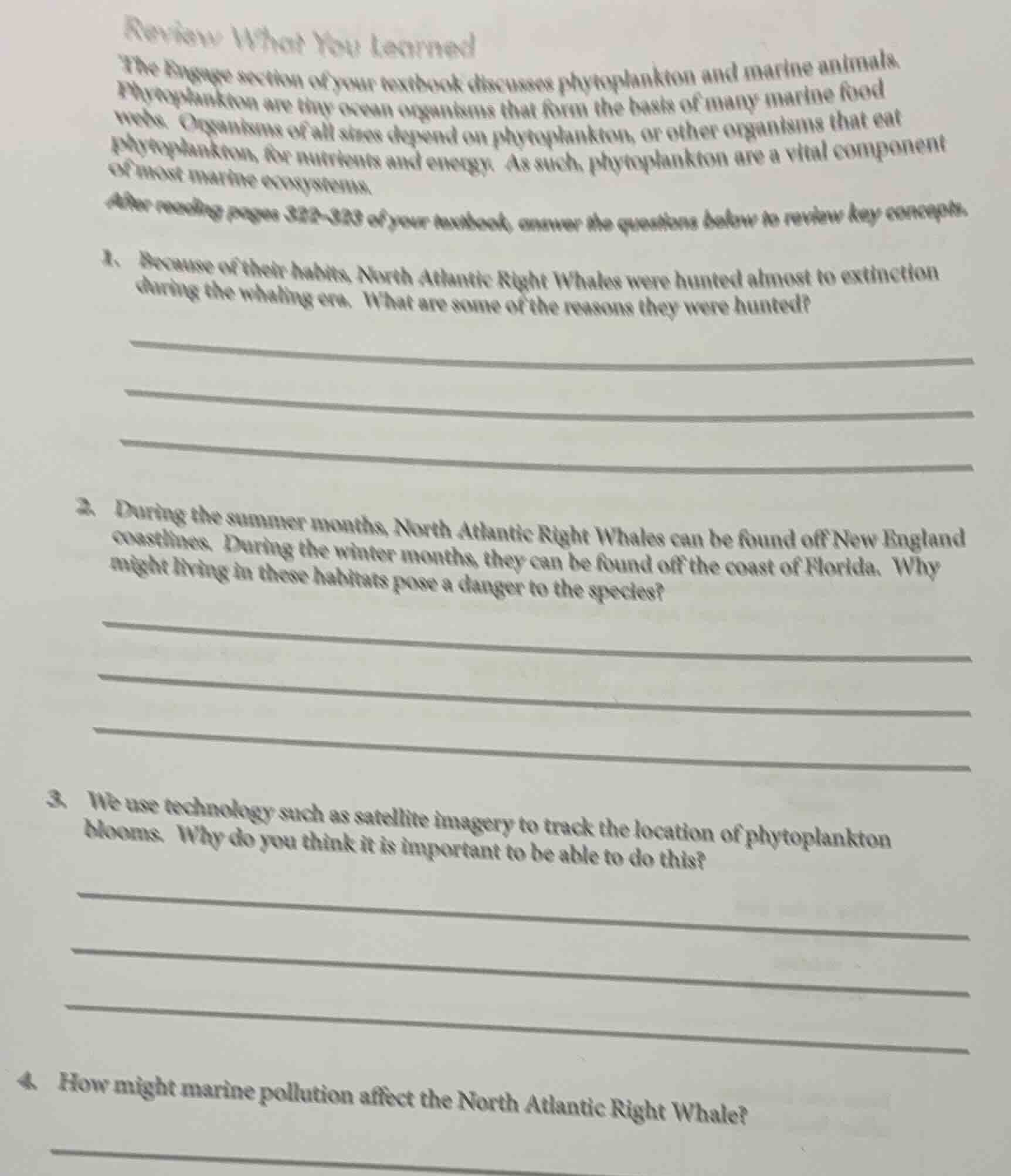
review what you learned
the engage section of your textbook discusses phytoplankton and marine animals.
phytoplankton are tiny ocean organisms that form the basis of many marine food
webs. organisms of all sizes depend on phytoplankton, or other organisms that eat
phytoplankton, for nutrients and energy. as such, phytoplankton are a vital component
of most marine ecosystems.
after reading pages 322-328 of your textbook, answer the questions below to review key concepts.
- because of their habits, north atlantic right whales were hunted almost to extinction
during the whaling era. what are some of the reasons they were hunted?
- during the summer months, north atlantic right whales can be found off new england
coastlines. during the winter months, they can be found off the coast of florida. why
might living in these habitats pose a danger to the species?
- we use technology such as satellite imagery to track the location of phytoplankton
blooms. why do you think it is important to be able to do this?
- how might marine pollution affect the north atlantic right whale?
- North Atlantic Right Whales were targeted because they swim slowly, float when killed (making them easy to retrieve), and have high blubber/whale oil content which was valuable for lighting, lubrication, and other industrial uses.
- These coastal habitats overlap with busy shipping lanes, increasing collision risks with vessels. They also have high levels of commercial fishing activity, leading to entanglement in fishing gear, both of which threaten the small remaining population.
- Tracking phytoplankton blooms is critical because they are the base of marine food webs; their location indicates areas with abundant food for larger marine organisms like whales. They also help monitor ocean health, nutrient levels, and can signal harmful algal blooms that threaten ecosystems and human health.
- Marine pollution can harm North Atlantic Right Whales in multiple ways: plastic debris can be ingested, causing internal injury or starvation; chemical pollution can accumulate in their bodies, harming reproduction and overall health; polluted waters can reduce their food supply (phytoplankton and zooplankton) by disrupting marine food webs.

Snap & solve any problem in the app
Get step-by-step solutions on Sovi AI
Photo-based solutions with guided steps
Explore more problems and detailed explanations
- They swam slowly, floated when dead (easy to harvest), and had valuable blubber/oil for industry.
- Coastal habitats overlap with busy shipping lanes (collision risk) and commercial fishing areas (entanglement risk), endangering the small population.
- To track marine food web hotspots, monitor ocean ecosystem health, and detect harmful algal blooms.
- Ingestion of plastic causes injury/starvation; chemical pollution impairs health/reproduction; pollution reduces their food supply by disrupting phytoplankton and zooplankton populations.