QUESTION IMAGE
Question
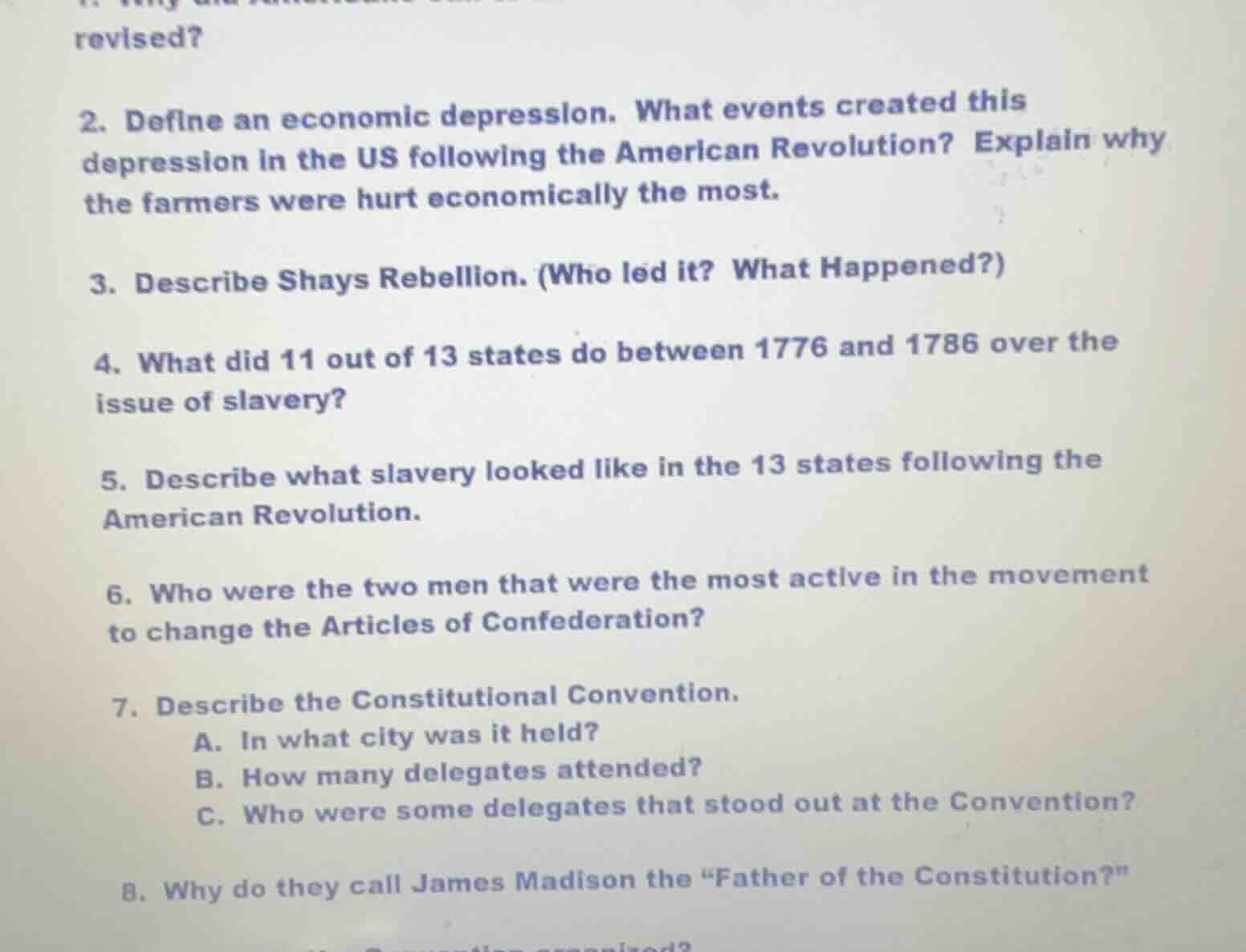
revised?
- define an economic depression. what events created this
depression in the us following the american revolution? explain why
the farmers were hurt economically the most.
- describe shays rebellion. (who led it? what happened?)
- what did 11 out of 13 states do between 1776 and 1786 over the
issue of slavery?
- describe what slavery looked like in the 13 states following the
american revolution.
- who were the two men that were the most active in the movement
to change the articles of confederation?
- describe the constitutional convention.
a. in what city was it held?
b. how many delegates attended?
c. who were some delegates that stood out at the convention?
- why do they call james madison the \father of the constitution?\
- (Note: Question 1 is cut off and unanswerable with provided text)
- Economic Depression Definition: A severe, prolonged downturn in economic activity with high unemployment, plummeting production, and widespread financial hardship.
- Post-Revolution US Causes: War debt, lack of a national currency, British trade restrictions, and collapsed state credit.
- Farmers Hit Hardest: They owed war debts, faced falling crop prices, lost access to British markets, and were targeted by state tax collectors for repayment.
- Shays Rebellion: Led by Daniel Shays, a former Continental Army captain. In 1786-1787, debt-ridden Massachusetts farmers protested high taxes and unfair debt collection by courthouses; the rebellion was suppressed, but it exposed weaknesses in the Articles of Confederation.
- 11 of 13 states either restricted the importation of enslaved people or passed laws allowing for gradual emancipation of enslaved individuals between 1776 and 1786.
- Post-Revolution Slavery: Northern states began gradual emancipation (enslaved people were freed over generations, or children of enslaved people were born free). Southern states tightened slave codes, restricted manumission, and expanded slavery to meet labor demands for cash crops like cotton and tobacco, as the institution became more entrenched in the region.
- Alexander Hamilton and James Madison were the most active in pushing to revise the Articles of Confederation.
- Constitutional Convention:
A. It was held in Philadelphia, Pennsylvania.
B. 55 delegates attended (though not all stayed for the entire convention).
C. Standout delegates included James Madison (author of the Virginia Plan), Alexander Hamilton (advocate for a strong national government), Benjamin Franklin (elder statesman and mediator), and George Washington (elected convention president).
- James Madison is called the "Father of the Constitution" because he drafted the Virginia Plan (the framework for the Constitution), kept detailed, authoritative notes of the convention debates, and was a leading advocate for ratifying the document through the Federalist Papers.

Snap & solve any problem in the app
Get step-by-step solutions on Sovi AI
Photo-based solutions with guided steps
Explore more problems and detailed explanations
- (Unanswerable; question text is incomplete)
- Economic depression: Severe, long-term economic collapse. Causes: War debt, trade limits, currency instability. Farmers hit hardest: Debt, low crop prices, tax seizures.
- Led by Daniel Shays; 1786-1787 MA farmers protested debt/taxes by attacking courthouses; suppressed, revealed Articles' flaws.
- 11 states restricted slave imports or enacted gradual emancipation laws.
- Northern states adopted gradual emancipation; Southern states strengthened slave codes and expanded slavery for cash crop labor.
- Alexander Hamilton and James Madison.
- A. Philadelphia, Pennsylvania
B. 55 delegates
C. George Washington, James Madison, Alexander Hamilton, Benjamin Franklin
- He drafted the Virginia Plan (Constitution framework), kept detailed convention notes, and led pro-ratification efforts via the Federalist Papers.