QUESTION IMAGE
Question
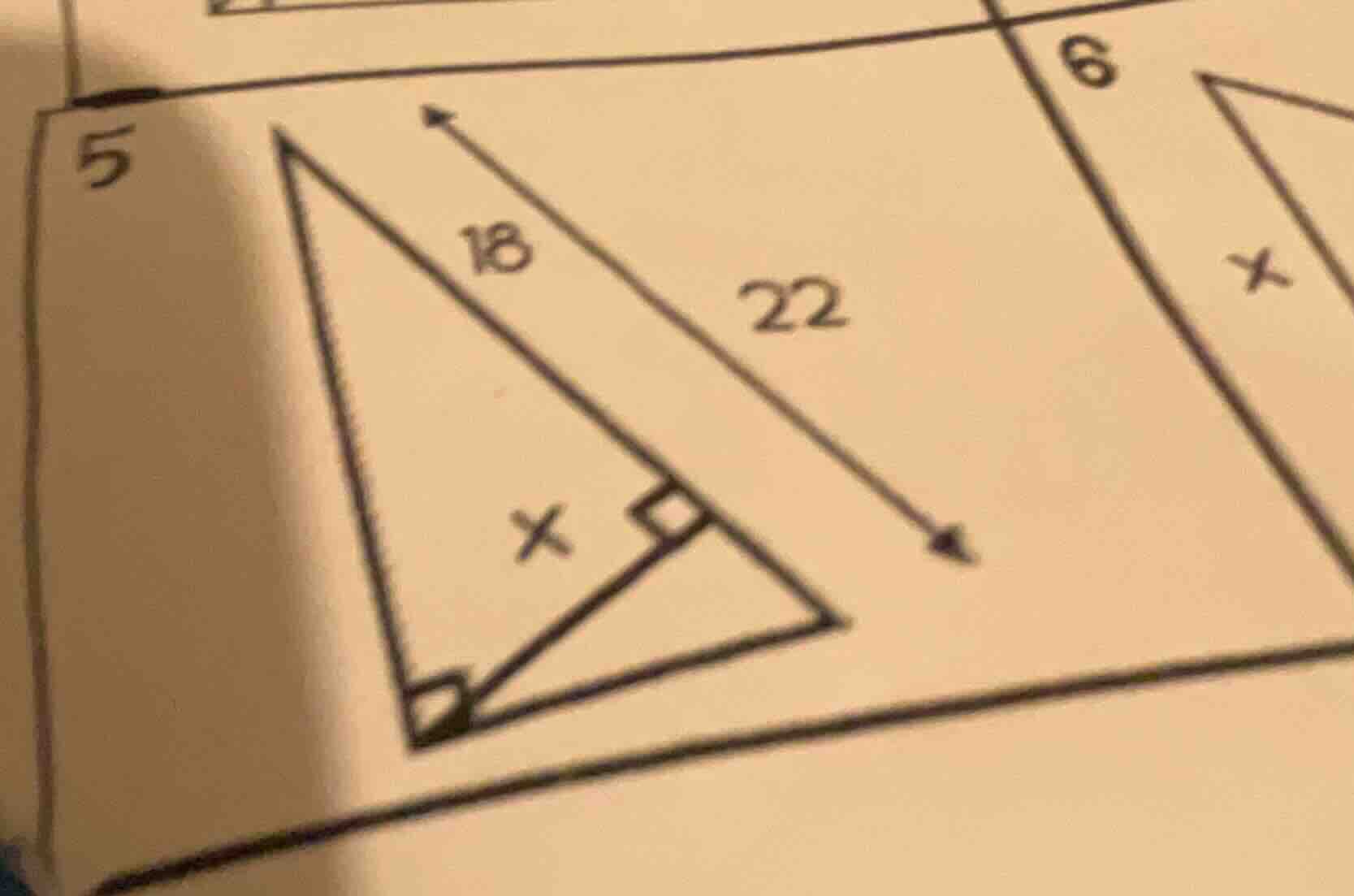
in the right triangle diagram, there are lengths 18, 22, and an unknown x (related to the right triangles side - length calculation, likely using geometric concepts like similar triangles or the geometric mean theorem for right triangles).
Step1: Identify the geometric relationship
This is a right triangle with an altitude to the hypotenuse. We can use the geometric mean theorem (also known as the altitude-on-hypotenuse theorem), which states that in a right triangle, the length of the altitude drawn to the hypotenuse is the geometric mean of the lengths of the two segments of the hypotenuse. Also, the length of each leg of the right triangle is the geometric mean of the length of the hypotenuse and the length of the segment of the hypotenuse adjacent to that leg. Here, we have a leg of length \( x \), the adjacent segment of the hypotenuse is \( 18 \), and the hypotenuse is \( 22 \)? Wait, no, maybe I misread. Wait, the hypotenuse is divided into two segments: one is \( 18 \) and the other? Wait, no, looking at the diagram, the hypotenuse is \( 22 \)? Wait, no, the leg is \( x \), the altitude is... Wait, maybe the correct formula is: If in a right triangle, a leg is \( a \), the segment of the hypotenuse adjacent to \( a \) is \( m \), and the hypotenuse is \( n \), then \( a^2 = m \times n \). Wait, let's re-express. Let the right triangle have hypotenuse \( c = 22 \), one segment of the hypotenuse (adjacent to leg \( x \)) is \( m = 18 \), then by the geometric mean theorem, \( x^2 = 18\times22 \)? Wait, no, maybe the hypotenuse is \( 22 \), and the two segments are \( 18 \) and \( 22 - 18 = 4 \)? No, that doesn't make sense. Wait, maybe the diagram is a right triangle with hypotenuse \( 22 \), and an altitude to the hypotenuse creating a segment of length \( 18 \) and the leg \( x \) is adjacent to the segment of length \( 18 \). So the formula is \( x^2 = 18\times22 \)? Wait, no, the geometric mean theorem says that for a right triangle, leg \( l \), segment of hypotenuse \( s \), hypotenuse \( h \), then \( l^2 = s \times h \). Wait, let's check the formula again. The geometric mean theorem: In a right triangle, the square of a leg is equal to the product of the hypotenuse and the segment of the hypotenuse adjacent to that leg. So if the hypotenuse is \( h \), the segment adjacent to leg \( x \) is \( s \), then \( x^2 = s \times h \). So here, \( s = 18 \), \( h = 22 \), so \( x^2 = 18\times22 \).
Step2: Calculate \( x^2 \)
First, calculate \( 18\times22 \). \( 18\times22 = (20 - 2)\times22 = 20\times22 - 2\times22 = 440 - 44 = 396 \). So \( x^2 = 396 \).
Step3: Find \( x \)
Take the square root of \( 396 \). \( \sqrt{396} = \sqrt{36\times11} = 6\sqrt{11} \approx 6\times3.3166 = 19.8996 \approx 20 \). Wait, but maybe I made a mistake in the segments. Wait, maybe the hypotenuse is \( 18 + 22 = 40 \)? No, the diagram shows the hypotenuse as \( 22 \) with an arrow, and the segment as \( 18 \). Wait, maybe the correct formula is that the leg \( x \) is the geometric mean of \( 18 \) and \( 22 \). So \( x = \sqrt{18\times22} \). Let's compute \( 18\times22 = 396 \), so \( x = \sqrt{396} = \sqrt{36\times11} = 6\sqrt{11} \approx 19.9 \), which is approximately \( 20 \). But maybe the diagram is different. Wait, maybe the hypotenuse is \( 22 \), and the segment is \( 18 \), so \( x^2 = 18\times22 \), so \( x = \sqrt{18\times22} \).
Step1 (corrected): Re-express the theorem
The geometric mean theorem (altitude-on-hypotenuse theorem) states that in a right triangle, the length of each leg is the geometric mean of the length of the hypotenuse and the length of the segment of the hypotenuse adjacent to that leg. So if we have a right triangle with hypotenuse \( c \), and a segment of the hypotenuse \( m \) adjacent to leg \( a \), then \( a^2 = m \times c \)…

Snap & solve any problem in the app
Get step-by-step solutions on Sovi AI
Photo-based solutions with guided steps
Explore more problems and detailed explanations
\( x = 6\sqrt{11} \approx 19.9 \) (or if we round to a whole number, \( 20 \))