QUESTION IMAGE
Question
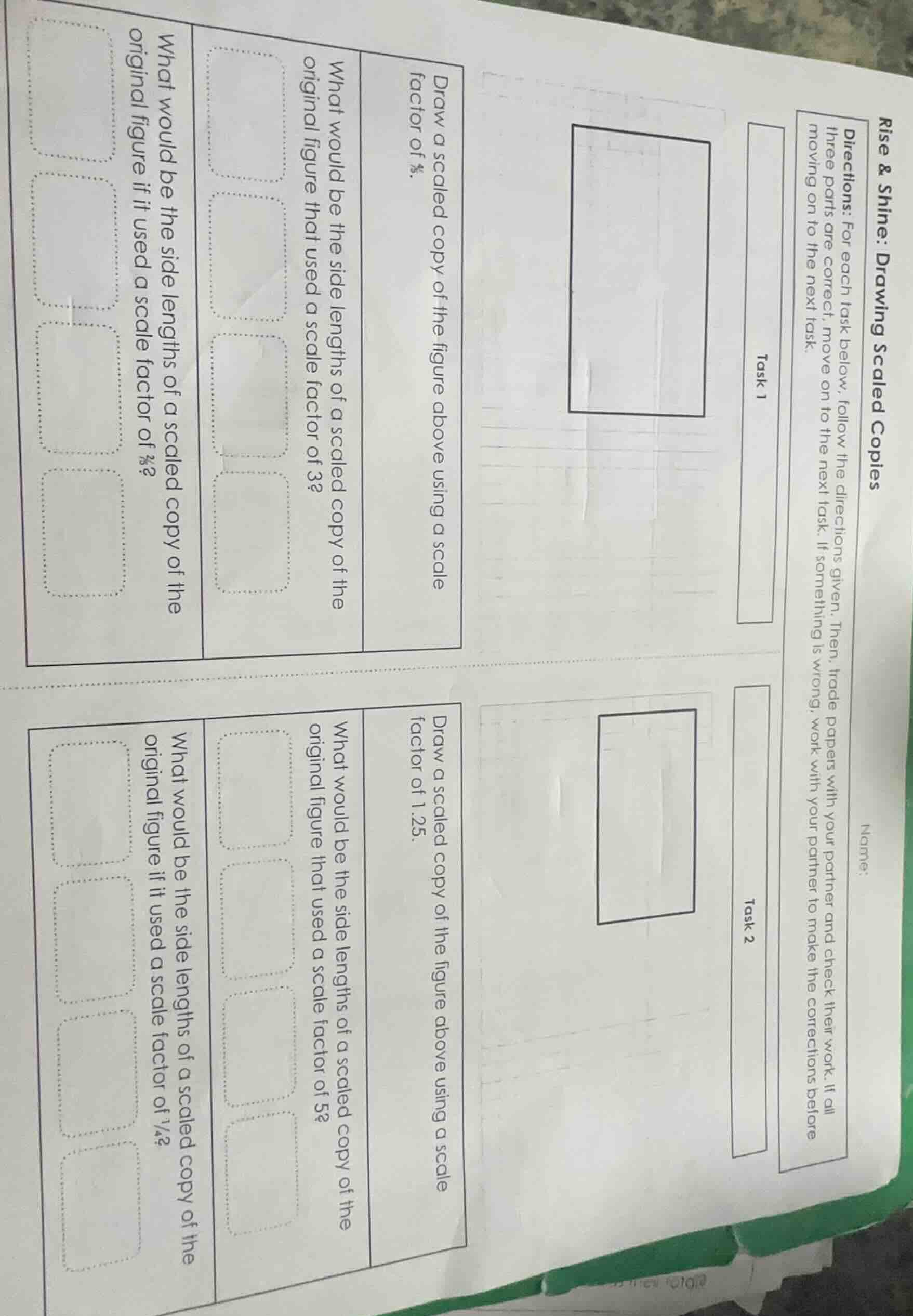
rise & shine: drawing scaled copies
directions: for each task below, follow the directions given. then, trade papers with your partner and check their work. if all three parts are correct, move on to the next task. if something is wrong, work with your partner to make the corrections before moving on to the next task.
task 1
draw a scaled copy of the figure above using a scale factor of ¼.
what would be the side lengths of a scaled copy of the original figure that used a scale factor of 3?
what would be the side lengths of a scaled copy of the original figure if it used a scale factor of ⅔?
task 2
draw a scaled copy of the figure above using a scale factor of 1.25.
what would be the side lengths of a scaled copy of the original figure that used a scale factor of 5?
what would be the side lengths of a scaled copy of the original figure if it used a scale factor of ¼?
To solve problems related to scaled copies, we use the concept of scale factors. Let's assume the original figure (a rectangle) has length \( l \) and width \( w \).
Task 1 (First Rectangle)
1. Scale Factor \( \frac{1}{4} \)
To find the side lengths of the scaled copy with a scale factor of \( \frac{1}{4} \), we multiply the original side lengths by \( \frac{1}{4} \).
- New length: \( l \times \frac{1}{4} = \frac{l}{4} \)
- New width: \( w \times \frac{1}{4} = \frac{w}{4} \)
2. Scale Factor \( 3 \)
To find the side lengths of the scaled copy with a scale factor of \( 3 \), we multiply the original side lengths by \( 3 \).
- New length: \( l \times 3 = 3l \)
- New width: \( w \times 3 = 3w \)
3. Scale Factor \( \frac{2}{3} \)
To find the side lengths of the scaled copy with a scale factor of \( \frac{2}{3} \), we multiply the original side lengths by \( \frac{2}{3} \).
- New length: \( l \times \frac{2}{3} = \frac{2l}{3} \)
- New width: \( w \times \frac{2}{3} = \frac{2w}{3} \)
Task 2 (Second Rectangle)
1. Scale Factor \( 1.25 \) (or \( \frac{5}{4} \))
To find the side lengths of the scaled copy with a scale factor of \( 1.25 \), we multiply the original side lengths by \( 1.25 \).
- New length: \( l \times 1.25 = 1.25l \)
- New width: \( w \times 1.25 = 1.25w \)
2. Scale Factor \( 5 \)
To find the side lengths of the scaled copy with a scale factor of \( 5 \), we multiply the original side lengths by \( 5 \).
- New length: \( l \times 5 = 5l \)
- New width: \( w \times 5 = 5w \)
3. Scale Factor \( \frac{1}{4} \)
To find the side lengths of the scaled copy with a scale factor of \( \frac{1}{4} \), we multiply the original side lengths by \( \frac{1}{4} \).
- New length: \( l \times \frac{1}{4} = \frac{l}{4} \)
- New width: \( w \times \frac{1}{4} = \frac{w}{4} \)
Drawing the Scaled Copies
For each scale factor, draw a rectangle with the calculated length and width. Ensure the proportions (length-to-width ratio) match the original figure.
Example (Assuming Original Rectangle: Length = 4 units, Width = 2 units)
Task 1:
- Scale Factor \( \frac{1}{4} \): Length = \( 4 \times \frac{1}{4} = 1 \) unit, Width = \( 2 \times \frac{1}{4} = 0.5 \) unit.
- Scale Factor \( 3 \): Length = \( 4 \times 3 = 12 \) units, Width = \( 2 \times 3 = 6 \) units.
- Scale Factor \( \frac{2}{3} \): Length = \( 4 \times \frac{2}{3} \approx 2.67 \) units, Width = \( 2 \times \frac{2}{3} \approx 1.33 \) units.
Task 2:
- Scale Factor \( 1.25 \): Length = \( 4 \times 1.25 = 5 \) units, Width = \( 2 \times 1.25 = 2.5 \) units.
- Scale Factor \( 5 \): Length = \( 4 \times 5 = 20 \) units, Width = \( 2 \times 5 = 10 \) units.
- Scale Factor \( \frac{1}{4} \): Length = \( 4 \times \frac{1}{4} = 1 \) unit, Width = \( 2 \times \frac{1}{4} = 0.5 \) unit.
Final Answer
To draw the scaled copies, use the calculated side lengths for each scale factor. For example, if the original rectangle has length \( 4 \) and width \( 2 \):
- Task 1 (Scale Factor \( \frac{1}{4} \)): Rectangle with length \( 1 \) and width \( 0.5 \).
- Task 1 (Scale Factor \( 3 \)): Rectangle with length \( 12 \) and width \( 6 \).
- Task 1 (Scale Factor \( \frac{2}{3} \)): Rectangle with length \( \approx 2.67 \) and width \( \approx 1.33 \).
- Task 2 (Scale Factor \( 1.25 \)): Rectangle with length \( 5 \) and width \( 2.5 \).
- Task 2 (Scale Factor \( 5 \)): Rectangle with length \( 20 \) and width \( 10 \).
- Task 2 (Scale Factor \( \frac{1}{4} \)): Rectangle with length \( 1 \) and width \( 0.5 \).
(Note: Repl…

Snap & solve any problem in the app
Get step-by-step solutions on Sovi AI
Photo-based solutions with guided steps
Explore more problems and detailed explanations
To solve problems related to scaled copies, we use the concept of scale factors. Let's assume the original figure (a rectangle) has length \( l \) and width \( w \).
Task 1 (First Rectangle)
1. Scale Factor \( \frac{1}{4} \)
To find the side lengths of the scaled copy with a scale factor of \( \frac{1}{4} \), we multiply the original side lengths by \( \frac{1}{4} \).
- New length: \( l \times \frac{1}{4} = \frac{l}{4} \)
- New width: \( w \times \frac{1}{4} = \frac{w}{4} \)
2. Scale Factor \( 3 \)
To find the side lengths of the scaled copy with a scale factor of \( 3 \), we multiply the original side lengths by \( 3 \).
- New length: \( l \times 3 = 3l \)
- New width: \( w \times 3 = 3w \)
3. Scale Factor \( \frac{2}{3} \)
To find the side lengths of the scaled copy with a scale factor of \( \frac{2}{3} \), we multiply the original side lengths by \( \frac{2}{3} \).
- New length: \( l \times \frac{2}{3} = \frac{2l}{3} \)
- New width: \( w \times \frac{2}{3} = \frac{2w}{3} \)
Task 2 (Second Rectangle)
1. Scale Factor \( 1.25 \) (or \( \frac{5}{4} \))
To find the side lengths of the scaled copy with a scale factor of \( 1.25 \), we multiply the original side lengths by \( 1.25 \).
- New length: \( l \times 1.25 = 1.25l \)
- New width: \( w \times 1.25 = 1.25w \)
2. Scale Factor \( 5 \)
To find the side lengths of the scaled copy with a scale factor of \( 5 \), we multiply the original side lengths by \( 5 \).
- New length: \( l \times 5 = 5l \)
- New width: \( w \times 5 = 5w \)
3. Scale Factor \( \frac{1}{4} \)
To find the side lengths of the scaled copy with a scale factor of \( \frac{1}{4} \), we multiply the original side lengths by \( \frac{1}{4} \).
- New length: \( l \times \frac{1}{4} = \frac{l}{4} \)
- New width: \( w \times \frac{1}{4} = \frac{w}{4} \)
Drawing the Scaled Copies
For each scale factor, draw a rectangle with the calculated length and width. Ensure the proportions (length-to-width ratio) match the original figure.
Example (Assuming Original Rectangle: Length = 4 units, Width = 2 units)
Task 1:
- Scale Factor \( \frac{1}{4} \): Length = \( 4 \times \frac{1}{4} = 1 \) unit, Width = \( 2 \times \frac{1}{4} = 0.5 \) unit.
- Scale Factor \( 3 \): Length = \( 4 \times 3 = 12 \) units, Width = \( 2 \times 3 = 6 \) units.
- Scale Factor \( \frac{2}{3} \): Length = \( 4 \times \frac{2}{3} \approx 2.67 \) units, Width = \( 2 \times \frac{2}{3} \approx 1.33 \) units.
Task 2:
- Scale Factor \( 1.25 \): Length = \( 4 \times 1.25 = 5 \) units, Width = \( 2 \times 1.25 = 2.5 \) units.
- Scale Factor \( 5 \): Length = \( 4 \times 5 = 20 \) units, Width = \( 2 \times 5 = 10 \) units.
- Scale Factor \( \frac{1}{4} \): Length = \( 4 \times \frac{1}{4} = 1 \) unit, Width = \( 2 \times \frac{1}{4} = 0.5 \) unit.
Final Answer
To draw the scaled copies, use the calculated side lengths for each scale factor. For example, if the original rectangle has length \( 4 \) and width \( 2 \):
- Task 1 (Scale Factor \( \frac{1}{4} \)): Rectangle with length \( 1 \) and width \( 0.5 \).
- Task 1 (Scale Factor \( 3 \)): Rectangle with length \( 12 \) and width \( 6 \).
- Task 1 (Scale Factor \( \frac{2}{3} \)): Rectangle with length \( \approx 2.67 \) and width \( \approx 1.33 \).
- Task 2 (Scale Factor \( 1.25 \)): Rectangle with length \( 5 \) and width \( 2.5 \).
- Task 2 (Scale Factor \( 5 \)): Rectangle with length \( 20 \) and width \( 10 \).
- Task 2 (Scale Factor \( \frac{1}{4} \)): Rectangle with length \( 1 \) and width \( 0.5 \).
(Note: Replace \( l \) and \( w \) with the actual dimensions of the original figure provided in the problem.)