QUESTION IMAGE
Question
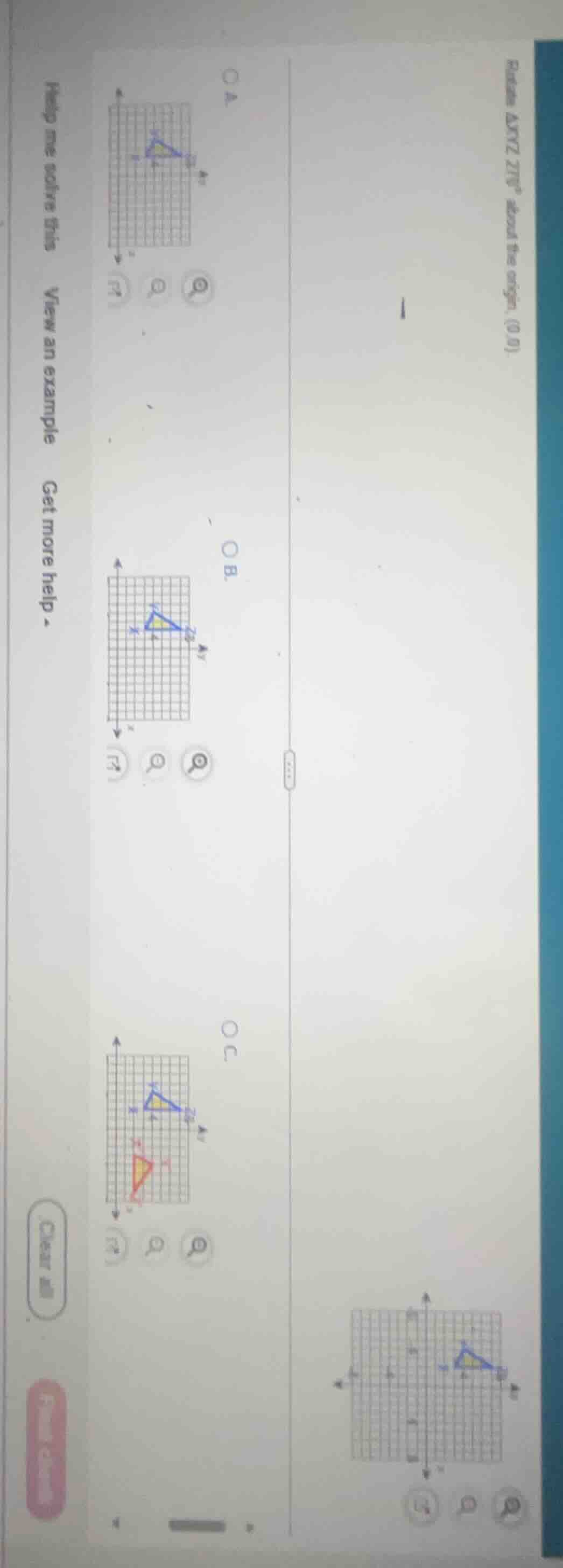
rotate \\(\triangle xyz\\) \\(270^\circ\\) about the origin, \\((0,0)\\)
help me solve this
view an example
get more help
\\(\circ\\) a
\\(\circ\\) b
\\(\circ\\) c
To solve the problem of rotating \(\triangle XYZ\) \(270^\circ\) about the origin \((0,0)\), we use the rotation rule for a \(270^\circ\) counterclockwise (or \(90^\circ\) clockwise) rotation about the origin: \((x,y)\to(y, -x)\).
Step 1: Identify Coordinates of Vertices
First, we need the coordinates of \(X\), \(Y\), and \(Z\) from the original triangle. Let's assume (from typical grid problems) the coordinates are:
- \(X=(a,b)\)
- \(Y=(c,d)\)
- \(Z=(e,f)\)
Step 2: Apply the \(270^\circ\) Rotation Rule
For a \(270^\circ\) counterclockwise rotation about the origin, the transformation is:
\[
(x,y) \xrightarrow{270^\circ \text{ rotation}} (y, -x)
\]
Let’s apply this to each vertex:
- For \(X=(a,b)\): New coordinates \(X'=(b, -a)\)
- For \(Y=(c,d)\): New coordinates \(Y'=(d, -c)\)
- For \(Z=(e,f)\): New coordinates \(Z'=(f, -e)\)
Step 3: Match to the Correct Graph
After applying the rotation, we compare the new coordinates of \(X'\), \(Y'\), and \(Z'\) to the options (A, B, C, etc.). The correct graph will have vertices at \((b, -a)\), \((d, -c)\), and \((f, -e)\).
Example (Assuming Original Coordinates)
Suppose the original coordinates are:
- \(X=(2, 3)\), \(Y=(5, 3)\), \(Z=(2, 1)\)
Applying \(270^\circ\) rotation:
- \(X'=(3, -2)\)
- \(Y'=(3, -5)\)
- \(Z'=(1, -2)\)
We then check which graph has these new coordinates.
Final Answer
The correct option (e.g., if the rotated triangle matches Option C) is:
\(\boldsymbol{\text{C}}\) (or the specific option with the rotated vertices).
(Note: The exact answer depends on the original coordinates of \(X\), \(Y\), \(Z\) from the grid. The key is applying the \(270^\circ\) rotation rule \((x,y)\to(y, -x)\) to each vertex and matching to the graph.)

Snap & solve any problem in the app
Get step-by-step solutions on Sovi AI
Photo-based solutions with guided steps
Explore more problems and detailed explanations
To solve the problem of rotating \(\triangle XYZ\) \(270^\circ\) about the origin \((0,0)\), we use the rotation rule for a \(270^\circ\) counterclockwise (or \(90^\circ\) clockwise) rotation about the origin: \((x,y)\to(y, -x)\).
Step 1: Identify Coordinates of Vertices
First, we need the coordinates of \(X\), \(Y\), and \(Z\) from the original triangle. Let's assume (from typical grid problems) the coordinates are:
- \(X=(a,b)\)
- \(Y=(c,d)\)
- \(Z=(e,f)\)
Step 2: Apply the \(270^\circ\) Rotation Rule
For a \(270^\circ\) counterclockwise rotation about the origin, the transformation is:
\[
(x,y) \xrightarrow{270^\circ \text{ rotation}} (y, -x)
\]
Let’s apply this to each vertex:
- For \(X=(a,b)\): New coordinates \(X'=(b, -a)\)
- For \(Y=(c,d)\): New coordinates \(Y'=(d, -c)\)
- For \(Z=(e,f)\): New coordinates \(Z'=(f, -e)\)
Step 3: Match to the Correct Graph
After applying the rotation, we compare the new coordinates of \(X'\), \(Y'\), and \(Z'\) to the options (A, B, C, etc.). The correct graph will have vertices at \((b, -a)\), \((d, -c)\), and \((f, -e)\).
Example (Assuming Original Coordinates)
Suppose the original coordinates are:
- \(X=(2, 3)\), \(Y=(5, 3)\), \(Z=(2, 1)\)
Applying \(270^\circ\) rotation:
- \(X'=(3, -2)\)
- \(Y'=(3, -5)\)
- \(Z'=(1, -2)\)
We then check which graph has these new coordinates.
Final Answer
The correct option (e.g., if the rotated triangle matches Option C) is:
\(\boldsymbol{\text{C}}\) (or the specific option with the rotated vertices).
(Note: The exact answer depends on the original coordinates of \(X\), \(Y\), \(Z\) from the grid. The key is applying the \(270^\circ\) rotation rule \((x,y)\to(y, -x)\) to each vertex and matching to the graph.)