QUESTION IMAGE
Question
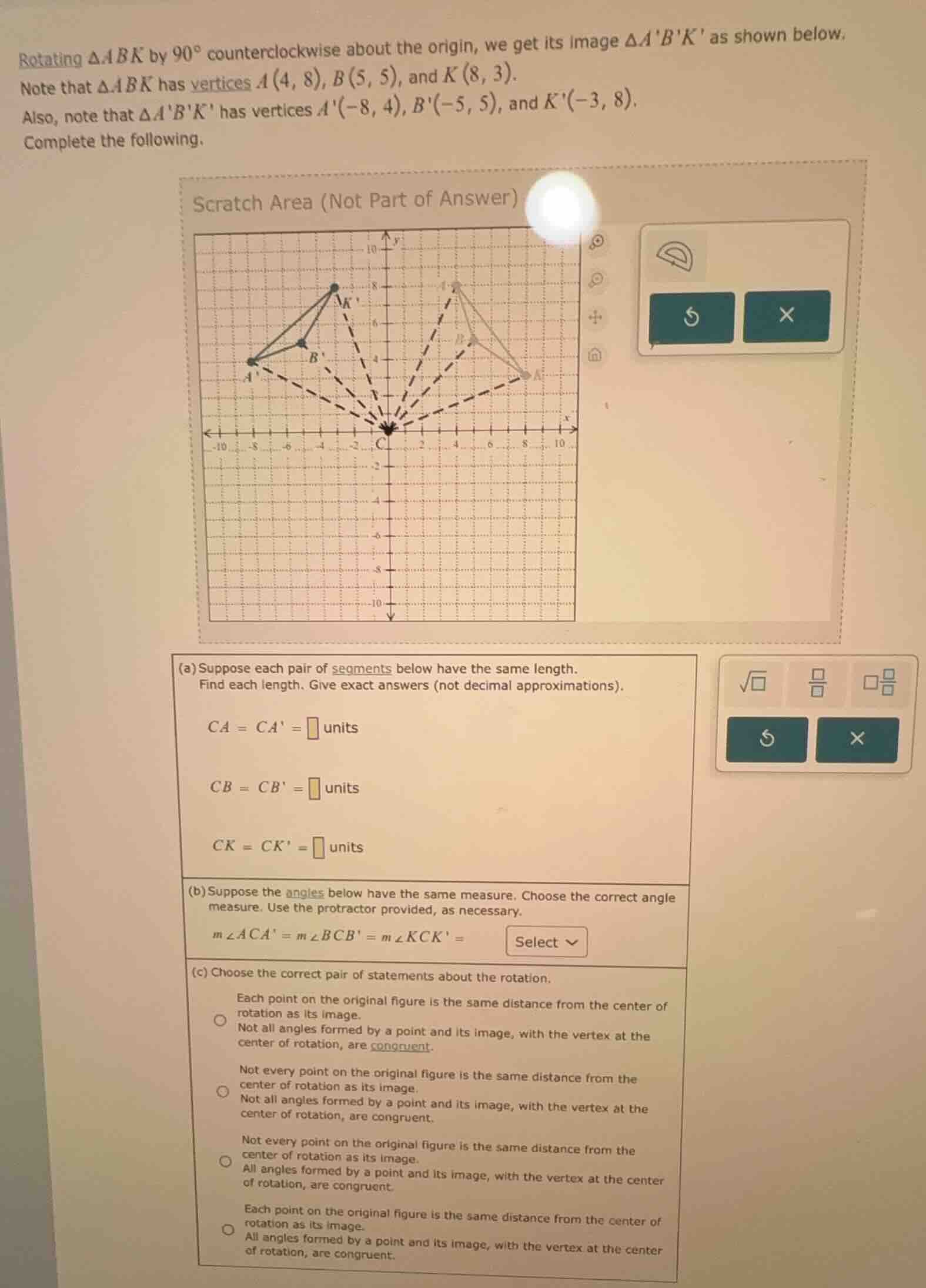
rotating $\triangle abk$ by $90^circ$ counterclockwise about the origin, we get its image $\triangle abk$ as shown below. note that $\triangle abk$ has vertices $a(4, 8)$, $b(5, 5)$, and $k(8, 3)$. also, note that $\triangle abk$ has vertices $a(-8, 4)$, $b(-5, 5)$, and $k(-3, 8)$. complete the following. scratch area (not part of answer) (a) suppose each pair of segments below have the same length. find each length. give exact answers (not decimal approximations). $ca = ca = square$ units $cb = cb = square$ units $ck = ck = square$ units (b) suppose the angles below have the same measure. choose the correct angle measure. use the protractor provided, as necessary. $mangle aca = mangle bcb = mangle kck =$ select (c) choose the correct pair of statements about the rotation. $\bigcirc$ each point on the original figure is the same distance from the center of rotation as its image. not all angles formed by a point and its image, with the vertex at the center of rotation, are congruent. $\bigcirc$ not every point on the original figure is the same distance from the center of rotation as its image. not all angles formed by a point and its image, with the vertex at the center of rotation, are congruent. $\bigcirc$ not every point on the original figure is the same distance from the center of rotation as its image. all angles formed by a point and its image, with the vertex at the center of rotation, are congruent. $\bigcirc$ each point on the original figure is the same distance from the center of rotation as its image. all angles formed by a point and its image, with the vertex at the center of rotation, are congruent.
Part (a)
To find the lengths \( CA \), \( CA' \), \( CB \), \( CB' \), \( CK \), and \( CK' \), we use the distance formula between a point \((x, y)\) and the origin \((0, 0)\), which is \( d = \sqrt{(x - 0)^2 + (y - 0)^2} = \sqrt{x^2 + y^2} \).
For \( CA \) (and \( CA' \)):
Point \( A \) is \((4, 8)\).
Step 1: Apply the distance formula
\( CA = \sqrt{(4 - 0)^2 + (8 - 0)^2} = \sqrt{4^2 + 8^2} \)
Step 2: Calculate the squares
\( 4^2 = 16 \) and \( 8^2 = 64 \)
Step 3: Sum the squares and take the square root
\( CA = \sqrt{16 + 64} = \sqrt{80} = \sqrt{16 \times 5} = 4\sqrt{5} \)
So, \( CA = CA' = 4\sqrt{5} \) units.
For \( CB \) (and \( CB' \)):
Point \( B \) is \((5, 5)\).
Step 1: Apply the distance formula
\( CB = \sqrt{(5 - 0)^2 + (5 - 0)^2} = \sqrt{5^2 + 5^2} \)
Step 2: Calculate the squares
\( 5^2 = 25 \) and \( 5^2 = 25 \)
Step 3: Sum the squares and take the square root
\( CB = \sqrt{25 + 25} = \sqrt{50} = \sqrt{25 \times 2} = 5\sqrt{2} \)
So, \( CB = CB' = 5\sqrt{2} \) units.
For \( CK \) (and \( CK' \)):
Point \( K \) is \((8, 3)\).
Step 1: Apply the distance formula
\( CK = \sqrt{(8 - 0)^2 + (3 - 0)^2} = \sqrt{8^2 + 3^2} \)
Step 2: Calculate the squares
\( 8^2 = 64 \) and \( 3^2 = 9 \)
Step 3: Sum the squares and take the square root
\( CK = \sqrt{64 + 9} = \sqrt{73} \)
So, \( CK = CK' = \sqrt{73} \) units.
Part (b)
When a figure is rotated \( 90^\circ \) counterclockwise about the origin, the angle between a point and its image with the vertex at the center of rotation (origin) is \( 90^\circ \). So, \( m\angle ACA' = m\angle BCB' = m\angle KCK' = 90^\circ \).
Part (c)
- The first statement in a pair: "Each point on the original figure is the same distance from the center of rotation as its image." This is true because rotation is a rigid transformation, so distances from the center of rotation are preserved.
- The second statement in a pair: "All angles formed by a point and its image, with the vertex at the center of rotation, are congruent." Since the rotation is by \( 90^\circ \) for all points, these angles (like \( \angle ACA' \), \( \angle BCB' \), \( \angle KCK' \)) are all \( 90^\circ \), so they are congruent.
So the correct pair is: "Each point on the original figure is the same distance from the center of rotation as its image. All angles formed by a point and its image, with the vertex at the center of rotation, are congruent."
Final Answers
(a)
\( CA = CA' = \boldsymbol{4\sqrt{5}} \) units
\( CB = CB' = \boldsymbol{5\sqrt{2}} \) units
\( CK = CK' = \boldsymbol{\sqrt{73}} \) units
(b)
\( m\angle ACA' = m\angle BCB' = m\angle KCK' = \boldsymbol{90^\circ} \)
(c)
The correct pair of statements is: "Each point on the original figure is the same distance from the center of rotation as its image. All angles formed by a point and its image, with the vertex at the center of rotation, are congruent."

Snap & solve any problem in the app
Get step-by-step solutions on Sovi AI
Photo-based solutions with guided steps
Explore more problems and detailed explanations
Part (a)
To find the lengths \( CA \), \( CA' \), \( CB \), \( CB' \), \( CK \), and \( CK' \), we use the distance formula between a point \((x, y)\) and the origin \((0, 0)\), which is \( d = \sqrt{(x - 0)^2 + (y - 0)^2} = \sqrt{x^2 + y^2} \).
For \( CA \) (and \( CA' \)):
Point \( A \) is \((4, 8)\).
Step 1: Apply the distance formula
\( CA = \sqrt{(4 - 0)^2 + (8 - 0)^2} = \sqrt{4^2 + 8^2} \)
Step 2: Calculate the squares
\( 4^2 = 16 \) and \( 8^2 = 64 \)
Step 3: Sum the squares and take the square root
\( CA = \sqrt{16 + 64} = \sqrt{80} = \sqrt{16 \times 5} = 4\sqrt{5} \)
So, \( CA = CA' = 4\sqrt{5} \) units.
For \( CB \) (and \( CB' \)):
Point \( B \) is \((5, 5)\).
Step 1: Apply the distance formula
\( CB = \sqrt{(5 - 0)^2 + (5 - 0)^2} = \sqrt{5^2 + 5^2} \)
Step 2: Calculate the squares
\( 5^2 = 25 \) and \( 5^2 = 25 \)
Step 3: Sum the squares and take the square root
\( CB = \sqrt{25 + 25} = \sqrt{50} = \sqrt{25 \times 2} = 5\sqrt{2} \)
So, \( CB = CB' = 5\sqrt{2} \) units.
For \( CK \) (and \( CK' \)):
Point \( K \) is \((8, 3)\).
Step 1: Apply the distance formula
\( CK = \sqrt{(8 - 0)^2 + (3 - 0)^2} = \sqrt{8^2 + 3^2} \)
Step 2: Calculate the squares
\( 8^2 = 64 \) and \( 3^2 = 9 \)
Step 3: Sum the squares and take the square root
\( CK = \sqrt{64 + 9} = \sqrt{73} \)
So, \( CK = CK' = \sqrt{73} \) units.
Part (b)
When a figure is rotated \( 90^\circ \) counterclockwise about the origin, the angle between a point and its image with the vertex at the center of rotation (origin) is \( 90^\circ \). So, \( m\angle ACA' = m\angle BCB' = m\angle KCK' = 90^\circ \).
Part (c)
- The first statement in a pair: "Each point on the original figure is the same distance from the center of rotation as its image." This is true because rotation is a rigid transformation, so distances from the center of rotation are preserved.
- The second statement in a pair: "All angles formed by a point and its image, with the vertex at the center of rotation, are congruent." Since the rotation is by \( 90^\circ \) for all points, these angles (like \( \angle ACA' \), \( \angle BCB' \), \( \angle KCK' \)) are all \( 90^\circ \), so they are congruent.
So the correct pair is: "Each point on the original figure is the same distance from the center of rotation as its image. All angles formed by a point and its image, with the vertex at the center of rotation, are congruent."
Final Answers
(a)
\( CA = CA' = \boldsymbol{4\sqrt{5}} \) units
\( CB = CB' = \boldsymbol{5\sqrt{2}} \) units
\( CK = CK' = \boldsymbol{\sqrt{73}} \) units
(b)
\( m\angle ACA' = m\angle BCB' = m\angle KCK' = \boldsymbol{90^\circ} \)
(c)
The correct pair of statements is: "Each point on the original figure is the same distance from the center of rotation as its image. All angles formed by a point and its image, with the vertex at the center of rotation, are congruent."