QUESTION IMAGE
Question
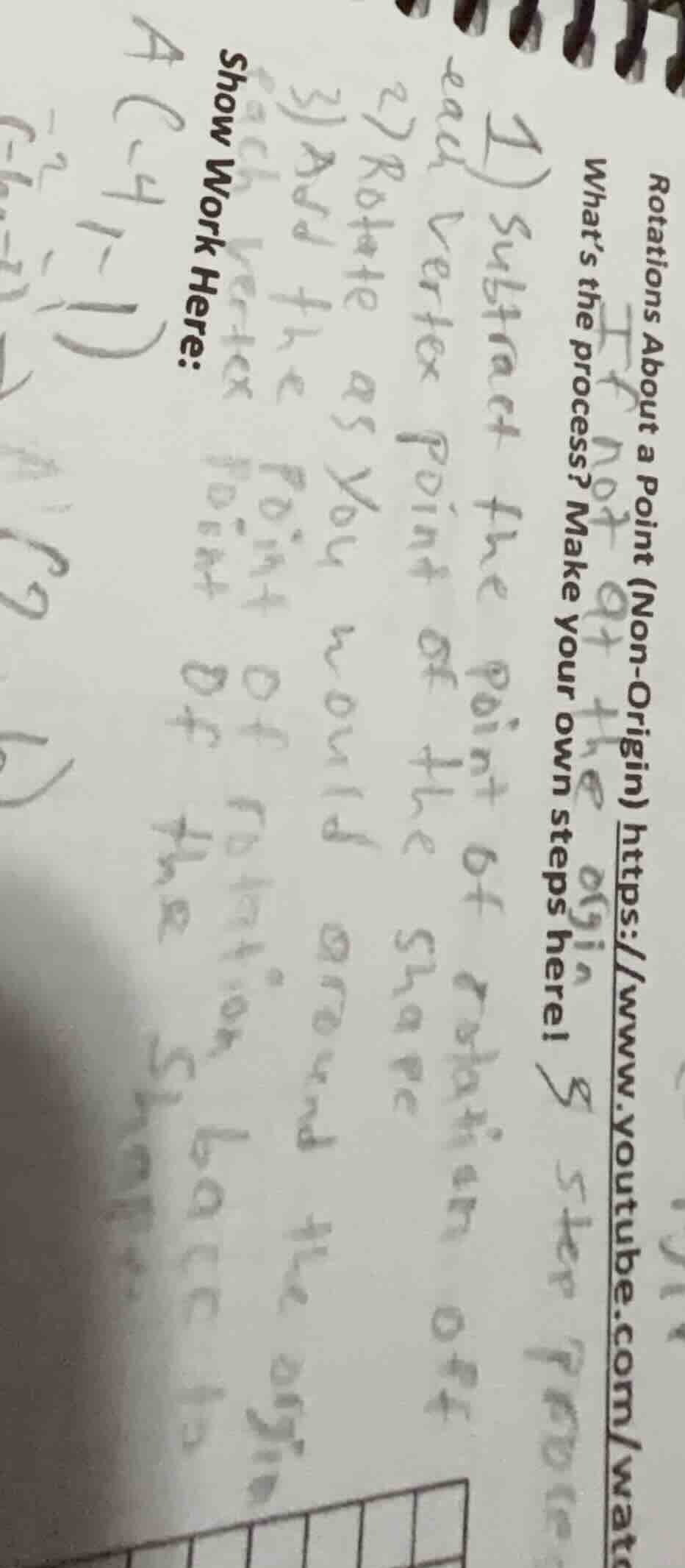
rotations about a point (non - origin)
whats the process? make your own steps here!
- subtract the point of rotation from each vertex point of the shape
- rotate as you would around the origin
- add the point of rotation back to each vertex point
show work here:
Step1: Translate shape to origin
For a vertex $(x,y)$ and rotation point $(h,k)$:
$x' = x - h$, $y' = y - k$
Step2: Rotate translated point
Use origin rotation rules:
- 90° clockwise: $(x',y') \to (y', -x')$
- 90° counterclockwise: $(x',y') \to (-y', x')$
- 180°: $(x',y') \to (-x', -y')$
- 270° clockwise: $(x',y') \to (-y', x')$
Step3: Translate back to rotation point
$x'' = x_{rot} + h$, $y'' = y_{rot} + k$

Snap & solve any problem in the app
Get step-by-step solutions on Sovi AI
Photo-based solutions with guided steps
Explore more problems and detailed explanations
The 3-step process for rotating a shape about a non-origin point $(h,k)$ is:
- Translate all vertices by subtracting the rotation point coordinates: $(x,y) \to (x-h, y-k)$
- Apply the desired origin rotation rule to the translated coordinates
- Translate the rotated coordinates back by adding the rotation point coordinates: $(x_{rot}, y_{rot}) \to (x_{rot}+h, y_{rot}+k)$
For example, rotating point $A(-4,-1)$ 90° clockwise about $(h,k)=(1,1)$:
Step1: $(-4-1, -1-1)=(-5,-2)$
Step2: $(-2, 5)$ (90° clockwise origin rule)
Step3: $(-2+1, 5+1)=(-1,6)$ (final rotated point)