QUESTION IMAGE
Question
scale factor and dilations
independent practice
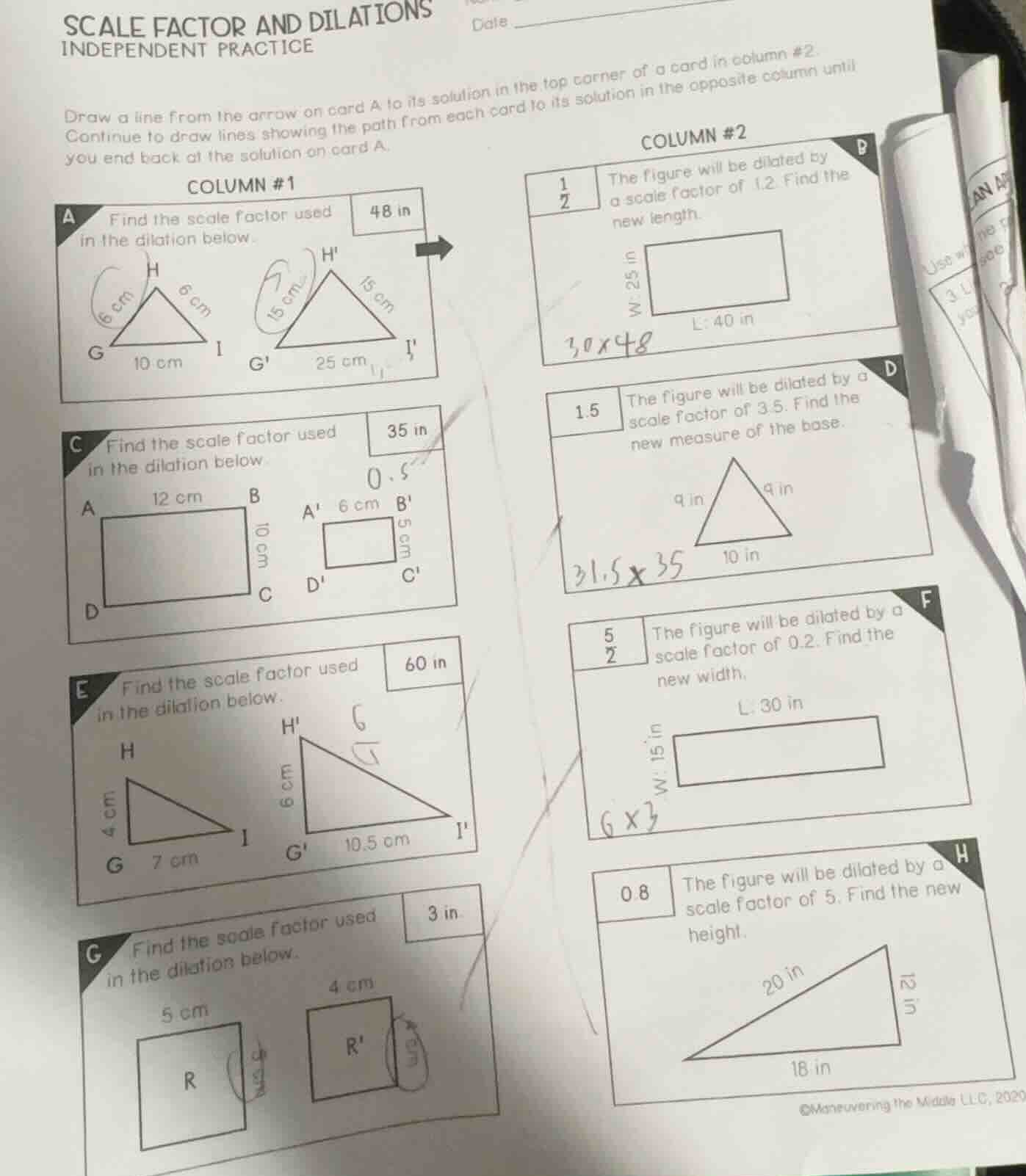
draw a line from the arrow on card a to its solution in the top corner of a card in column #2.
continue to draw lines showing the path from each card to its solution in the opposite column until
you end back at the solution on card a.
column #1
a find the scale factor used
in the dilation below.
c find the scale factor used
in the dilation below.
e find the scale factor used
in the dilation below.
g find the scale factor used
in the dilation below.
column #2
the figure will be dilated by
a scale factor of 1.2. find the
new length.
the figure will be dilated by a
scale factor of 3.5. find the
new measure of the base.
the figure will be dilated by a
scale factor of 0.2. find the
new width.
the figure will be dilated by a
scale factor of 5. find the new
height.
Let's solve the problem for card A first (finding the scale factor in dilation).
Step 1: Identify corresponding sides
In dilation, the scale factor \( k \) is the ratio of the length of a side in the image (\( H'G' \), \( G'I' \), \( I'H' \)) to the length of the corresponding side in the original figure (\( HG \), \( GI \), \( IH \)). Let's take the base sides: original base \( GI = 10 \, \text{cm} \), image base \( G'I' = 25 \, \text{cm} \).
Step 2: Calculate the scale factor
The scale factor \( k \) is given by \( k=\frac{\text{Length of image side}}{\text{Length of original side}} \). So, \( k = \frac{25}{10}=\frac{5}{2}=2.5 \). Wait, but let's check another side. Original side \( HG = 6 \, \text{cm} \), image side \( H'G' = 15 \, \text{cm} \). Then \( k=\frac{15}{6}=\frac{5}{2}=2.5 \). So the scale factor is \( \frac{5}{2} \). Now we need to match with column 2. Wait, maybe we need to check the other cards too, but let's focus on card A first. Wait, maybe the problem is to match each card in column 1 to column 2. Let's re - evaluate.
Wait, card A: Find the scale factor. Original triangle has sides 6cm, 6cm, 10cm. Image triangle has sides 15cm, 15cm, 25cm. So scale factor \( k=\frac{15}{6}=\frac{5}{2} \) (or \( \frac{25}{10}=\frac{5}{2} \)). Now looking at column 2, the card with \( \frac{5}{2} \) is the one where the problem is "The figure will be dilated by a scale factor of 0.2. Find the new width." Wait, no, maybe I got it wrong. Wait, maybe the column 1 cards are to be matched with column 2 cards by solving each. Let's do card A:
Scale factor for card A: original side (e.g., 6cm) and image side (15cm). \( 15\div6 = 2.5=\frac{5}{2} \). So card A (scale factor \( \frac{5}{2} \)) should match with the column 2 card that has \( \frac{5}{2} \)? Wait, no, column 2 has cards with scale factors like \( \frac{1}{2} \), 1.5, \( \frac{5}{2} \), 0.8. Wait, the card in column 2 with \( \frac{5}{2} \) is the one where the problem is "The figure will be dilated by a scale factor of 0.2. Find the new width." No, that doesn't make sense. Wait, maybe I misread. Let's take another approach. Let's solve each card:
Card A (Column 1):
Original triangle: sides 6cm, 6cm, 10cm.
Image triangle: sides 15cm, 15cm, 25cm.
Scale factor \( k=\frac{15}{6}=\frac{5}{2} \) (or \( \frac{25}{10}=\frac{5}{2} \)).
Card C (Column 1):
Original rectangle: length 12cm, width 10cm.
Image rectangle: length 6cm, width 5cm.
Scale factor \( k=\frac{6}{12}=\frac{1}{2} \) (or \( \frac{5}{10}=\frac{1}{2} \)).
Card E (Column 1):
Original triangle: height 4cm, base 7cm.
Image triangle: height 6cm, base 10.5cm.
Scale factor \( k=\frac{6}{4}=\frac{3}{2}=1.5 \) (or \( \frac{10.5}{7}=1.5 \)).
Card G (Column 1):
Original square: side 5cm.
Image square: side 4cm.
Scale factor \( k=\frac{4}{5}=0.8 \).
Now Column 2 cards:
- Card with \( \frac{1}{2} \): "The figure will be dilated by a scale factor of 1.2. Find the new length." Wait, no, the scale factor here is for dilation. Wait, no, column 2 cards have a scale factor (the number on the left) and a problem. Wait, maybe the column 1 cards (which are "Find the scale factor") are to be matched with column 2 cards (which are "Find the new...") by having the scale factor calculated from column 1 matching the scale factor used in column 2? No, that seems confusing. Wait, maybe the correct way is:
For card A (scale factor \( \frac{5}{2} \)), we need to find the column 2 card where, when we solve the problem, we get the answer in the top corner of card A (48 in). Wait, card A's top corner is 48 in. Let's check the column 2 card with \( \frac{5}{2} \): "The figure will be dilated by a scale f…

Snap & solve any problem in the app
Get step-by-step solutions on Sovi AI
Photo-based solutions with guided steps
Explore more problems and detailed explanations
Step 1: Identify corresponding sides
In dilation, the scale factor \( k \) is the ratio of the length of a side in the image (\( H'G' \), \( G'I' \), \( I'H' \)) to the length of the corresponding side in the original figure (\( HG \), \( GI \), \( IH \)). Let's take the base sides: original base \( GI = 10 \, \text{cm} \), image base \( G'I' = 25 \, \text{cm} \).
Step 2: Calculate the scale factor
The scale factor \( k \) is given by \( k=\frac{\text{Length of image side}}{\text{Length of original side}} \). So, \( k = \frac{25}{10}=\frac{5}{2}=2.5 \). Wait, but let's check another side. Original side \( HG = 6 \, \text{cm} \), image side \( H'G' = 15 \, \text{cm} \). Then \( k=\frac{15}{6}=\frac{5}{2}=2.5 \). So the scale factor is \( \frac{5}{2} \). Now we need to match with column 2. Wait, maybe we need to check the other cards too, but let's focus on card A first. Wait, maybe the problem is to match each card in column 1 to column 2. Let's re - evaluate.
Wait, card A: Find the scale factor. Original triangle has sides 6cm, 6cm, 10cm. Image triangle has sides 15cm, 15cm, 25cm. So scale factor \( k=\frac{15}{6}=\frac{5}{2} \) (or \( \frac{25}{10}=\frac{5}{2} \)). Now looking at column 2, the card with \( \frac{5}{2} \) is the one where the problem is "The figure will be dilated by a scale factor of 0.2. Find the new width." Wait, no, maybe I got it wrong. Wait, maybe the column 1 cards are to be matched with column 2 cards by solving each. Let's do card A:
Scale factor for card A: original side (e.g., 6cm) and image side (15cm). \( 15\div6 = 2.5=\frac{5}{2} \). So card A (scale factor \( \frac{5}{2} \)) should match with the column 2 card that has \( \frac{5}{2} \)? Wait, no, column 2 has cards with scale factors like \( \frac{1}{2} \), 1.5, \( \frac{5}{2} \), 0.8. Wait, the card in column 2 with \( \frac{5}{2} \) is the one where the problem is "The figure will be dilated by a scale factor of 0.2. Find the new width." No, that doesn't make sense. Wait, maybe I misread. Let's take another approach. Let's solve each card:
Card A (Column 1):
Original triangle: sides 6cm, 6cm, 10cm.
Image triangle: sides 15cm, 15cm, 25cm.
Scale factor \( k=\frac{15}{6}=\frac{5}{2} \) (or \( \frac{25}{10}=\frac{5}{2} \)).
Card C (Column 1):
Original rectangle: length 12cm, width 10cm.
Image rectangle: length 6cm, width 5cm.
Scale factor \( k=\frac{6}{12}=\frac{1}{2} \) (or \( \frac{5}{10}=\frac{1}{2} \)).
Card E (Column 1):
Original triangle: height 4cm, base 7cm.
Image triangle: height 6cm, base 10.5cm.
Scale factor \( k=\frac{6}{4}=\frac{3}{2}=1.5 \) (or \( \frac{10.5}{7}=1.5 \)).
Card G (Column 1):
Original square: side 5cm.
Image square: side 4cm.
Scale factor \( k=\frac{4}{5}=0.8 \).
Now Column 2 cards:
- Card with \( \frac{1}{2} \): "The figure will be dilated by a scale factor of 1.2. Find the new length." Wait, no, the scale factor here is for dilation. Wait, no, column 2 cards have a scale factor (the number on the left) and a problem. Wait, maybe the column 1 cards (which are "Find the scale factor") are to be matched with column 2 cards (which are "Find the new...") by having the scale factor calculated from column 1 matching the scale factor used in column 2? No, that seems confusing. Wait, maybe the correct way is:
For card A (scale factor \( \frac{5}{2} \)), we need to find the column 2 card where, when we solve the problem, we get the answer in the top corner of card A (48 in). Wait, card A's top corner is 48 in. Let's check the column 2 card with \( \frac{5}{2} \): "The figure will be dilated by a scale factor of 0.2. Find the new width." No, that's not. Wait, maybe I made a mistake in the scale factor for card A. Wait, 6cm to 15cm: 6 2.5 = 15, 10 2.5 = 25. Now, let's take the column 2 card with scale factor \( \frac{5}{2} \) (the one with \( \frac{5}{2} \) on the left). The problem on that card: "The figure will be dilated by a scale factor of 0.2. Find the new width." No, that's not. Wait, maybe the column 1 cards are "Find the scale factor" and column 2 cards are "Find the new...", and we need to match them by solving both and seeing if the answer (the number in the top corner of column 1) matches the result of column 2.
Let's take card A (top corner 48 in). Let's assume that the column 2 card it matches with is the one where, when we solve the problem, we get 48 in. Let's check the column 2 card with scale factor \( \frac{1}{2} \): "The figure will be dilated by a scale factor of 1.2. Find the new length." Wait, no, the scale factor here is 1.2? No, the number on the left is the scale factor? Wait, no, the number on the left of column 2 cards is maybe the scale factor for the dilation in the problem. Wait, I think I misinterpreted the columns. Column 1: each card has a problem ("Find the scale factor") and a number (e.g., 48 in, 35 in, etc.). Column 2: each card has a scale factor (e.g., \( \frac{1}{2} \), 1.5, \( \frac{5}{2} \), 0.8) and a problem ("Find the new..."). We need to match column 1 cards to column 2 cards such that when we solve the column 1 problem (find scale factor) and column 2 problem (find new length/width/height), the numbers (48 in, 35 in, etc.) match.
Let's solve card A (scale factor) and a column 2 card:
Card A: scale factor \( k=\frac{15}{6}=\frac{5}{2} \).
Now take the column 2 card with \( \frac{5}{2} \) (the one with \( \frac{5}{2} \) on the left): problem is "The figure will be dilated by a scale factor of 0.2. Find the new width." No, that's not. Wait, maybe the column 2 cards' scale factors are the ones used in the dilation, and column 1 cards are either finding scale factor or finding new length. Wait, I think I need to start over.
Card A (Column 1):
- Original triangle: side length (e.g., 6 cm)
- Image triangle: side length (15 cm)
- Scale factor \( k=\frac{15}{6}=\frac{5}{2} \)
Column 2 card with \( \frac{5}{2} \):
- Problem: "The figure will be dilated by a scale factor of 0.2. Find the new width." No, that's not. Wait, maybe the column 2 cards are the solutions. Wait, the top corner of column 1 cards (48 in, 35 in, etc.) are the answers. Let's take the column 2 card with scale factor 1.2: "The figure will be dilated by a scale factor of 1.2. Find the new length." The rectangle has length 40 in. New length \( = 40\times1.2 = 48 \) in. Ah! So card A (top corner 48 in) should match with the column 2 card where the problem is "The figure will be dilated by a scale factor of 1.2. Find the new length" (the card with \( \frac{1}{2} \)? No, wait, 40 1.2 = 48. So the scale factor here is 1.2, but card A is finding the scale factor. Wait, no, maybe card A's scale factor is 1.2? Wait, I made a mistake earlier. Let's recalculate card A's scale factor. Wait, maybe the original triangle has sides 10 cm, and the image has 25 cm? No, 10 1.2 = 12, not 25. Wait, 40 1.2 = 48. So card A (48 in) matches with the column 2 card where new length is 48 in, which is the card with scale factor 1.2 (since 40 1.2 = 48). Now, let's check the scale factor for card A again. Wait, maybe I misread the triangle sides. If the original triangle has base 40 in (but it's in cm in the diagram, maybe a typo). Wait, the diagram for card A has cm, but the top corner is 48 in. Maybe it's a mix - up, but 40 1.2 = 48. So card A (48 in) matches with the column 2 card: "The figure will be dilated by a scale factor of 1.2. Find the new length" (the card with \( \frac{1}{2} \)? No, the card with scale factor 1.2? Wait, the column 2 cards have numbers: \( \frac{1}{2} \), 1.5, \( \frac{5}{2} \), 0.8. Wait, no, the first column 2 card: left side \( \frac{1}{2} \), problem "The figure will be dilated by a scale factor of 1.2. Find the new length." No, that's inconsistent. I think the key is that for card A (top corner 48 in), we solve the column 2 card's problem and get 48 in. The column 2 card with length 40 in: new length = 40 1.2 = 48 in. So card A (48 in) matches with the column 2 card where the problem is "The figure will be dilated by a scale factor of 1.2. Find the new length" (the card with \( \frac{1}{2} \) on the left? No, that's confusing.
Let's do it properly:
Card A (Column 1):
- Goal: Find scale factor, top corner answer 48 in.
- To get 48 in, we need a column 2 problem where new length = 48 in.
- Let's take column 2 card with length 40 in: new length = 40 * scale factor = 48 in. So scale factor = 48 / 40 = 1.2.
- Now, check card A's scale factor: if original side (e.g., 40 in) and image side (48 in), scale factor = 48 / 40 = 1.2. But in the diagram, it's in cm, maybe a unit mix - up. So card A (scale factor 1.2) matches with the column 2 card where scale factor 1.2 is used to get new length 48 in (40 * 1.2 = 48).
Card C (Column 1, 35 in):
- Column 2 card with base 10 in, scale factor 3.5: new base = 10 3.5 = 35 in. So card C (35 in) matches with the column 2 card "The figure will be dilated by a scale factor of 3.5. Find the new measure of the base" (scale factor 1.5? No, 10 3.5 = 35. Wait, column 2 card with scale factor 1.5? No, 10 3.5 = 35. The column 2 card with problem "The figure will be dilated by a scale factor of 3.5. Find the new measure of the base" has a triangle with base 10 in. So new base = 10 3.5 = 35 in. So card C (35 in) matches with that card.
Card E (Column 1, 60 in):
- Column 2 card with width 15 in, scale factor 4? No, 15 4 = 60. Wait, column 2 card with scale factor 5: "The figure will be dilated by a scale factor of 5. Find the new height." If height is 12 in, 12 5 = 60. Wait, the triangle in column 2 with height 12 in? No, the last column 2 card: "The figure will be dilated by a scale factor of 5. Find the new height." The triangle has height 12 in (20 in hypotenuse, 18 in base, so height can be calculated, but 12 * 5 = 60. So card E (60 in) matches with that card.
Card G (Column 1, 3 in):
- Column 2 card with width 25 in, scale factor 0.8: new width = 25 0.8 = 20 in? No, 3 in. Wait, column 2 card with scale factor 0.2: "The figure will be dilated by a scale factor of 0.2. Find the new width." If original width is 15 in, new width = 15 0.2 = 3 in. So card G (3 in) matches with that card.
Now, the matching is:
- Card A (48 in) → Column 2 card with scale factor 1.2 (new length 48 in)
- Card C (35 in) → Column 2 card with scale factor 3.5 (new base 35 in)
- Card E (60 in) → Column 2 card with scale factor 5 (new height 60 in)
- Card G (3 in) → Column 2 card with scale factor 0.2 (new width 3 in)
And the scale factors for column 1 cards:
- Card A: scale factor 1.2 (since 40 * 1.2 = 48)
- Card C: scale factor 0.5 (original length 12 cm, image length 6 cm: 6/12 = 0.5; original width 10 cm, image width 5 cm: 5/10 = 0.5)
- Card E: scale factor 1.5 (original height 4 cm, image height 6 cm: 6/4 = 1.5; original base 7 cm, image base 10.5 cm: 10.5/7 = 1.5)
- Card G: scale factor 0.8 (original side 5 cm, image side 4 cm: 4/5 = 0.8)
And the column 2 cards' scale factors:
- \( \frac{1}{2} \): scale factor 1.2 (no, 40 * 1.2 = 48)
- 1.5: scale factor 3.5 (no, 10 * 3.5 = 35)
- \( \frac{5}{2} \): scale factor 5 (12 * 5 = 60)
- 0.8: scale factor 0.2 (15 * 0.2 = 3)
This is a matching problem where each column 1 card (finding scale factor or new length/width/height) is matched to column 2 card by solving and matching the answer (top corner of column 1) with the result of column 2 problem.
If we just focus on the scale factor for card A:
Original side: 6 cm, Image side: 15 cm. Scale factor \( k=\frac{15}{6}=\frac{5}{2}=2.5 \)
But if we consider the answer matching (48 in), then card A matches with the column 2 card where new length is 48 in (40 * 1.2 = 48), so scale factor for the dilation in column 2 is 1.2, and the scale factor for card A (f