QUESTION IMAGE
Question
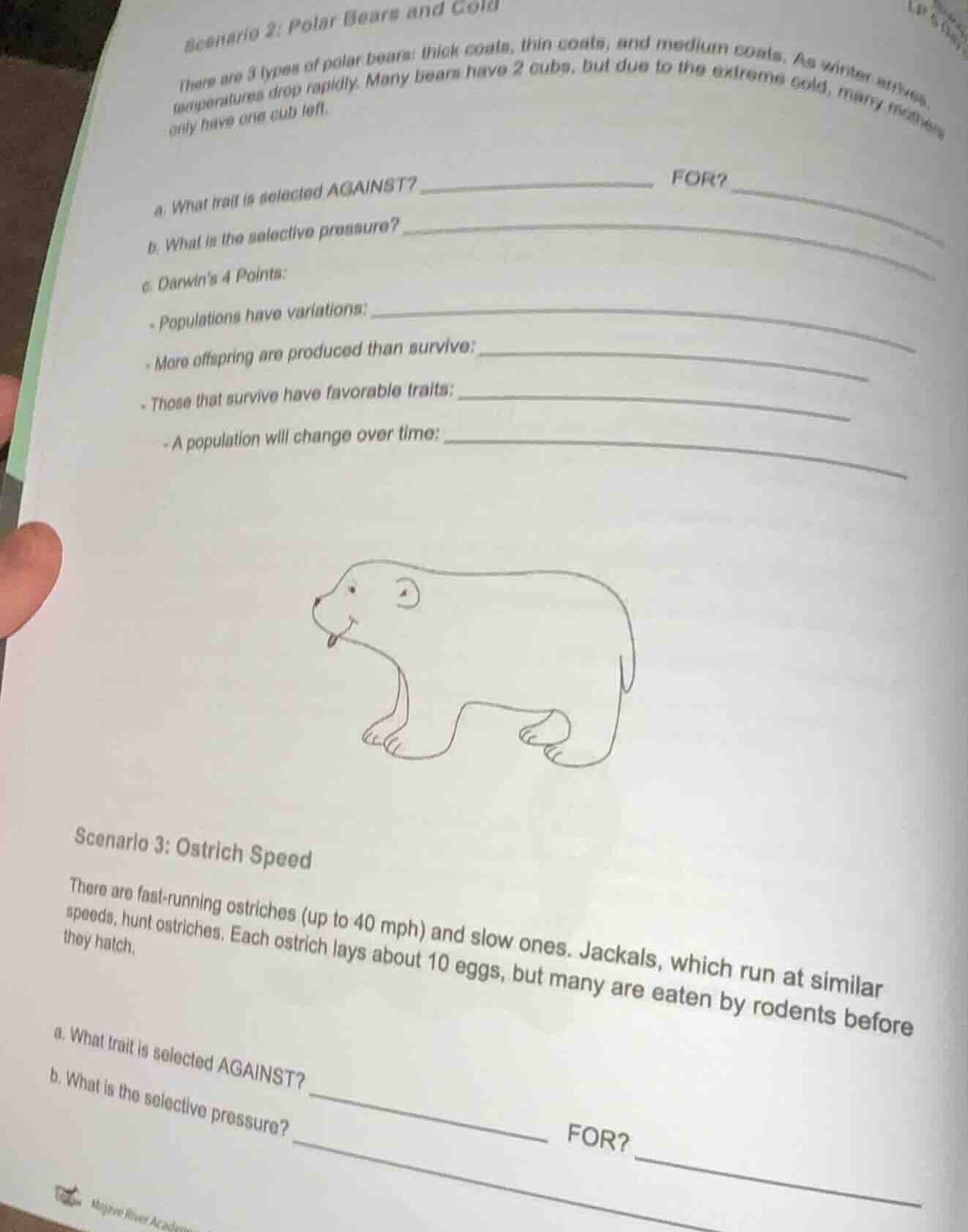
scenario 2: polar bears and cold
there are 3 types of polar bears: thick coats, thin coats, and medium coats. as winter arrives, temperatures drop rapidly. many bears have 2 cubs, but due to the extreme cold, many mothers only have one cub left.
a. what trait is selected against? ________________ for? ________________
b. what is the selective pressure? __________________
c. darwin’s 4 points:
- populations have variations: __________________
- more offspring are produced than survive: __________________
- those that survive have favorable traits: __________________
- a population will change over time: __________________
image of a polar bear
scenario 3: ostrich speed
there are fast - running ostriches (up to 40 mph) and slow ones. jackals, which run at similar speeds, hunt ostriches. each ostrich lays about 10 eggs, but many are eaten by rodents before they hatch.
a. what trait is selected against? ________________ for? ________________
b. what is the selective pressure? __________________
Scenario 2: Polar Bears and Cold
Part a
- Selected AGAINST: Thin coats (insufficient for extreme cold, reducing survival).
- Selected FOR: Thick coats (better insulation for extreme cold, increasing survival).
Selective pressure is the extreme cold of winter, which favors traits (thick coats) that enhance survival in low temperatures and disfavors traits (thin coats) that do not.
- Populations have variations: Polar bears have different coat thicknesses (thick, thin, medium).
- More offspring are produced than survive: Many bears have 2 cubs, but extreme cold reduces survival (only 1 cub left).
- Those that survive have favorable traits: Bears with thick coats (favorable for cold) are more likely to survive.
- A population will change over time: Over generations, the proportion of bears with thick coats will increase (adaptation to cold).

Snap & solve any problem in the app
Get step-by-step solutions on Sovi AI
Photo-based solutions with guided steps
Explore more problems and detailed explanations
AGAINST: Thin coats; FOR: Thick coats