QUESTION IMAGE
Question
science - biology n11 day 5
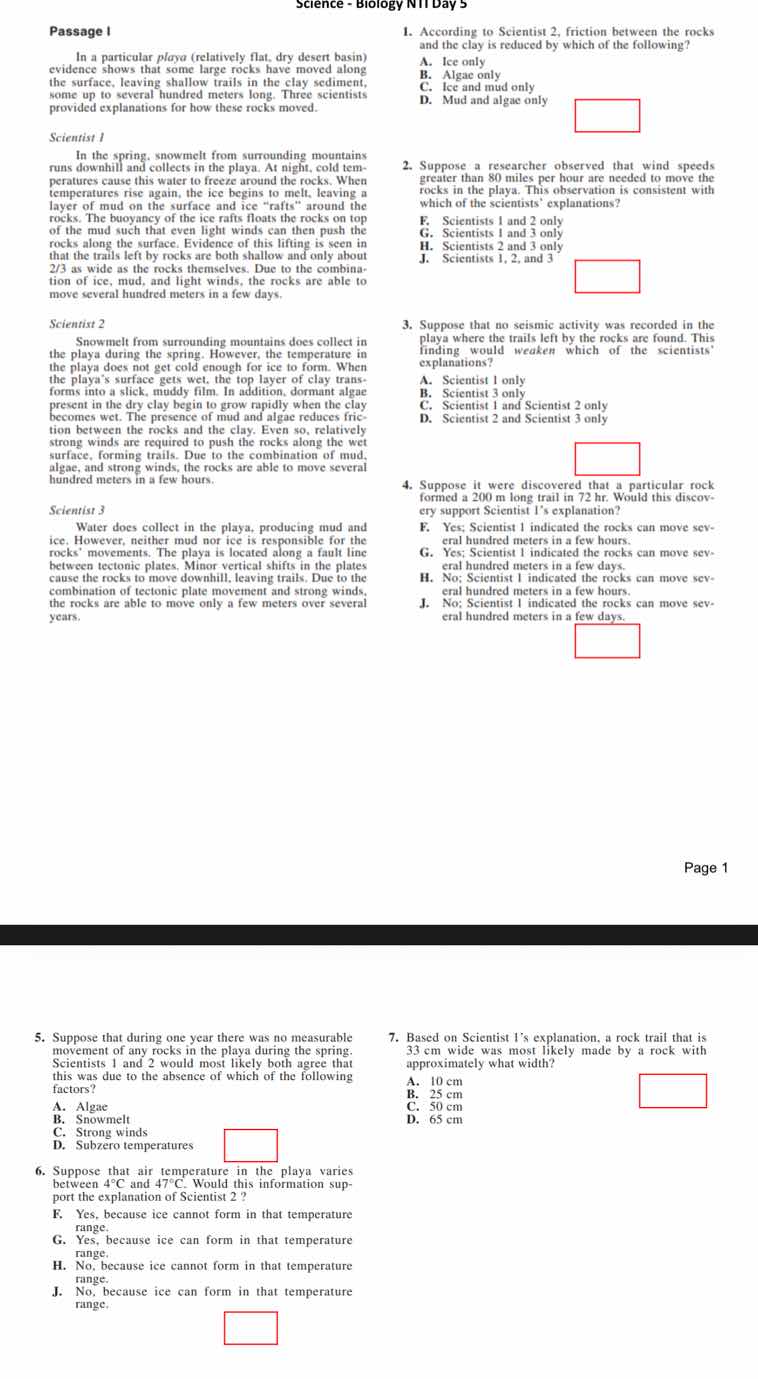
passage 1
in a particular playa (relatively flat, dry desert basin) evidence shows that some large rocks have moved along the surface, leaving shallow trails in the clay sediment, some up to several hundred meters long. three scientists provided explanations for how these rocks moved.
scientist 1
in the spring, snowmelt from surrounding mountains runs downhill and collects in the playa. at night, cold temperatures cause this water to freeze around the rocks. when a layer of mud on the surface and ice
afts\ around the rocks. the buoyancy of the ice rafts floats the rocks on top of the mud such that even light winds can then push the rocks along the surface. evidence of this lifting is seen in that the trails left by the rocks are both shallow and only about 2/3 as wide as the rocks themselves. due to the combination of ice, mud, and light winds, the rocks are able to move several hundred meters in a few days.
scientist 2
snowmelt from surrounding mountains does collect in the playa during the spring. however, the temperature in the playa does not get cold enough for ice to form. when the wet mud dries, the clay particles in the mud form a slick, muddy film. in addition, dormant algae present in the dry clay begin to grow rapidly when the clay becomes wet. the presence of mud and algae reduces friction between the rocks and the clay. even so, relatively strong winds are required to push the rocks along the wet surface, forming trails. due to the combination of mud, algae, and strong winds, the rocks are able to move several hundred meters in a few hours.
scientist 3
water does collect in the playa, producing mud and ice. however, neither mud nor ice is responsible for the rocks’ movements. the playa is located along a fault line between tectonic plates. minor vertical shifts in the plates cause the rocks to move downhill, leaving trails. due to the combination of tectonic plate movement and strong winds, the rocks are able to move only a few meters over several years.
- according to scientist 2, friction between the rocks and the clay is reduced by which of the following?
a. ice only
b. algae only
c. ice and mud only
d. mud and algae only
- suppose a researcher observed that wind speeds greater than 80 miles per hour are needed to move the rocks in the playa. this observation is consistent with which of the scientists’ explanations?
f. scientists 1 and 2 only
g. scientists 1 and 3 only
h. scientists 2 and 3 only
j. scientists 1, 2, and 3
- suppose that no seismic activity was recorded in the playa where the trails left by the rocks are found. this finding is inconsistent with which of the scientists’ explanations?
a. scientist 1 only
b. scientist 3 only
c. scientist 1 and scientist 2 only
d. scientist 2 and scientist 3 only
- suppose it were discovered that a particular rock formed a 200 m long trail in 72 hr. would this discovery support scientist 1’s explanation?
f. yes; scientist 1 indicated the rocks can move several hundred meters in a few days.
g. yes; scientist 1 indicated the rocks can move several hundred meters in a few hours.
h. no; scientist 1 indicated the rocks can move several hundred meters in a few hours.
j. no; scientist 1 indicated the rocks can move several hundred meters in a few days.
- suppose that during one year there was no measurable movement of any rocks in the playa during the spring. scientists 1 and 2 would most likely both agree that this was due to the absence of which of the following factors?
a. algae
b. snowmelt
c. strong winds
d. subzero temperatures
- suppose that air temperature in the playa varies between 4 °c and 47 °c. would this information support the explanation of scientist 2?
f. yes, because ice cannot form in that temperature range.
g. yes, because ice can form in that temperature range.
h. no, because ice cannot form in that temperature range.
j. no, because ice can form in that temperature range.
- based on scientist 1’s explanation, a rock trail that is 33 cm wide was most likely made by a rock with approximately what width?
a. 10 cm
b. 25 cm
c. 50 cm
d. 65 cm
Step1: Analyze Scientist 2's claim
Scientist 2 states that when the playa's surface gets wet, dormant algae grow rapidly, reducing friction between rocks and clay.
Step2: Match to question option
The only factor listed that reduces friction per Scientist 2 is algae.
Step1: Check each scientist's wind requirement
- Scientist 1: Light winds move rocks.
- Scientist 2: Relatively strong winds move rocks.
- Scientist 3: Strong winds + tectonic movement move rocks.
Step2: Evaluate 80+ mph wind fit
80+ mph is strong wind, consistent with all three scientists' explanations (light winds are a subset of possible winds, strong winds satisfy Scientist 1's low threshold, and meet 2 and 3's requirements).
Step1: Identify seismic-reliant scientist
Only Scientist 3 claims tectonic plate movement (seismic activity) causes rock movement.
Step2: Evaluate weakening effect
No seismic activity directly contradicts Scientist 3's mechanism, but does not affect Scientists 1 or 2.
Step1: Check Scientist 1's timeline
Scientist 1 states rocks move hundreds of meters in a few days.
Step2: Compare to discovery
200 meters in 72 hours (3 days) matches Scientist 1's timeline, so it supports the explanation.

Snap & solve any problem in the app
Get step-by-step solutions on Sovi AI
Photo-based solutions with guided steps
Explore more problems and detailed explanations
- B. Algae only
---