QUESTION IMAGE
Question
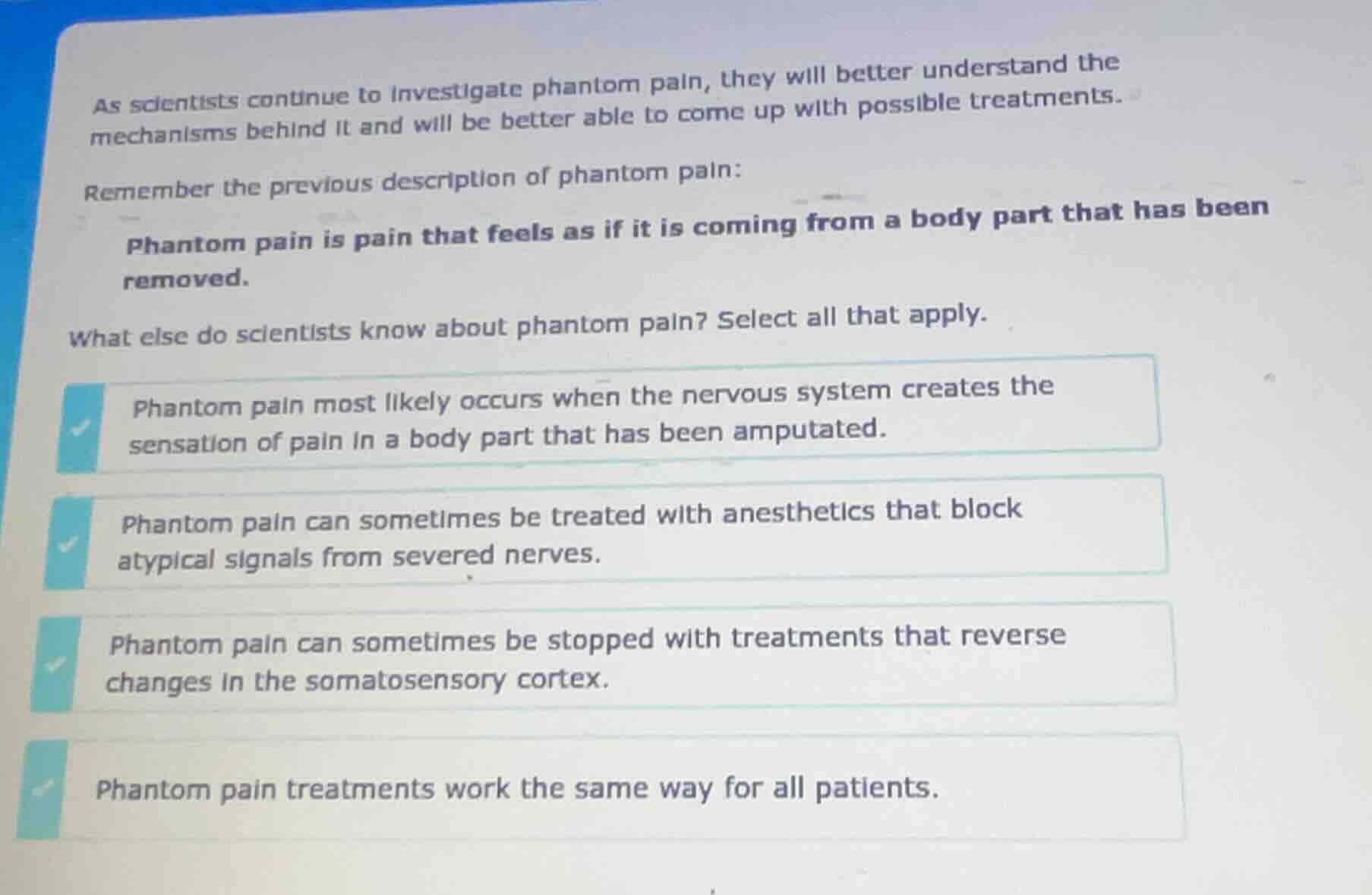
as scientists continue to investigate phantom pain, they will better understand the mechanisms behind it and will be better able to come up with possible treatments.
remember the previous description of phantom pain:
phantom pain is pain that feels as if it is coming from a body part that has been removed.
what else do scientists know about phantom pain? select all that apply.
phantom pain most likely occurs when the nervous system creates the sensation of pain in a body part that has been amputated.
phantom pain can sometimes be treated with anesthetics that block atypical signals from severed nerves.
phantom pain can sometimes be stopped with treatments that reverse changes in the somatosensory cortex.
phantom pain treatments work the same way for all patients.
- Phantom pain arises from the nervous system generating pain signals for an amputated body part, matching the first statement.
- Anesthetics that block abnormal signals from severed nerves are a documented treatment for phantom pain, supporting the second statement.
- Neuroplastic changes in the somatosensory cortex are linked to phantom pain, so treatments reversing these changes can alleviate it, validating the third statement.
- Patient physiology and pain causes vary, so treatments do not work identically for everyone, making the fourth statement false.

Snap & solve any problem in the app
Get step-by-step solutions on Sovi AI
Photo-based solutions with guided steps
Explore more problems and detailed explanations
- Phantom pain most likely occurs when the nervous system creates the sensation of pain in a body part that has been amputated.
- Phantom pain can sometimes be treated with anesthetics that block atypical signals from severed nerves.
- Phantom pain can sometimes be stopped with treatments that reverse changes in the somatosensory cortex.