QUESTION IMAGE
Question
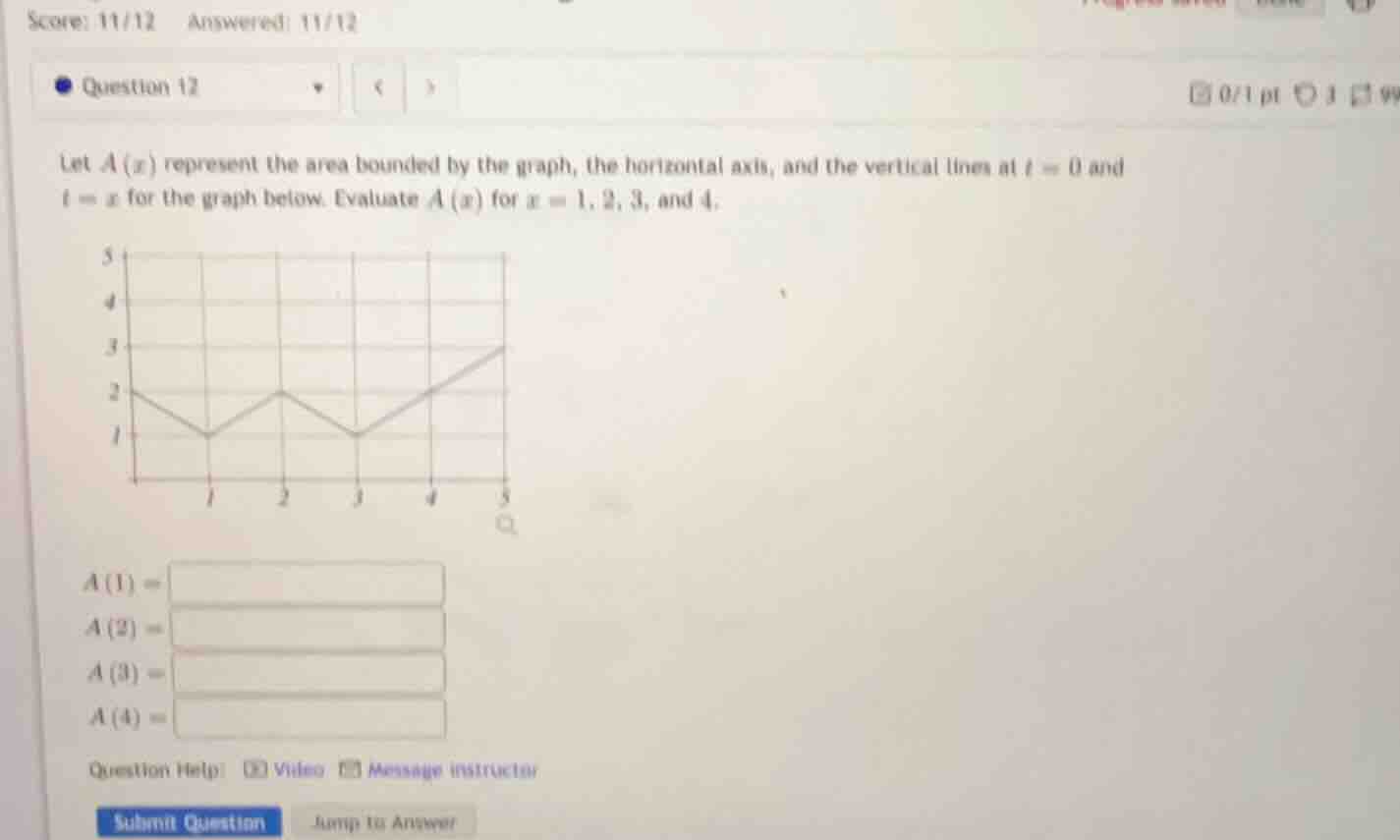
score: 11/12 answered: 11/12 question 12 0/1 pt let ( a(x) ) represent the area bounded by the graph, the horizontal axis, and the vertical lines at ( t = 0 ) and ( t = x ) for the graph below. evaluate ( a(x) ) for ( x = 1, 2, 3, ) and ( 4 ). graph with axes from 0 to 5, showing a piecewise linear graph with points (0,2), (1,1), (2,2), (3,1), (4,2), (5,3) ( a(1) = ) ( a(2) = ) ( a(3) = ) ( a(4) = ) question help: video message instructor submit question jump to answer
Step1: Evaluate \( A(1) \)
The graph from \( t = 0 \) to \( t = 1 \) forms a trapezoid (or a triangle and a rectangle, but easier as a trapezoid) with bases \( 2 \) and \( 1 \), and height \( 1 \). The area of a trapezoid is \( \frac{(b_1 + b_2)h}{2} \). So \( A(1)=\frac{(2 + 1)\times1}{2}=\frac{3}{2}=1.5 \).
Step2: Evaluate \( A(2) \)
From \( t = 0 \) to \( t = 2 \), we can split it into two trapezoids (from \( 0 - 1 \) and \( 1 - 2 \)). The first trapezoid (0 - 1) has area \( 1.5 \), the second trapezoid (1 - 2) has bases \( 1 \) and \( 2 \), height \( 1 \). Area of second trapezoid: \( \frac{(1 + 2)\times1}{2}=1.5 \). So total \( A(2)=1.5 + 1.5 = 3 \).
Step3: Evaluate \( A(3) \)
From \( t = 0 \) to \( t = 3 \), we add the area from \( 2 - 3 \) to \( A(2) \). The trapezoid from \( 2 - 3 \) has bases \( 2 \) and \( 1 \), height \( 1 \). Area: \( \frac{(2 + 1)\times1}{2}=1.5 \). So \( A(3)=3 + 1.5 = 4.5 \).
Step4: Evaluate \( A(4) \)
From \( t = 0 \) to \( t = 4 \), add the area from \( 3 - 4 \) to \( A(3) \). The trapezoid from \( 3 - 4 \) has bases \( 1 \) and \( 2 \), height \( 1 \). Area: \( \frac{(1 + 2)\times1}{2}=1.5 \). So \( A(4)=4.5 + 1.5 = 6 \).

Snap & solve any problem in the app
Get step-by-step solutions on Sovi AI
Photo-based solutions with guided steps
Explore more problems and detailed explanations
\( A(1)=\frac{3}{2} \) (or \( 1.5 \)), \( A(2)=3 \), \( A(3)=\frac{9}{2} \) (or \( 4.5 \)), \( A(4)=6 \)