QUESTION IMAGE
Question
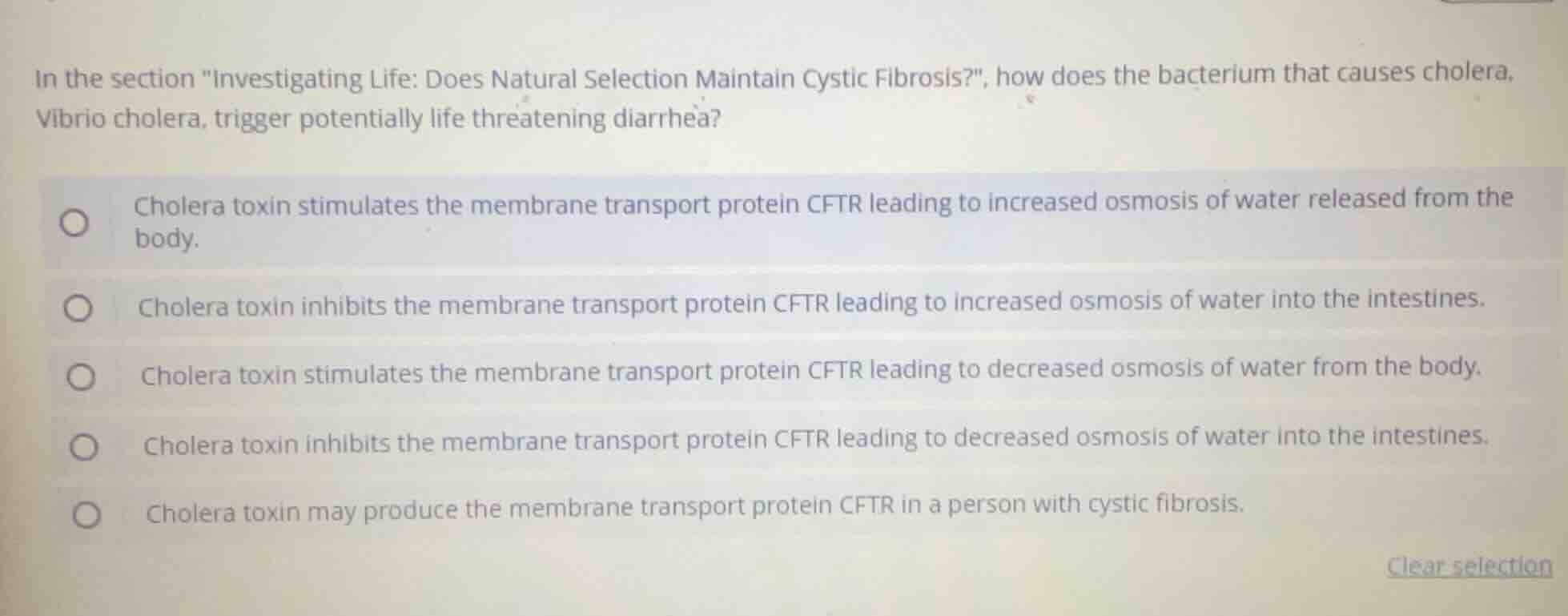
in the section \investigating life: does natural selection maintain cystic fibrosis?\, how does the bacterium that causes cholera, vibrio cholera, trigger potentially life threatening diarrhea?
cholera toxin stimulates the membrane transport protein cftr leading to increased osmosis of water released from the body.
cholera toxin inhibits the membrane transport protein cftr leading to increased osmosis of water into the intestines.
cholera toxin stimulates the membrane transport protein cftr leading to decreased osmosis of water from the body.
cholera toxin inhibits the membrane transport protein cftr leading to decreased osmosis of water into the intestines.
cholera toxin may produce the membrane transport protein cftr in a person with cystic fibrosis.
To solve this, we recall how Vibrio cholerae causes diarrhea. Cholera toxin stimulates the CFTR (a membrane transport protein). When CFTR is stimulated, it leads to increased chloride ion secretion, which increases the osmotic pressure in the intestines. This causes water to osmotically flow into the intestines (and then be released from the body as diarrhea). Let's analyze each option:
- Option 1: Says cholera toxin stimulates CFTR leading to increased osmosis of water released from the body. This matches the mechanism (stimulation of CFTR leads to more water in intestines, hence released as diarrhea).
- Option 2: Inhibiting CFTR would not lead to increased water in intestines; stimulation is correct, so this is wrong.
- Option 3: Decreased osmosis of water from the body is opposite; it should be increased, so wrong.
- Option 4: Inhibiting CFTR and decreased water into intestines is wrong as the mechanism is stimulation and increased water.
- Option 5: Cholera toxin doesn't produce CFTR; CFTR is a human protein, so this is wrong.

Snap & solve any problem in the app
Get step-by-step solutions on Sovi AI
Photo-based solutions with guided steps
Explore more problems and detailed explanations
A. Cholera toxin stimulates the membrane transport protein CFTR leading to increased osmosis of water released from the body.