QUESTION IMAGE
Question
section 3 (pages 504 - 509)
date
the new deal affects
many groups
before you read
in the last section, you read about the second new deal.
in this section, you will learn about some of the effects of
the new deal.
as you read
use the chart below to take notes on how the new deal
affected the groups listed in the chart.
terms and names
frances perkins secretary of labor
mary mcleod bethune head of the
office of minority affairs in the nya
john collier commissioner on
indian affairs
new deal coalition voters from dif-
ferent groups that supported the
democratic party because of the
new deal
congress of industrial organizations
(cio) labor union
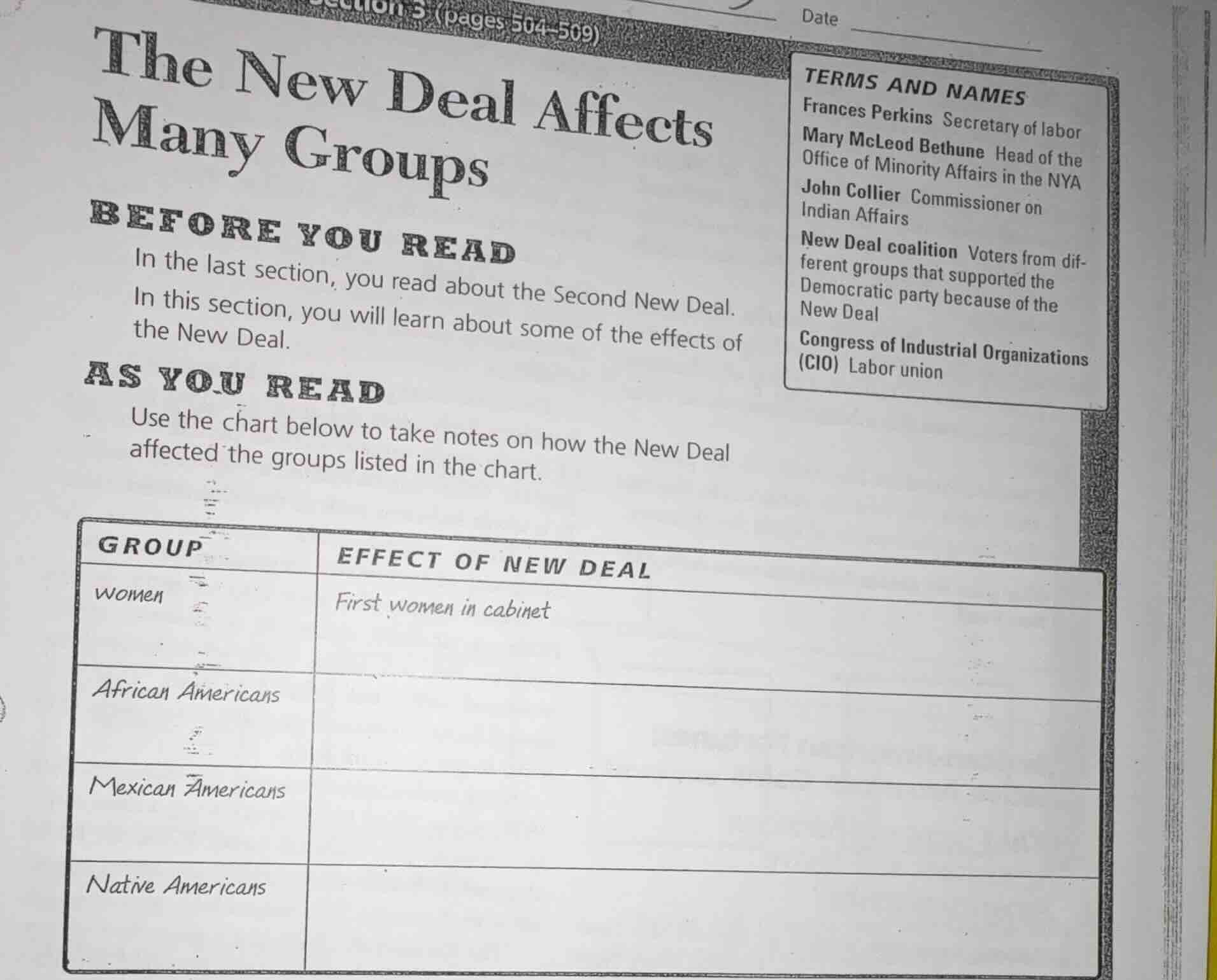
group effect of new deal
women first women in cabinet
african americans
mexican americans
native americans
To answer how the New Deal affected African Americans, Mexican Americans, and Native Americans, we use historical knowledge of the New Deal's impact:
For African Americans:
Mary McLeod Bethune headed the Office of Minority Affairs in the NYA, and the New Deal opened some job opportunities and increased political representation, though discrimination still existed. A key effect is Increased political representation (e.g., Mary McLeod Bethune’s role) and some economic relief programs.
For Mexican Americans:
Many Mexican Americans worked in agriculture and received limited relief; some New Deal programs (like the CCC) included them, but discrimination persisted. A key effect is Limited relief through programs, but faced discrimination in implementation.
For Native Americans:
John Collier (Commissioner of Indian Affairs) pushed for the Indian Reorganization Act (1934), ending forced assimilation, restoring tribal self - government, and returning land to tribes. A key effect is Indian Reorganization Act (1934) restored tribal self - government and land rights.
Filled Chart:
| GROUP | EFFECT OF NEW DEAL |
|---|---|
| African Americans | Increased political representation (e.g., Mary McLeod Bethune’s role), some economic relief |
| Mexican Americans | Limited relief through programs; faced discrimination in implementation |
| Native Americans | Indian Reorganization Act (1934) restored tribal self - government and land rights |

Snap & solve any problem in the app
Get step-by-step solutions on Sovi AI
Photo-based solutions with guided steps
Explore more problems and detailed explanations
To answer how the New Deal affected African Americans, Mexican Americans, and Native Americans, we use historical knowledge of the New Deal's impact:
For African Americans:
Mary McLeod Bethune headed the Office of Minority Affairs in the NYA, and the New Deal opened some job opportunities and increased political representation, though discrimination still existed. A key effect is Increased political representation (e.g., Mary McLeod Bethune’s role) and some economic relief programs.
For Mexican Americans:
Many Mexican Americans worked in agriculture and received limited relief; some New Deal programs (like the CCC) included them, but discrimination persisted. A key effect is Limited relief through programs, but faced discrimination in implementation.
For Native Americans:
John Collier (Commissioner of Indian Affairs) pushed for the Indian Reorganization Act (1934), ending forced assimilation, restoring tribal self - government, and returning land to tribes. A key effect is Indian Reorganization Act (1934) restored tribal self - government and land rights.
Filled Chart:
| GROUP | EFFECT OF NEW DEAL |
|---|---|
| African Americans | Increased political representation (e.g., Mary McLeod Bethune’s role), some economic relief |
| Mexican Americans | Limited relief through programs; faced discrimination in implementation |
| Native Americans | Indian Reorganization Act (1934) restored tribal self - government and land rights |