QUESTION IMAGE
Question
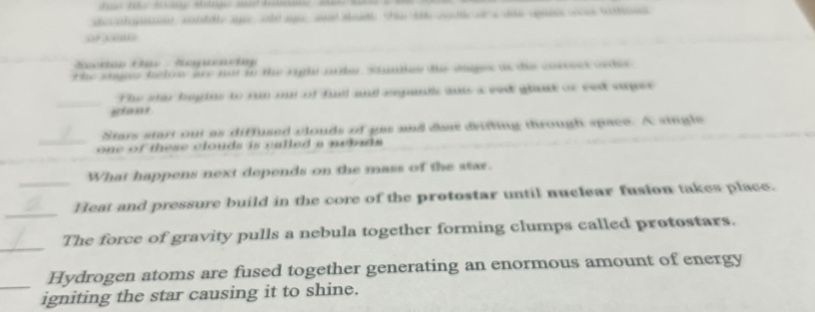
section has: sequencing
the steps below are not in the right order. sluntles the stages in the correct order
____ the star begins to run out of fuel and expands into a red giant or red super giant
____ stars start out as diffused clouds of gas and dust drifting through space. a single one of these clouds is called a nebula
____ what happens next depends on the mass of the star.
____ heat and pressure build in the core of the protostar until nuclear fusion takes place.
____ the force of gravity pulls a nebula together forming clumps called protostars.
____ hydrogen atoms are fused together generating an enormous amount of energy igniting the star causing it to shine.
To solve this, we analyze the stages of stellar evolution:
- Identify the first stage: Stars begin as diffused gas clouds (nebulae). So "Stars start out as diffused clouds of gas... (nebula)" is step 1.
- Next, gravity forms protostars: Gravity pulls the nebula into protostars. So "The force of gravity pulls a nebula... protostars" is step 2.
- Heat/pressure build in protostar: Pressure/heat build in the protostar’s core. So "Heat and pressure build in the core... fusion" is step 3.
- Nuclear fusion ignites the star: Hydrogen fuses, releasing energy (star shines). So "Hydrogen atoms are fused... shine" is step 4.
- Final stage (star runs out of fuel): The star expands into a red giant. So "The star begins to run out of fuel... red giant" is step 5.
- Intermediate “mass - dependent” step: "What happens next depends on the mass of the star" comes after fusion (step 4) and before the red giant (step 5), so it is step 5? Wait, no—re - ordering:
Wait, correct sequence:
- Nebula (diffused gas) → 2. Protostar (gravity pulls nebula) → 3. Heat/pressure build (protostar) → 4. Nuclear fusion (star shines) → 5. "What happens next depends on mass" (after fusion, before end - stage) → 6. Red giant (star runs out of fuel). Wait, the original list has 6 statements? Wait, the user’s list:
Statements:
- The star begins to run out of fuel... red giant
- Stars start out as diffused clouds... nebula
- What happens next depends on the mass of the star
- Heat and pressure build... fusion
- The force of gravity pulls... protostars
- Hydrogen atoms are fused... shine
Correct order (stellar evolution):
- 2 (nebula) → 5 (protostar) → 4 (heat/pressure) → 6 (fusion/shine) → 3 (mass - dependent) → 1 (red giant)
Wait, no—let's re - check:
Stellar evolution steps:
- Nebula (stage 1: 2)
- Protostar (stage 2: 5)
- Protostar → pre - main sequence (heat/pressure: 4)
- Main sequence (fusion: 6)
- After main sequence (mass - dependent: 3)
- Red giant (fuel runs out: 1)
So numbering:
- 2: 1st
- 5: 2nd
- 4: 3rd
- 6: 4th
- 3: 5th
- 1: 6th
Wait, the user’s list has 6 blanks? Let's count the lines: the user’s list has 6 statements. So:
- Stars start out as diffused clouds... (nebula) → position 2
- The force of gravity pulls... protostars → position 5
- Heat and pressure build... fusion → position 4
- Hydrogen atoms are fused... shine → position 6
- What happens next depends on mass → position 3
- The star begins to run out... red giant → position 1
Wait, no—let's list in order:
- Step 1: Stars form from nebulae (statement 2: "Stars start out as diffused clouds of gas and dust drifting through space. A single one of these clouds is called a nebula")
- Step 2: Gravity forms protostars (statement 5: "The force of gravity pulls a nebula together forming clumps called protostars")
- Step 3: Heat and pressure build in protostar (statement 4: "Heat and pressure build in the core of the protostar until nuclear fusion takes place")
- Step 4: Nuclear fusion (statement 6: "Hydrogen atoms are fused together generating an enormous amount of energy igniting the star causing it to shine")
- Step 5: Mass - dependent path (statement 3: "What happens next depends on the mass of the star")
- Step 6: Star runs out of fuel (statement 1: "The star begins to run out of fuel and expands into a red giant or red super giant")
So the order (blank numbers, left to right) is:
Blank 1: 6 (red giant)
Blank 2: 1 (nebula)
Blank 3: 5 (mass - dependent)
Blank 4: 3 (heat/pressure)
Blank 5: 2 (protostar)
Blank 6: 4 (fusi…

Snap & solve any problem in the app
Get step-by-step solutions on Sovi AI
Photo-based solutions with guided steps
Explore more problems and detailed explanations
To solve this, we analyze the stages of stellar evolution:
- Identify the first stage: Stars begin as diffused gas clouds (nebulae). So "Stars start out as diffused clouds of gas... (nebula)" is step 1.
- Next, gravity forms protostars: Gravity pulls the nebula into protostars. So "The force of gravity pulls a nebula... protostars" is step 2.
- Heat/pressure build in protostar: Pressure/heat build in the protostar’s core. So "Heat and pressure build in the core... fusion" is step 3.
- Nuclear fusion ignites the star: Hydrogen fuses, releasing energy (star shines). So "Hydrogen atoms are fused... shine" is step 4.
- Final stage (star runs out of fuel): The star expands into a red giant. So "The star begins to run out of fuel... red giant" is step 5.
- Intermediate “mass - dependent” step: "What happens next depends on the mass of the star" comes after fusion (step 4) and before the red giant (step 5), so it is step 5? Wait, no—re - ordering:
Wait, correct sequence:
- Nebula (diffused gas) → 2. Protostar (gravity pulls nebula) → 3. Heat/pressure build (protostar) → 4. Nuclear fusion (star shines) → 5. "What happens next depends on mass" (after fusion, before end - stage) → 6. Red giant (star runs out of fuel). Wait, the original list has 6 statements? Wait, the user’s list:
Statements:
- The star begins to run out of fuel... red giant
- Stars start out as diffused clouds... nebula
- What happens next depends on the mass of the star
- Heat and pressure build... fusion
- The force of gravity pulls... protostars
- Hydrogen atoms are fused... shine
Correct order (stellar evolution):
- 2 (nebula) → 5 (protostar) → 4 (heat/pressure) → 6 (fusion/shine) → 3 (mass - dependent) → 1 (red giant)
Wait, no—let's re - check:
Stellar evolution steps:
- Nebula (stage 1: 2)
- Protostar (stage 2: 5)
- Protostar → pre - main sequence (heat/pressure: 4)
- Main sequence (fusion: 6)
- After main sequence (mass - dependent: 3)
- Red giant (fuel runs out: 1)
So numbering:
- 2: 1st
- 5: 2nd
- 4: 3rd
- 6: 4th
- 3: 5th
- 1: 6th
Wait, the user’s list has 6 blanks? Let's count the lines: the user’s list has 6 statements. So:
- Stars start out as diffused clouds... (nebula) → position 2
- The force of gravity pulls... protostars → position 5
- Heat and pressure build... fusion → position 4
- Hydrogen atoms are fused... shine → position 6
- What happens next depends on mass → position 3
- The star begins to run out... red giant → position 1
Wait, no—let's list in order:
- Step 1: Stars form from nebulae (statement 2: "Stars start out as diffused clouds of gas and dust drifting through space. A single one of these clouds is called a nebula")
- Step 2: Gravity forms protostars (statement 5: "The force of gravity pulls a nebula together forming clumps called protostars")
- Step 3: Heat and pressure build in protostar (statement 4: "Heat and pressure build in the core of the protostar until nuclear fusion takes place")
- Step 4: Nuclear fusion (statement 6: "Hydrogen atoms are fused together generating an enormous amount of energy igniting the star causing it to shine")
- Step 5: Mass - dependent path (statement 3: "What happens next depends on the mass of the star")
- Step 6: Star runs out of fuel (statement 1: "The star begins to run out of fuel and expands into a red giant or red super giant")
So the order (blank numbers, left to right) is:
Blank 1: 6 (red giant)
Blank 2: 1 (nebula)
Blank 3: 5 (mass - dependent)
Blank 4: 3 (heat/pressure)
Blank 5: 2 (protostar)
Blank 6: 4 (fusion/shine)
Wait, no—if we number the blanks as 1 to 6 (from top to bottom in the user’s image):
Blank 1 (top): 6 (red giant)
Blank 2: 1 (nebula)
Blank 3: 5 (mass - dependent)
Blank 4: 3 (heat/pressure)
Blank 5: 2 (protostar)
Blank 6: 4 (fusion/shine)
Wait, let's re - express the correct sequence of events:
- Nebula (statement 2) → blank 2
- Protostar (statement 5) → blank 5
- Heat/pressure (statement 4) → blank 4
- Fusion (statement 6) → blank 6
- Mass - dependent (statement 3) → blank 3
- Red giant (statement 1) → blank 1
So the numbers (for each blank, top to bottom) are:
Blank 1: 6
Blank 2: 1
Blank 3: 5
Blank 4: 3
Blank 5: 2
Blank 6: 4
Wait, maybe a better way: list the statements with their correct order numbers (1 = first stage, 6 = last):
- Statement 2 (nebula): 1
- Statement 5 (protostar): 2
- Statement 4 (heat/pressure): 3
- Statement 6 (fusion): 4
- Statement 3 (mass - dependent): 5
- Statement 1 (red giant): 6
Now, match to the blanks (top to bottom, the blanks are 6 in total, numbered 1 to 6 from top):
Blank 1 (top): statement 1 (red giant) → order 6
Blank 2: statement 2 (nebula) → order 1
Blank 3: statement 3 (mass - dependent) → order 5
Blank 4: statement 4 (heat/pressure) → order 3
Blank 5: statement 5 (protostar) → order 2
Blank 6: statement 6 (fusion) → order 4
So the sequence (blank numbers 1–6, top to bottom) is: 6, 1, 5, 3, 2, 4.