QUESTION IMAGE
Question
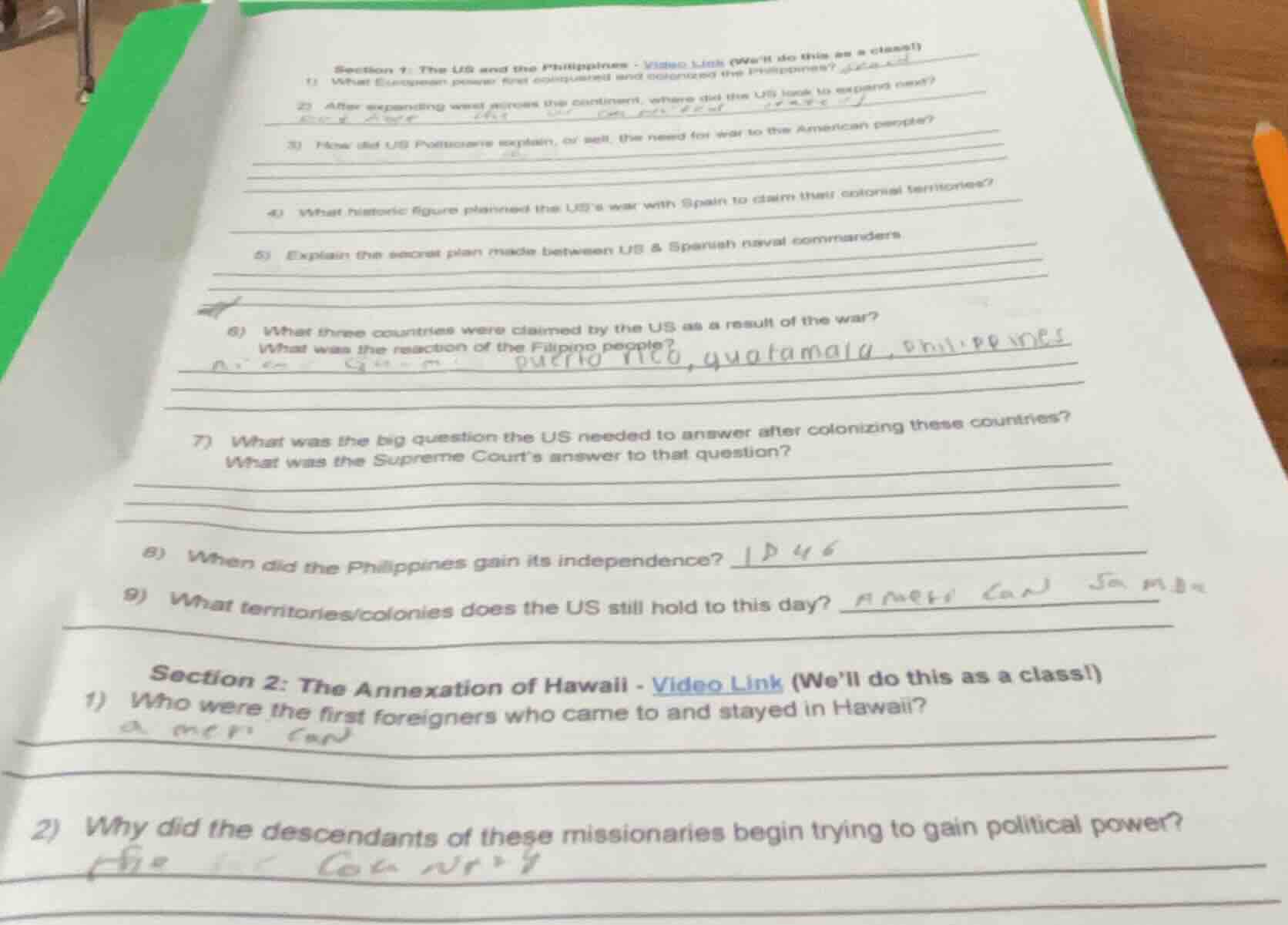
section 1: the us and the philippines - video link (well do this as a class!)
- what european power first conquered and colonized the philippines?
- after expanding west across the continent, where did the us look to expand next?
- how did us politicians explain, or sell, the need for war to the american people?
- what historic figure planned the uss war with spain to claim their colonial territories?
- explain the secret plan made between us & spanish naval commanders.
- what three countries were claimed by the us as a result of the war?
what was the reaction of the filipino people?
- what was the big question the us needed to answer after colonizing these countries?
what was the supreme court’s answer to that question?
- when did the philippines gain its independence?
- what territories/colonies does the us still hold to this day?
section 2: the annexation of hawaii - video link (well do this as a class!)
- who were the first foreigners who came to and stayed in hawaii?
- why did the descendants of these missionaries begin trying to gain political power?
To answer these questions, we can analyze them one by one:
Section 1: The US and the Philippines
- What European power first conquered and colonized the Philippines?
The Spanish were the first European power to colonize the Philippines (starting in the 16th century).
- After expanding west across the continent, where did the US look to expand next?
After continental expansion, the US looked to expand overseas (into the Pacific and Caribbean, e.g., Hawaii, Philippines, Cuba).
- How did US Politicians explain, or sell, the need for war to the American people?
Politicians framed war (e.g., against Spain) as a fight for freedom (liberating Cuba/Philippines from Spanish rule) and national glory, using propaganda (e.g., "Remember the Maine!").
- What historic figure planned the US’s war with Spain to claim their colonial territories?
President William McKinley (or figures like Theodore Roosevelt) played key roles in planning the Spanish - American War to acquire Spanish colonies.
- Explain the secret plan made between US & Spanish naval commanders.
There was a staged “surrender” (e.g., the Battle of Manila Bay had a pre - arranged outcome to avoid excessive bloodshed, though details vary; some accounts suggest a secret agreement to limit combat).
- What three countries were claimed by the US as a result of the war? What was the reaction of the Filipino people?
The US claimed the Philippines, Puerto Rico, and Guam. Filipinos reacted with rebellion (the Philippine - American War) as they wanted independence, not US colonization.
- What was the big question the US needed to answer after colonizing these countries? What was the Supreme Court’s answer to that question?
The big question was: Do the Constitution and rights of US citizens apply to these new territories? The Supreme Court (in cases like Downes v. Bidwell) ruled that territories were “unincorporated” — the Constitution did not fully apply, and Congress had broad power over them.
- When did the Philippines gain its independence?
The Philippines gained independence on July 4, 1946 (after WWII, from US rule).
- What territories/colonies does the US still hold to this day?
The US still holds territories like Puerto Rico, Guam, American Samoa, the Northern Mariana Islands, and the US Virgin Islands (unincorporated territories).
Section 2: The Annexation of Hawaii
- Who were the first foreigners who came to and stayed in Hawaii?
The first foreigners to stay in Hawaii were American missionaries (in the early 19th century) and traders.
- Why did the descendants of these missionaries begin trying to gain political power?
Missionary descendants (sugar planters) sought political power to protect their economic interests (sugar trade, land ownership) and gain control over Hawaii’s government (leading to annexation by the US).
These answers are based on historical context of US imperialism, the Spanish - American War, and Hawaiian annexation.

Snap & solve any problem in the app
Get step-by-step solutions on Sovi AI
Photo-based solutions with guided steps
Explore more problems and detailed explanations
To answer these questions, we can analyze them one by one:
Section 1: The US and the Philippines
- What European power first conquered and colonized the Philippines?
The Spanish were the first European power to colonize the Philippines (starting in the 16th century).
- After expanding west across the continent, where did the US look to expand next?
After continental expansion, the US looked to expand overseas (into the Pacific and Caribbean, e.g., Hawaii, Philippines, Cuba).
- How did US Politicians explain, or sell, the need for war to the American people?
Politicians framed war (e.g., against Spain) as a fight for freedom (liberating Cuba/Philippines from Spanish rule) and national glory, using propaganda (e.g., "Remember the Maine!").
- What historic figure planned the US’s war with Spain to claim their colonial territories?
President William McKinley (or figures like Theodore Roosevelt) played key roles in planning the Spanish - American War to acquire Spanish colonies.
- Explain the secret plan made between US & Spanish naval commanders.
There was a staged “surrender” (e.g., the Battle of Manila Bay had a pre - arranged outcome to avoid excessive bloodshed, though details vary; some accounts suggest a secret agreement to limit combat).
- What three countries were claimed by the US as a result of the war? What was the reaction of the Filipino people?
The US claimed the Philippines, Puerto Rico, and Guam. Filipinos reacted with rebellion (the Philippine - American War) as they wanted independence, not US colonization.
- What was the big question the US needed to answer after colonizing these countries? What was the Supreme Court’s answer to that question?
The big question was: Do the Constitution and rights of US citizens apply to these new territories? The Supreme Court (in cases like Downes v. Bidwell) ruled that territories were “unincorporated” — the Constitution did not fully apply, and Congress had broad power over them.
- When did the Philippines gain its independence?
The Philippines gained independence on July 4, 1946 (after WWII, from US rule).
- What territories/colonies does the US still hold to this day?
The US still holds territories like Puerto Rico, Guam, American Samoa, the Northern Mariana Islands, and the US Virgin Islands (unincorporated territories).
Section 2: The Annexation of Hawaii
- Who were the first foreigners who came to and stayed in Hawaii?
The first foreigners to stay in Hawaii were American missionaries (in the early 19th century) and traders.
- Why did the descendants of these missionaries begin trying to gain political power?
Missionary descendants (sugar planters) sought political power to protect their economic interests (sugar trade, land ownership) and gain control over Hawaii’s government (leading to annexation by the US).
These answers are based on historical context of US imperialism, the Spanish - American War, and Hawaiian annexation.