QUESTION IMAGE
Question
segment proofs
proof 1
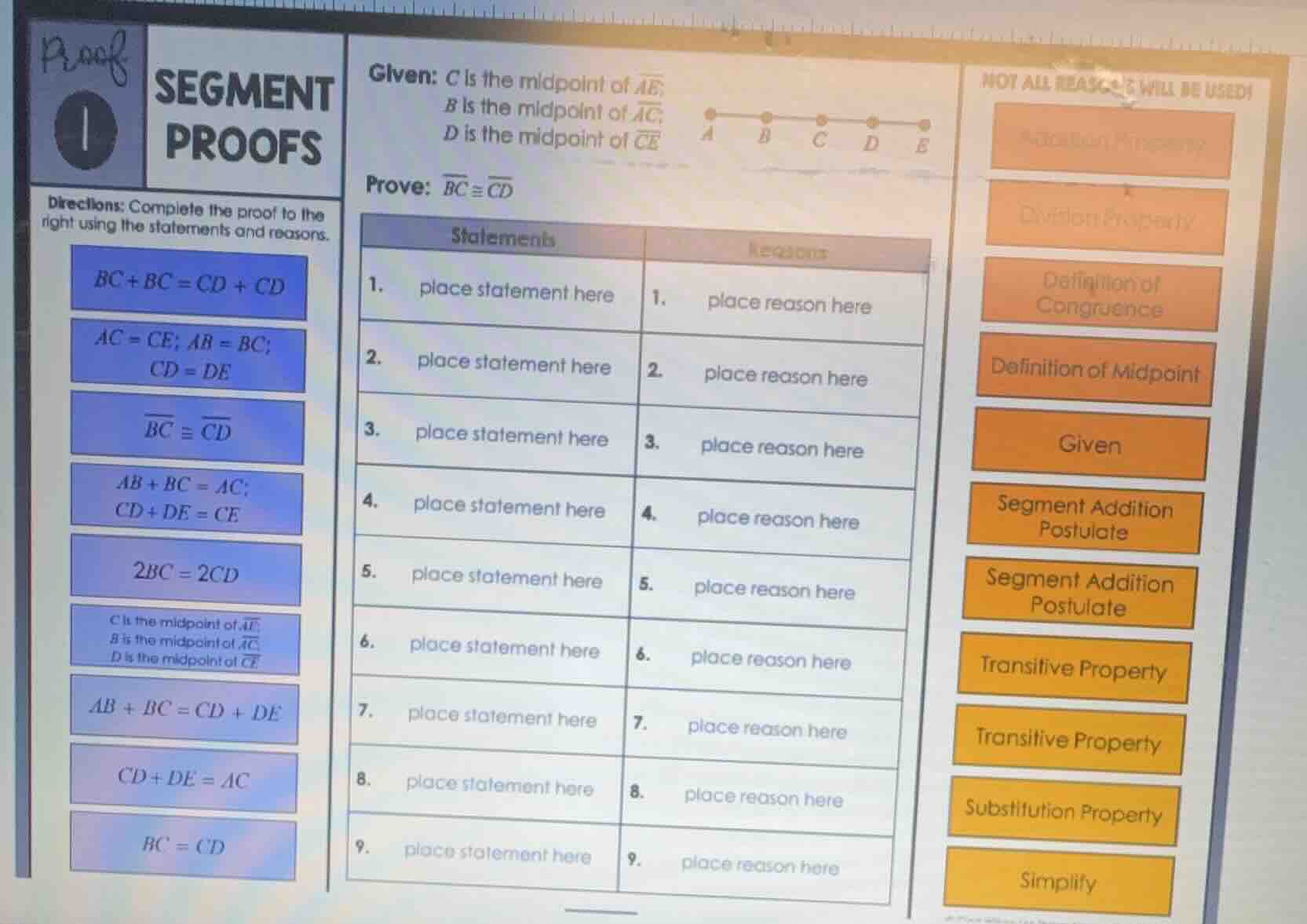
directions: complete the proof to the right using the statements and reasons.
given: c is the midpoint of (overline{ae});
b is the midpoint of (overline{ac});
d is the midpoint of (overline{ce})
prove: (overline{bc} cong overline{cd})
(image of a number line with points a, b, c, d, e)
statements (1 - 9, all place statement here)
reasons (1 - 9, all place reason here)
not all reasons will be used!
reasons list: addition property, division property, definition of congruence, definition of midpoint, given, segment addition postulate, segment addition postulate, transitive property, transitive property, substitution property, simplify
statements options (blue boxes):
(bc + bc = cd + cd)
(ac = ce); (ab = bc); (cd = de)
(overline{bc} cong overline{cd})
(ab + bc = ac); (cd + de = ce)
(2bc = 2cd)
c is the midpoint of (overline{ae}); b is the midpoint of (overline{ac}); d is the midpoint of (overline{ce})
(ab + bc = cd + de)
(cd + de = ac)
(bc = cd)
Step1: Identify Given Information
We know from the problem statement that \( C \) is the midpoint of \( \overline{AE} \), \( B \) is the midpoint of \( \overline{AC} \), and \( D \) is the midpoint of \( \overline{CE} \). So our first statement is the given information.
Statement 1: \( C \) is the midpoint of \( \overline{AE} \); \( B \) is the midpoint of \( \overline{AC} \); \( D \) is the midpoint of \( \overline{CE} \)
Reason 1: Given
Step2: Use Definition of Midpoint
By the definition of a midpoint, if a point is the midpoint of a segment, it divides the segment into two congruent parts. So for midpoint \( B \) of \( \overline{AC} \), we have \( AB = BC \), and for midpoint \( D \) of \( \overline{CE} \), we have \( CD = DE \), and for midpoint \( C \) of \( \overline{AE} \), we have \( AC = CE \).
Statement 2: \( AC = CE \); \( AB = BC \); \( CD = DE \)
Reason 2: Definition of Midpoint
Step3: Use Segment Addition Postulate
The Segment Addition Postulate states that for a segment with points in between, the sum of the smaller segments equals the larger segment. So for segment \( \overline{AC} \) with point \( B \), we have \( AB + BC = AC \), and for segment \( \overline{CE} \) with point \( D \), we have \( CD + DE = CE \).
Statement 3: \( AB + BC = AC \); \( CD + DE = CE \)
Reason 3: Segment Addition Postulate
Step4: Substitute Equal Segments
From Step 2, we know \( AB = BC \) and \( CD = DE \), and from Step 2 we also know \( AC = CE \). So we can substitute \( AB \) with \( BC \) in \( AB + BC = AC \) to get \( BC + BC = AC \), and substitute \( DE \) with \( CD \) in \( CD + DE = CE \) to get \( CD + CD = CE \). Then, since \( AC = CE \), we can set \( BC + BC = CD + CD \).
Statement 4: \( BC + BC = CD + CD \)
Reason 4: Substitution Property (substituting \( AB \) with \( BC \), \( DE \) with \( CD \), and \( AC \) with \( CE \))
Step5: Simplify the Equations
Simplifying \( BC + BC \) gives \( 2BC \) and simplifying \( CD + CD \) gives \( 2CD \). So we have \( 2BC = 2CD \).
Statement 5: \( 2BC = 2CD \)
Reason 5: Simplify (combining like terms)
Step6: Use Division Property of Equality
If we divide both sides of the equation \( 2BC = 2CD \) by 2, we get \( BC = CD \).
Statement 6: \( BC = CD \)
Reason 6: Division Property (dividing both sides by 2)
Step7: Use Definition of Congruence
If two segments have equal length, they are congruent. Since \( BC = CD \), we can conclude that \( \overline{BC} \cong \overline{CD} \).
Statement 7: \( \overline{BC} \cong \overline{CD} \)
Reason 7: Definition of Congruence (if \( BC = CD \), then \( \overline{BC} \cong \overline{CD} \))

Snap & solve any problem in the app
Get step-by-step solutions on Sovi AI
Photo-based solutions with guided steps
Explore more problems and detailed explanations
The completed proof is as follows:
| Statements | Reasons |
|---|---|
| 2. \( AC = CE \); \( AB = BC \); \( CD = DE \) | 2. Definition of Midpoint |
| 3. \( AB + BC = AC \); \( CD + DE = CE \) | 3. Segment Addition Postulate |
| 4. \( BC + BC = CD + CD \) | 4. Substitution Property |
| 5. \( 2BC = 2CD \) | 5. Simplify |
| 6. \( BC = CD \) | 6. Division Property |
| 7. \( \overline{BC} \cong \overline{CD} \) | 7. Definition of Congruence |
(Note: The number of steps might vary slightly depending on how the proof is structured, but this is a logical flow to prove \( \overline{BC} \cong \overline{CD} \))