QUESTION IMAGE
Question
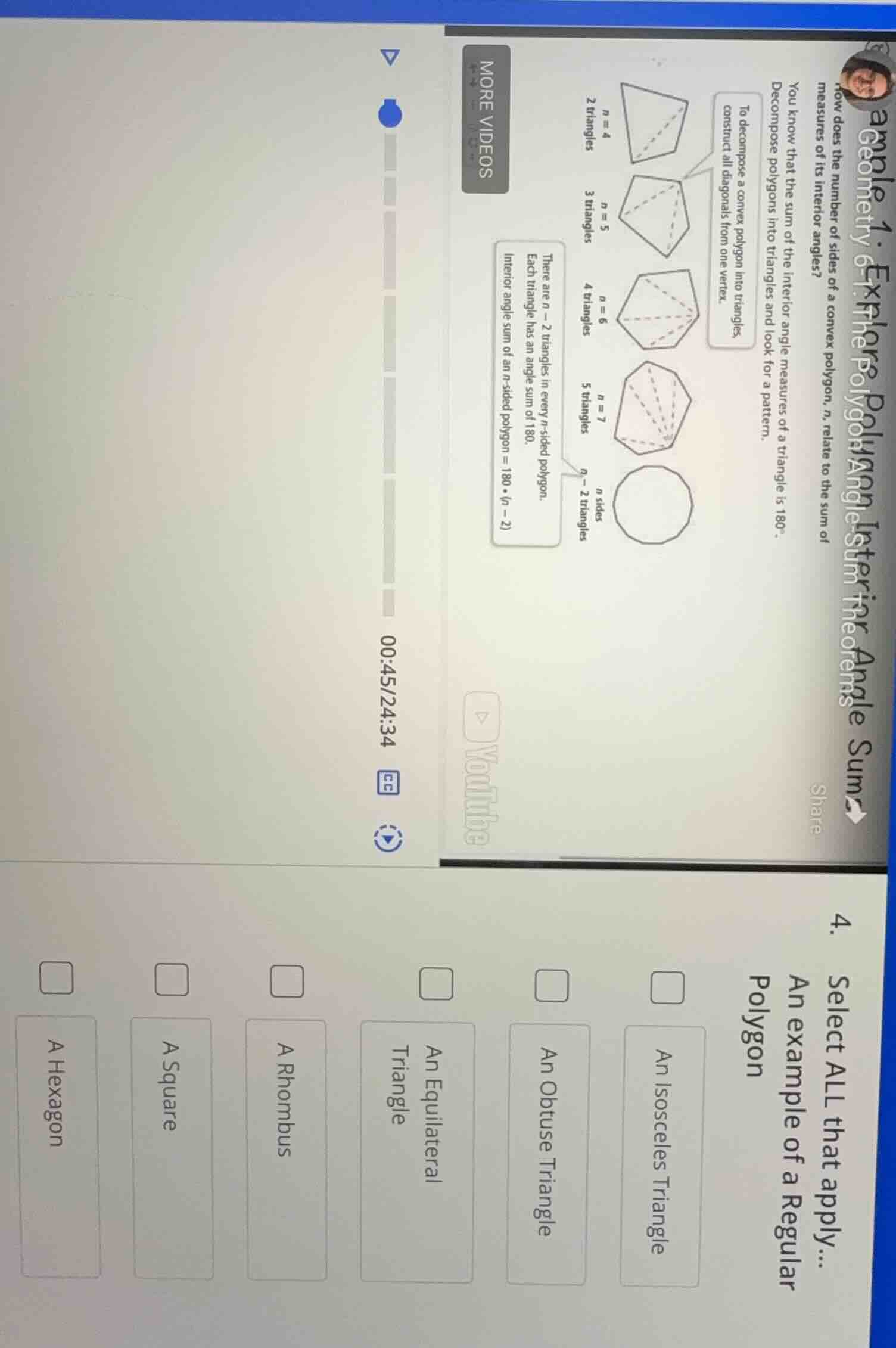
- select all that apply... an example of a regular polygon an isosceles triangle an obtuse triangle an equilateral triangle a rhombus a square a hexagon
A regular polygon has all sides equal and all interior angles equal. An equilateral triangle has 3 equal sides and 3 equal angles (each 60°), a square has 4 equal sides and 4 equal angles (each 90°), a rhombus has 4 equal sides but its angles are not necessarily equal (unless it's a square), an isosceles triangle has at least 2 equal sides but angles may not all be equal, an obtuse triangle has one angle >90° and sides/angles not all equal, a hexagon can be regular (6 equal sides and angles) or irregular. So the regular polygons here are the equilateral triangle, square, and regular hexagon (assuming the hexagon option is regular). Wait, but let's check each:
- An Equilateral Triangle: All sides equal, all angles 60° – regular.
- A Square: All sides equal, all angles 90° – regular.
- A Hexagon (if regular): All sides equal, all angles 120° – regular. Wait, but the options: the problem says "Select ALL that apply... An example of a Regular Polygon". Let's re - evaluate each option:
- An Isosceles Triangle: Not all sides/angles equal (unless it's equilateral), so not regular.
- An Obtuse Triangle: Angles and sides not all equal, not regular.
- An Equilateral Triangle: Regular.
- A Rhombus: Sides equal, but angles can be different (e.g., 60° and 120°), so not regular (a rhombus is regular only if it's a square).
- A Square: Regular.
- A Hexagon: If it's a regular hexagon (all sides and angles equal), then it's regular. But in the context of typical options, an equilateral triangle, square, and regular hexagon are regular polygons. Wait, but maybe the hexagon option is regular. Let's confirm the definitions:
Regular polygon: a polygon that is equiangular (all angles equal in measure) and equilateral (all sides equal in length).
- Equilateral Triangle: equiangular (60° each) and equilateral – regular.
- Square: equiangular (90° each) and equilateral – regular.
- Hexagon (if the option is regular hexagon): equiangular (120° each) and equilateral – regular.
- Isosceles Triangle: only 2 sides equal, angles not all equal (unless equilateral) – not regular.
- Obtuse Triangle: angles not equal, sides not equal – not regular.
- Rhombus: sides equal, but angles can be unequal – not regular (unless it's a square).
So the correct options are An Equilateral Triangle, A Square, A Hexagon. Wait, but let's check again. Wait, the rhombus: a rhombus has all sides equal, but its angles are equal only if it's a square. So a rhombus is not a regular polygon unless it's a square. So the regular polygons here are:
An Equilateral Triangle: yes, regular.
A Square: yes, regular.
A Hexagon: if it's a regular hexagon (the option likely means regular hexagon), yes.
Wait, but maybe the problem's hexagon option is regular. Let's go with the definitions. So the correct options are:
An Equilateral Triangle, A Square, A Hexagon, and wait, no – wait the equilateral triangle is a regular triangle, square is regular quadrilateral, hexagon (regular) is regular hexagon. The rhombus is not regular (unless square), isosceles and obtuse triangles are not regular.
Wait, maybe I made a mistake with the hexagon. Let's check the options again. The options are:
- An Isosceles Triangle – no
- An Obtuse Triangle – no
- An Equilateral Triangle – yes
- A Rhombus – no (unless square)
- A Square – yes
- A Hexagon – yes (if regular)
So the correct options are An Equilateral Triangle, A Square, A Hexagon. Wait, but maybe the hexagon is considered regular here. Alternatively, maybe the rhombus is not, as its angles are not necessarily equal. So the regular polygons…

Snap & solve any problem in the app
Get step-by-step solutions on Sovi AI
Photo-based solutions with guided steps
Explore more problems and detailed explanations
An Equilateral Triangle, A Square, A Hexagon