QUESTION IMAGE
Question
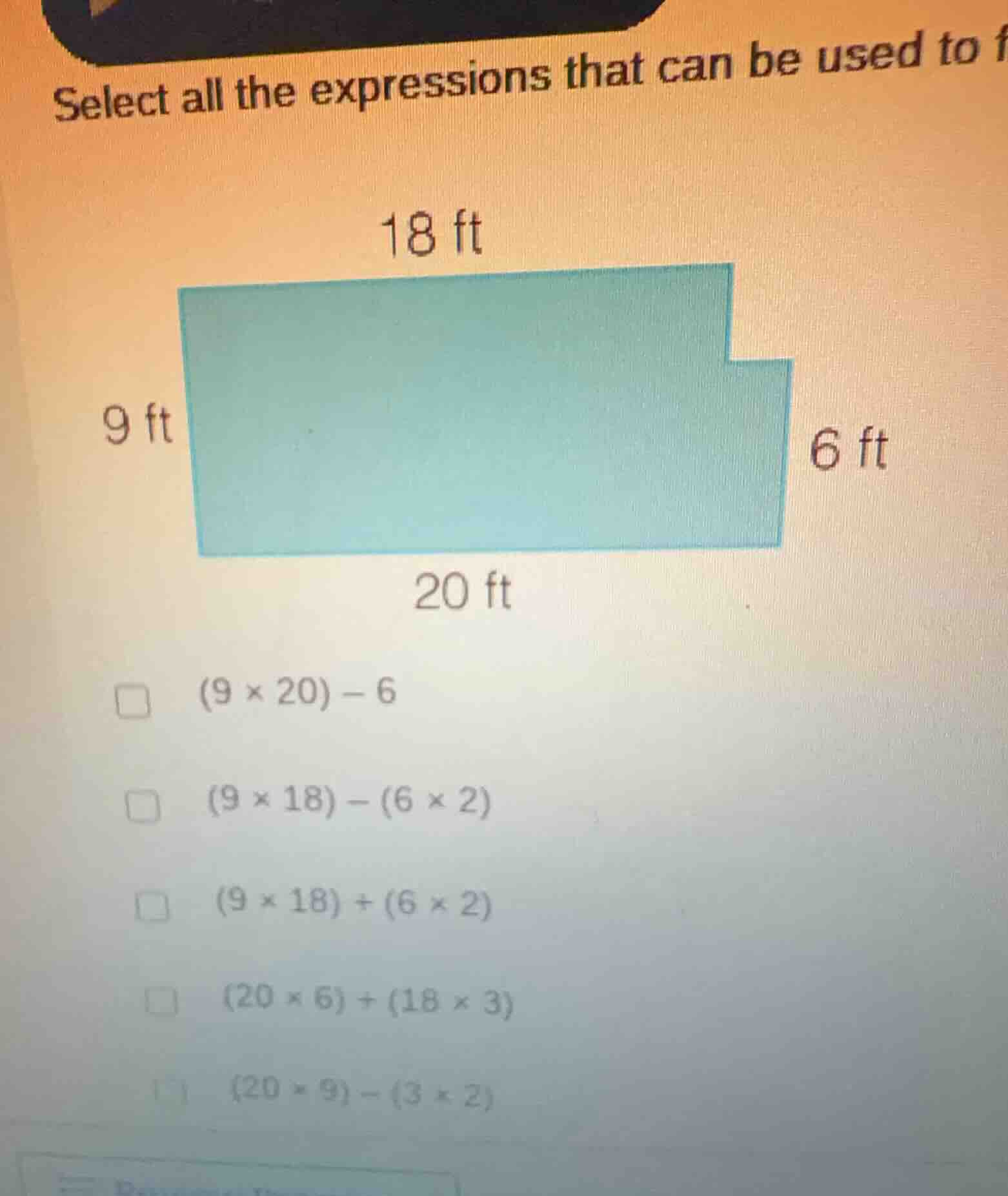
select all the expressions that can be used to 18 ft 9 ft 6 ft 20 ft (9 × 20) − 6 (9 × 18) − (6 × 2) (9 × 18) + (6 × 2) (20 × 6) + (18 × 3) (20 × 9) − (3 × 2)
To find the area of the composite figure, we can use two methods:
Method 1: Subtraction of a small rectangle from a large rectangle
The large rectangle has dimensions \(20\) ft (length) and \(9\) ft (width). The small rectangle that is missing has dimensions \((20 - 18)=2\) ft (length) and \((9 - 6) = 3\) ft (width)? Wait, no, let's re - examine. Wait, actually, if we consider the figure as a large rectangle of \(20\times9\) and then subtract the area of the small rectangle that is "cut out". The cut - out rectangle has length \(20 - 18=2\) ft and width \(9 - 6 = 3\) ft? Wait, no, maybe another way. Wait, the correct way:
Alternatively, we can split the figure into two rectangles. One rectangle with dimensions \(18\times9\) and another rectangle with dimensions \(6\times2\) (since \(20 - 18 = 2\) and the height of the second rectangle is \(6\) ft? Wait, no, the height of the second rectangle: the total height is \(9\) ft, and the first part has height \(9\) ft, the second part has height \(6\) ft? Wait, maybe I made a mistake. Let's re - analyze the figure.
The figure can be thought of as a large rectangle of length \(20\) ft and width \(9\) ft, and then a small rectangle of length \((20 - 18)=2\) ft and width \((9 - 6)=3\) ft is subtracted? No, wait, the vertical side on the right is \(6\) ft, and the left is \(9\) ft, so the difference in height is \(9 - 6 = 3\) ft. The horizontal difference is \(20 - 18=2\) ft. So the area of the cut - out is \(2\times3\). So the area of the figure is \(20\times9-2\times3=(20\times9)-(3\times2)\).
Another way: split the figure into two rectangles. The first rectangle has length \(18\) ft and width \(9\) ft, and the second rectangle has length \(2\) ft (\(20 - 18\)) and width \(6\) ft. Then the area is \(18\times9+2\times6=(9\times18)+(6\times2)\).
Now let's check each option:
- Option \((9\times20)-6\): The area of the large rectangle is \(9\times20\), and subtracting \(6\) (a length, not an area) is incorrect. So this option is wrong.
- Option \((9\times18)-(6\times2)\): \(9\times18\) is the area of the left - hand rectangle, and subtracting \(6\times2\) (which would be a subtraction of an area, but in reality, we should be adding the area of the right - hand rectangle, not subtracting). So this option is wrong.
- Option \((9\times18)+(6\times2)\): The left - hand rectangle has area \(9\times18\), and the right - hand rectangle has length \(20 - 18 = 2\) and width \(6\), so its area is \(6\times2\). Adding these two areas gives the total area of the figure. So this option is correct.
- Option \((20\times6)+(18\times3)\): The first part \(20\times6\) is the area of a rectangle with length \(20\) and width \(6\), and the second part \(18\times3\) (since \(9 - 6=3\)) is the area of the upper rectangle. Let's calculate: \(20\times6 = 120\), \(18\times3=54\), \(120 + 54=174\). Now, let's calculate the area using the correct method. The area of the figure: if we use the split method \(18\times9+6\times2=162 + 12 = 174\). If we use the subtraction method \(20\times9-3\times2=180 - 6 = 174\). And \((20\times6)+(18\times3)=120 + 54 = 174\). So this option is correct.
- Option \((20\times9)-(3\times2)\): The area of the large rectangle is \(20\times9 = 180\), the area of the cut - out is \(3\times2=6\), so \(180 - 6 = 174\), which is the correct area. So this option is correct.
Wait, let's re - check the third option \((9\times18)+(6\times2)\): \(9\times18 = 162\), \(6\times2 = 12\), \(162+12 = 174\).
Fourth option \((20\times6)+(18\times3)\): \(20\times6=120\), \(18\times3 = 54\), \(120…

Snap & solve any problem in the app
Get step-by-step solutions on Sovi AI
Photo-based solutions with guided steps
Explore more problems and detailed explanations
The correct expressions are:
- \((9\times18)+(6\times2)\)
- \((20\times6)+(18\times3)\)
- \((20\times9)-(3\times2)\)