QUESTION IMAGE
Question
select the correct answer.
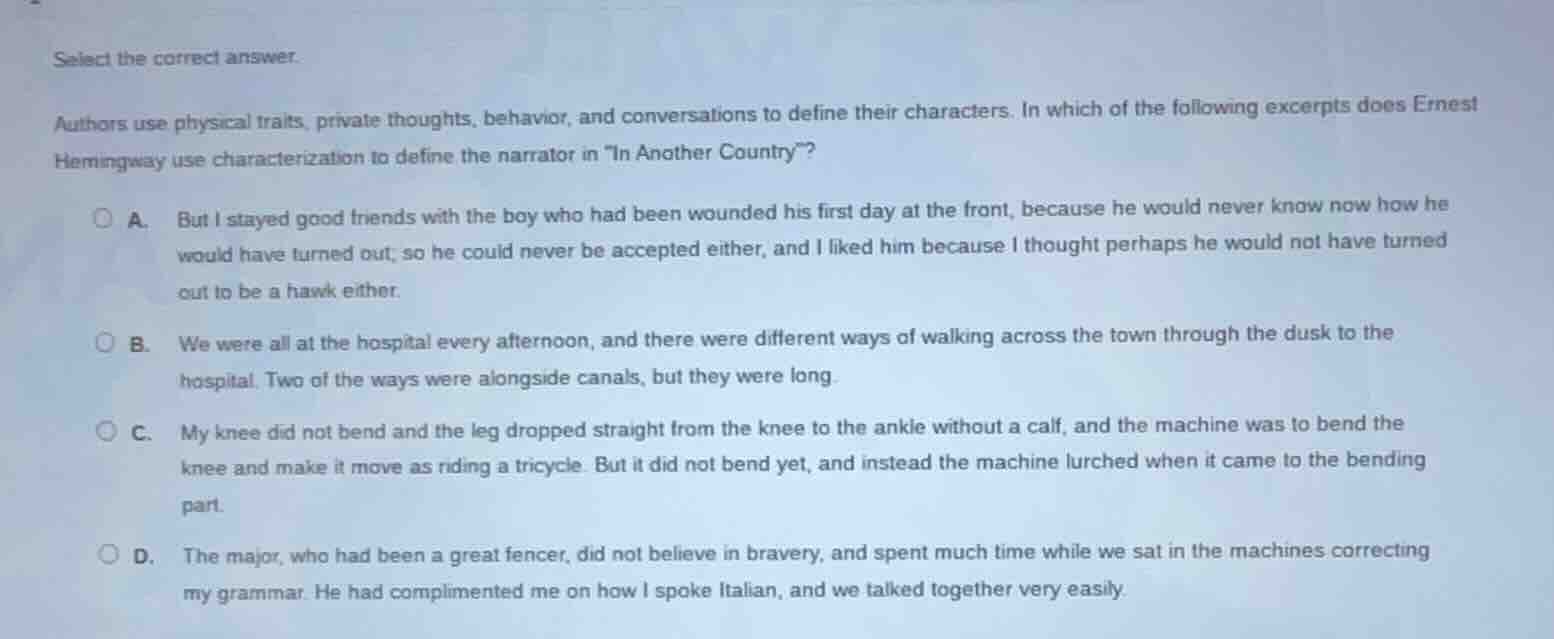
authors use physical traits, private thoughts, behavior, and conversations to define their characters. in which of the following excerpts does ernest hemingway use characterization to define the narrator in \in another country\?
a. but i stayed good friends with the boy who had been wounded his first day at the front, because he would never know now how he would have turned out; so he could never be accepted either, and i liked him because i thought perhaps he would not have turned out to be a hawk either.
b. we were all at the hospital every afternoon, and there were different ways of walking across the town through the dusk to the hospital. two of the ways were alongside canals, but they were long.
c. my knee did not bend and the leg dropped straight from the knee to the ankle without a calf, and the machine was to bend the knee and make it move as riding a tricycle. but it did not bend yet, and instead the machine lurched when it came to the bending part.
d. the major, who had been a great fencer, did not believe in bravery, and spent much time while we sat in the machines correcting my grammar. he had complimented me on how i spoke italian, and we talked together very easily.
To determine which excerpt uses characterization for the narrator, we analyze each option:
- Option A: Shows the narrator's thoughts about a boy, revealing the narrator's empathy and perspective (private thoughts/behavior - characterization of narrator).
- Option B: Describes the setting and paths to the hospital, not characterization of the narrator.
- Option C: Describes the narrator's physical injury and machine, but it's more about the injury than defining the narrator's character (more physical description of condition, not character traits).
- Option D: Focuses on the major, not the narrator.
So Option A uses the narrator's thoughts and interactions to define his character.

Snap & solve any problem in the app
Get step-by-step solutions on Sovi AI
Photo-based solutions with guided steps
Explore more problems and detailed explanations
A. But I stayed good friends with the boy who had been wounded his first day at the front, because he would never know now how he would have turned out; so he could never be accepted either, and I liked him because I thought perhaps he would not have turned out to be a hawk either.