QUESTION IMAGE
Question
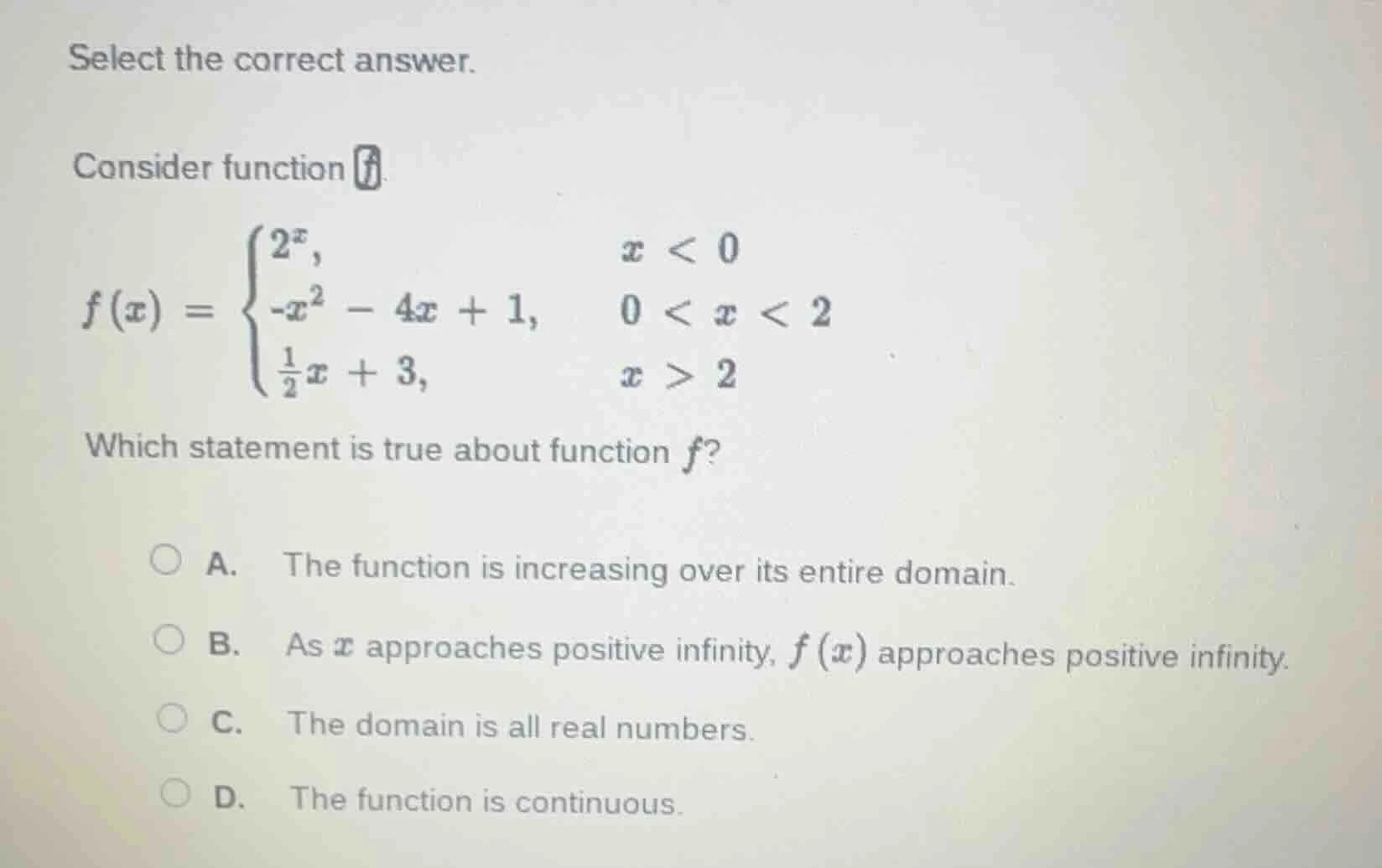
select the correct answer. consider function ( f(x) = \begin{cases} 2^x, & x < 0 \\ -x^2 - 4x + 1, & 0 < x < 2 \\ \frac{1}{2}x + 3, & x > 2 end{cases} ) which statement is true about function ( f )? a. the function is increasing over its entire domain. b. as ( x ) approaches positive infinity, ( f(x) ) approaches positive infinity. c. the domain is all real numbers. d. the function is continuous.
Step1: Analyze Option A
Check monotonicity of each piece:
- For $x<0$: $f(x)=2^x$, derivative $f'(x)=2^x\ln2>0$, increasing.
- For $0
Thus, function is not increasing everywhere.
Step2: Analyze Option B
For $x>2$, $f(x)=\frac{1}{2}x+3$. As $x\to+\infty$, $\frac{1}{2}x+3\to+\infty$. This holds true.
Step3: Analyze Option C
Check domain: The function is undefined at $x=0$ and $x=2$ (only inequalities $x<0,0
Step4: Analyze Option D
Check continuity at $x=0$:
$\lim_{x\to0^-}f(x)=2^0=1$, $\lim_{x\to0^+}f(x)=-0-0+1=1$, but $f(0)$ is undefined. At $x=2$:
$\lim_{x\to2^-}f(x)=-4-8+1=-11$, $\lim_{x\to2^+}f(x)=\frac{1}{2}\times2+3=4$, limits differ. Function is not continuous.

Snap & solve any problem in the app
Get step-by-step solutions on Sovi AI
Photo-based solutions with guided steps
Explore more problems and detailed explanations
B. As $x$ approaches positive infinity, $f(x)$ approaches positive infinity.