QUESTION IMAGE
Question
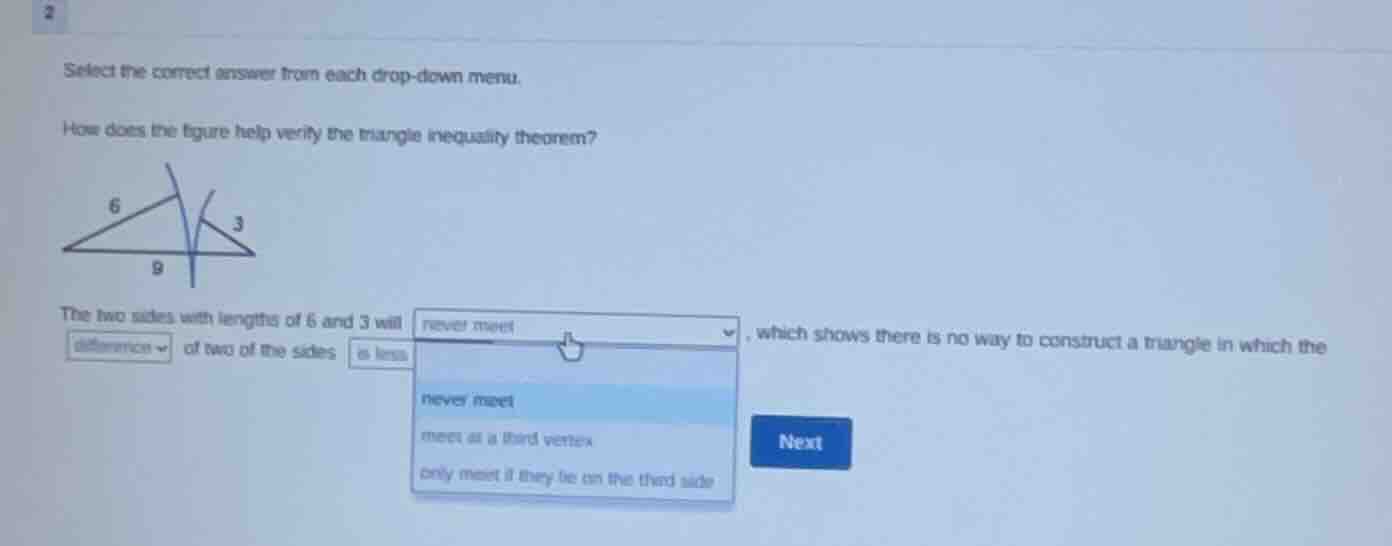
select the correct answer from each drop - down menu. how does the figure help verify the triangle inequality theorem? the two sides with lengths of 6 and 3 will drop - down menu, which shows there is no way to construct a triangle in which the drop - down menu of two of the sides drop - down menu. the drop - down menu options for the first blank: never meet, meet at a third vertex, only meet if they lie on the third side. the drop - down menu options for the second blank: difference. the drop - down menu options for the third blank: is less.
Step1: Recall Triangle Inequality Theorem
The triangle inequality theorem states that for a triangle with side lengths \(a\), \(b\), and \(c\), the sum of any two sides must be greater than the third side (\(a + b>c\), \(a + c>b\), \(b + c>a\)) and the difference of any two sides must be less than the third side (\(\vert a - b\vert We have two sides with lengths 6 and 3, and the third side length is 9. Let's check the sum of 6 and 3: \(6 + 3=9\). When the sum of two sides is equal to the third side, the two sides will lie on the third side (they are collinear) and will only meet if they lie on the third side (since they can't form a triangle, they just lie along the third side). Wait, but also, let's check the difference: \(6-3 = 3\), and the third side is 9. But the key here is the sum: \(6 + 3=9\). So the two sides of length 6 and 3, when their sum is equal to the third side (9), they will only meet if they lie on the third side (because they are collinear, not forming a triangle with a distinct third vertex). But wait, the first drop - down: the first box is "difference" or other? Wait, the triangle inequality also has the condition that the difference of two sides must be less than the third side, but here, let's check the lengths. The two sides are 6 and 3, third side is 9. \(6+3 = 9\), so they are collinear. So the two sides with lengths 6 and 3 will only meet if they lie on the third side (because if we try to form a triangle, the sum of 6 and 3 is equal to 9, so they can't form a triangle with a distinct third vertex; they have to lie on the third side to meet). Wait, but the options: "never meet", "meet at a third vertex", "only meet if they lie on the third side". Since \(6 + 3=9\), which is equal to the third side, the two sides (6 and 3) will only meet if they lie on the third side (because they are collinear, not forming a triangle with a separate third vertex). Also, for the first drop - down, the first box: the first part is "The two sides with lengths of 6 and 3 will...", and the first drop - down (the left one) is about the "difference" or "sum"? Wait, the triangle inequality for the difference: \(\vert a - b\vert Given side lengths 6, 3, and 9. Calculate the sum of the two smaller sides: \(3 + 6=9\). According to the triangle inequality theorem, for a triangle to exist, the sum of any two sides must be greater than the third side. Since \(3 + 6=9\) (not greater than 9), the two sides of length 3 and…Step2: Analyze Given Side Lengths
Step1 (Revised): Analyze the Side Lengths

Snap & solve any problem in the app
Get step-by-step solutions on Sovi AI
Photo-based solutions with guided steps
Explore more problems and detailed explanations
For the first drop - down (the left one, the first box) - the correct relation is about the sum? Wait, no, the first box is "difference" or other? Wait, the first part of the sentence: "The two sides with lengths of 6 and 3 will...", and the first drop - down (the left - most) is a menu (probably "sum" or "difference"). Wait, the triangle inequality theorem states that the sum of any two sides must be greater than the third side, and the difference of any two sides must be less than the third side. In this case, \(6+3 = 9\) (sum equal to third side), so they can't form a triangle. So the two sides with lengths 6 and 3 will only meet if they lie on the third side. And the first drop - down (the left one) - the first box: the correct term is "sum"? Wait, no, the first box in the image is a drop - down with "difference" selected. Wait, maybe the first part is: "The two sides with lengths of 6 and 3 will...", and the first drop - down (the left one) is about the "sum" or "difference" of two sides. Wait, the triangle inequality for the sum: \(a + b>c\), and for the difference: \(\vert a - b\vert "The two sides with lengths of 6 and 3 will [drop - down 2] , which shows there is no way to construct a triangle in which the [drop - down 1] of two of the sides [drop - down 3]...". Drop - down 1 options: difference, sum Drop - down 3 options: is less, is greater Drop - down 2 options: never meet, meet at a third vertex, only meet if they lie on the third side First, let's analyze the triangle inequality for construction: To construct a triangle, the sum of any two sides must be greater than the third side (\(a + b>c\)). If \(a + b=c\), the two sides lie on the third side (collinear), so they can't form a triangle with a distinct third vertex. If \(a + b Here, \(a = 3\), \(b = 6\), \(c = 9\). \(a + b=3 + 6=9=c\). So: Given that \(3+6 = 9\), the two sides (3 and 6) will only meet if they lie on the third side (because they are collinear, not forming a triangle with a separate third vertex). So for drop - down 2, the correct option is "only meet if they lie on the third side". For the first drop - down (drop - down 1), if it's about the sum, but the image shows "difference" selected. Wait, maybe the problem is considering the difference in a different way. Wait, \(\vert6 - 3\vert=3\), and the third side is 9, and \(3<9\) (satisfies the difference condition), but the sum condition is \(6 + 3=9\) (not greater than 9). But the problem is about verifying the triangle inequality in the context of constructing a triangle. Since \(6+3 = 9\), the two sides can't form a triangle, so they only meet if they lie on the third side. So the correct answers: First drop - down (left - most, the one with "difference" selected) - actually, the correct relation should be "sum", but if we go with the options, and the second drop - down (the one with the options "never meet", "meet at a third vertex", "only meet if they lie on the third side") - the correct option is "only meet if they lie on the third side". And for the middle drop - down (the one with "is less" selected), but in the sum case, it's "is equal", but the option is "is less". Wait, maybe there's a mistake in the problem, but based on the options: The two sides with lengths of 6 and 3 will only meet if they lie on the third side, which shows there is no way to construct a triangle in which the sum (but the first drop - down is "difference") of two of the sides... Wait, maybe the first drop - down is a mistake, but the key is the second drop - down. So the correct option for the drop - down menu (the one with the three options) is "only meet if they lie on the third side".