QUESTION IMAGE
Question
select the correct answer from each drop-down menu.
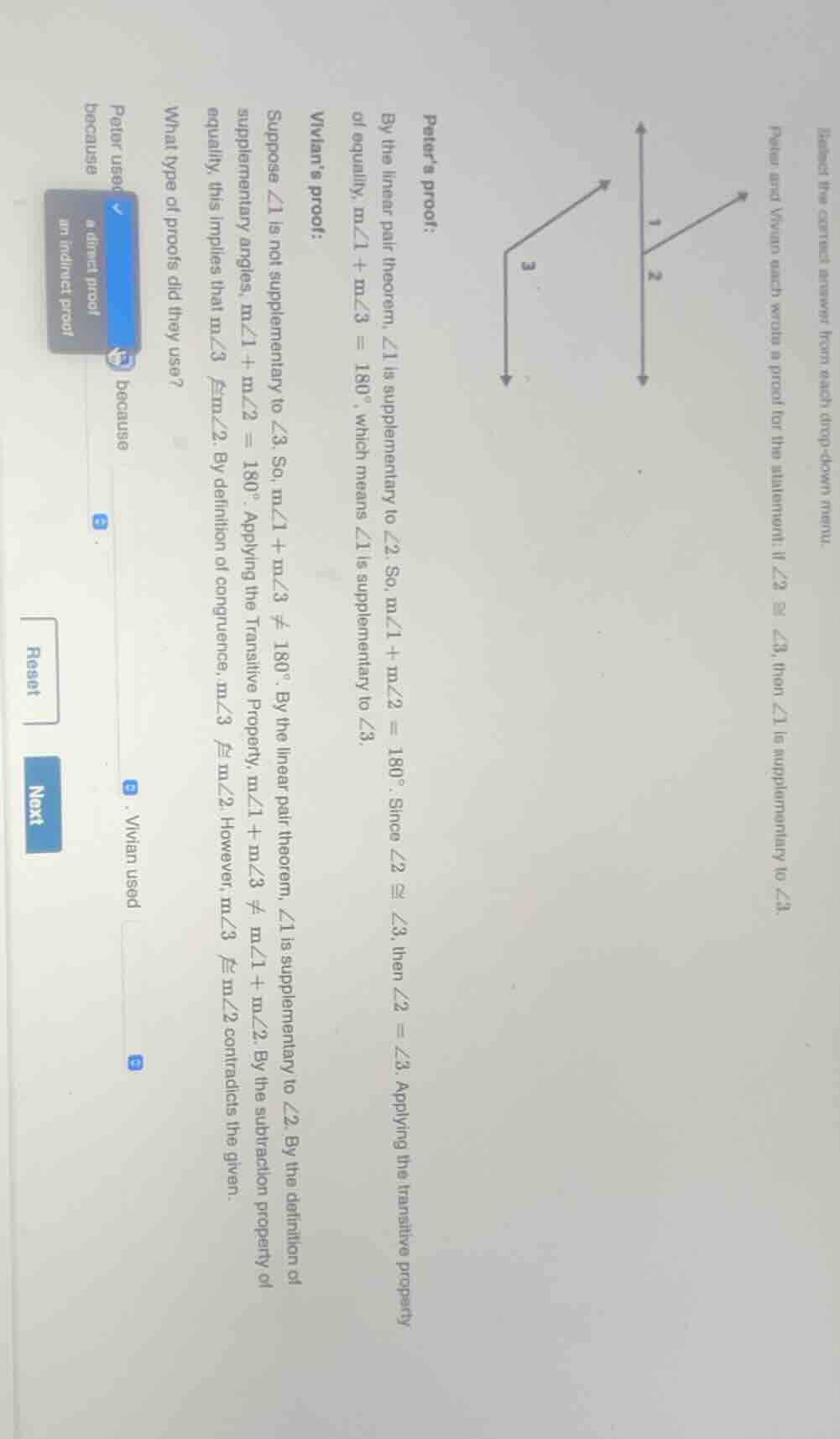
peter and vivian each wrote a proof for the statement: if ( angle 2 cong angle 3 ), then ( angle 1 ) is supplementary to ( angle 3 ).
peter’s proof:
by the linear pair theorem, ( angle 1 ) is supplementary to ( angle 2 ). so, ( mangle 1 + mangle 2 = 180^circ ). since ( angle 2 cong angle 3 ), then ( angle 2 = angle 3 ). applying the transitive property of equality, ( mangle 1 + mangle 3 = 180^circ ), which means ( angle 1 ) is supplementary to ( angle 3 ).
vivian’s proof:
suppose ( angle 1 ) is not supplementary to ( angle 3 ). so, ( mangle 1 + mangle 3
eq 180^circ ). by the linear pair theorem, ( angle 1 ) is supplementary to ( angle 2 ). by the definition of supplementary angles, ( mangle 1 + mangle 2 = 180^circ ). applying the transitive property of equality, this implies that ( mangle 3
eq mangle 2 ). by definition of congruence, ( mangle 3
otcong mangle 2 ). however, ( mangle 3
otcong mangle 2 ) contradicts the given.
what type of proofs did they use?
peter used (\boldsymbol{\text{drop - down option: a direct proof, an indirect proof}}) because (\boldsymbol{\text{reason}}).
vivian used (\boldsymbol{\text{drop - down option: a direct proof, an indirect proof}}) because (\boldsymbol{\text{reason}}).

Snap & solve any problem in the app
Get step-by-step solutions on Sovi AI
Photo-based solutions with guided steps
Explore more problems and detailed explanations
Peter used a direct proof because he used the given information to show that the statement is true.
Vivian used an indirect proof because she assumed that the statement is false and showed that this leads to a contradiction.