QUESTION IMAGE
Question
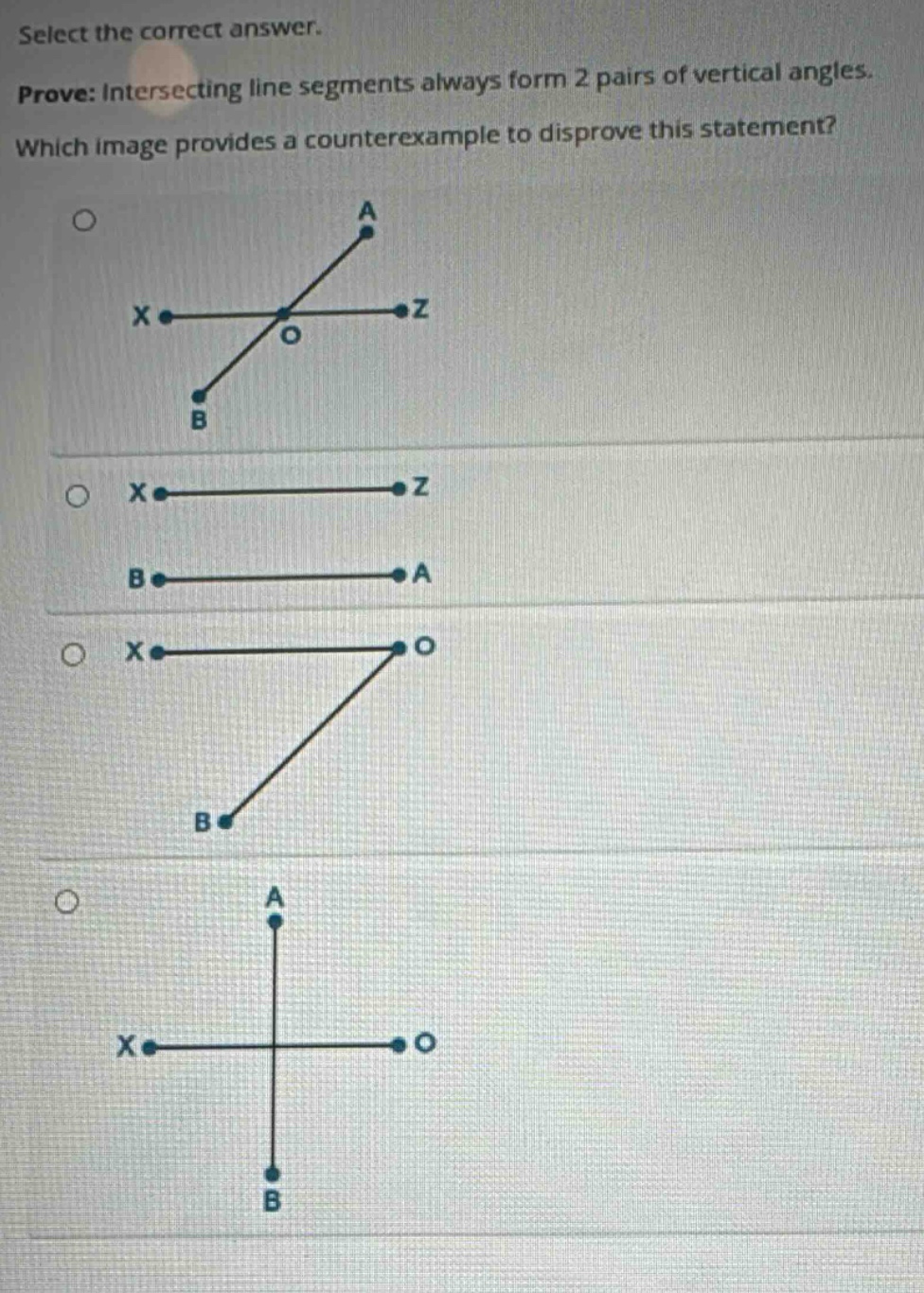
select the correct answer. prove: intersecting line segments always form 2 pairs of vertical angles. which image provides a counterexample to disprove this statement? four images of line segments/angles omitted
Brief Explanations
To find a counterexample, we need an image of intersecting line segments that do not form 2 pairs of vertical angles. Let's analyze each option:
- The first image: Segments \( XZ \) and \( AB \) intersect at \( O \), forming 2 pairs of vertical angles.
- The second image: Segments \( XZ \) and \( BA \) are parallel (not intersecting), so it's not a case of intersecting segments.
- The third image: Segments \( XO \) and \( BO \) share a common endpoint \( O \) (they are not intersecting in the way that forms vertical angles; they meet at a single point, not crossing each other). This is a counterexample because intersecting line segments (that cross each other, not just meet at a point) form vertical angles. Here, they meet at \( O \) without crossing, so they don't form 2 pairs of vertical angles.
- The fourth image: Segments \( XO \) and \( AB \) intersect, forming 2 pairs of vertical angles.
So the third image (with \( X \), \( O \), \( B \)) is the counterexample.

Snap & solve any problem in the app
Get step-by-step solutions on Sovi AI
Photo-based solutions with guided steps
Explore more problems and detailed explanations
The third option (the image with points \( X \), \( O \), \( B \) and \( O \) connected to \( B \), \( X \) connected to \( O \))