QUESTION IMAGE
Question
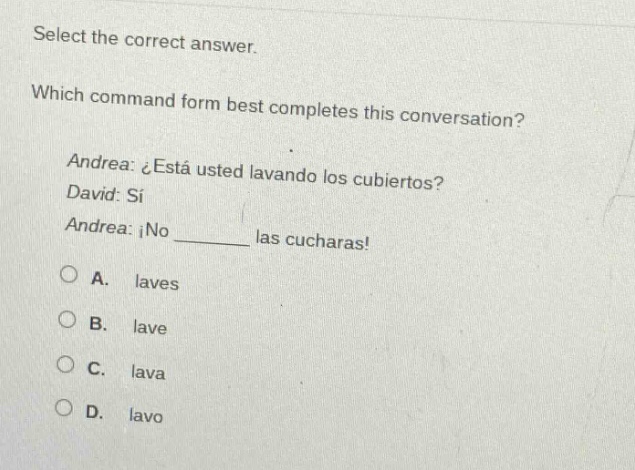
select the correct answer.
which command form best completes this conversation?
andrea: ¿está usted lavando los cubiertos?
david: sí
andrea: ¡no ______ las cucharas!
a. laves
b. lave
c. lava
d. lavo
To solve this, we analyze the context and Spanish subjunctive/command forms. The sentence is a negative command (¡No...) with "usted" (formal you). For negative commands with "usted", we use the subjunctive form. The verb "lavar" (to wash) has the subjunctive form for "usted" as "laves"? Wait, no—wait, "lavar" subjunctive for "usted" is " lave"? Wait, no, let's recall: For negative commands with "usted", the structure is "No + subjunctive of the verb". The verb "lavar" (regular -ar verb) has subjunctive for "usted" as "lave"? Wait, no, the subjunctive of "lavar" for "usted" (él/ella/usted) is "lave"? Wait, no, let's conjugate:
Infinitive: lavar
Present subjunctive:
yo: lave
tú: laves
él/ella/usted: lave
nosotros: lavemos
vosotros: lavéis
ellos/ellas/ustedes: laven
Wait, but the negative command with "usted" is "No + subjunctive of the verb". Wait, but the options: A is "laves" (tú subjunctive), B is "lave" (usted subjunctive), C is "lava" (tú or él/usted indicative), D is "lavo" (yo indicative).
The context is Andrea telling David (usted, formal) not to wash the spoons. So negative command with "usted" uses subjunctive. So the correct form is "lave"? Wait, no, wait—wait, maybe I made a mistake. Wait, the negative command for "usted" is "No + subjunctive". Wait, but "laves" is tú subjunctive. Wait, maybe the subject is "tú"? Wait, the original question: Andrea is talking to David—maybe "usted" is used, but maybe the verb form. Wait, let's check the options again.
Wait, the sentence is "¡No ______ las cucharas!". Let's think about the correct form. If it's a negative command to "tú" (informal you), the form would be "No laves" (tú subjunctive). But if it's "usted", it's "No lave". But the options: A is "laves" (tú subjunctive), B is "lave" (usted subjunctive), C is "lava" (tú or él/usted indicative), D is "lavo" (yo indicative).
Wait, maybe the context is "tú" (informal). Let's re-examine the conversation: Andrea asks "¿Está usted lavando los cubiertos?" (Are you washing the cutlery?—"usted" is formal). Then David says "Sí". Then Andrea says "¡No ______ las cucharas!". So she's addressing David with "usted" (formal), so the negative command with "usted" uses subjunctive. So "lave" (usted subjunctive). But wait, the option A is "laves" (tú subjunctive). Wait, maybe the question is using "tú" instead of "usted"? Maybe the "usted" in the first question is just the question, but the command is to "tú". Wait, maybe the error is in my conjugation. Let's check again.
Wait, the present subjunctive of "lavar" for "tú" is "laves" (tú: laves). So if the command is to "tú" (informal), then "No laves" (negative command with tú: No + subjunctive). So maybe the first question uses "usted" (formal) for the question, but the command is to "tú" (informal). Let's see the options: A is "laves" (tú subjunctive), which would be correct for a negative command to "tú". So maybe the answer is A? Wait, I'm confused. Wait, let's check the options again.
Wait, the options:
A. laves (tú subjunctive)
B. lave (usted subjunctive)
C. lava (tú indicative or él/usted indicative)
D. lavo (yo indicative)
The correct negative command for "tú" is "No laves" (don't wash). For "usted", it's "No lave". But the first question is "¿Está usted...", so David is addressed as "usted" (formal). So the command should be "usted" form. But "lave" is the subjunctive for "usted". But why is A an option? Wait, maybe the question has a typo, or I'm misunderstanding. Wait, let's check a reference: Negative commands with "tú" use "No + subjunctive (tú form)". For example, "…

Snap & solve any problem in the app
Get step-by-step solutions on Sovi AI
Photo-based solutions with guided steps
Explore more problems and detailed explanations
A. laves