QUESTION IMAGE
Question
select the correct answer.
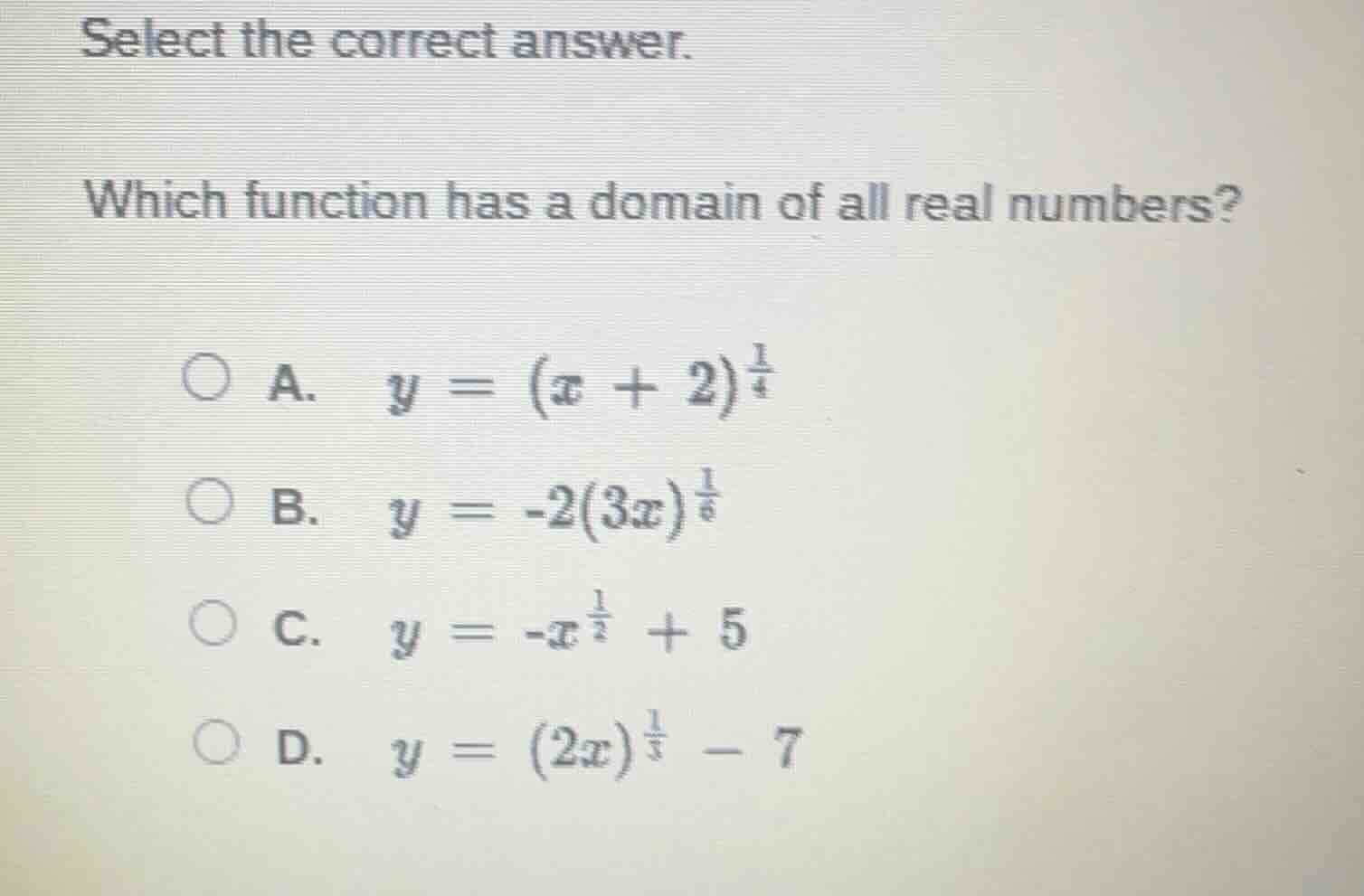
which function has a domain of all real numbers?
a. $y = (x + 2)^{\frac{1}{4}}$
b. $y = -2(3x)^{\frac{1}{6}}$
c. $y = -x^{\frac{1}{2}} + 5$
d. $y = (2x)^{\frac{1}{3}} - 7$
Step1: Recall the domain rules for radical functions
For a function of the form \( y = (f(x))^{\frac{1}{n}}=\sqrt[n]{f(x)} \), if \( n \) is even, the radicand \( f(x) \geq 0 \); if \( n \) is odd, the radicand \( f(x) \) can be any real number (since odd - root functions are defined for all real numbers).
Step2: Analyze Option A
For \( y=(x + 2)^{\frac{1}{4}}=\sqrt[4]{x + 2} \), here \( n = 4 \) (even). So we need \( x+2\geq0\), which implies \( x\geq - 2 \). The domain is not all real numbers.
Step3: Analyze Option B
For \( y=-2(3x)^{\frac{1}{6}}=-2\sqrt[6]{3x} \), here \( n = 6 \) (even). So we need \( 3x\geq0\), which implies \( x\geq0 \). The domain is not all real numbers.
Step4: Analyze Option C
For \( y=-x^{\frac{1}{2}}+5=-\sqrt{x}+5 \), here \( n = 2 \) (even). So we need \( x\geq0 \). The domain is not all real numbers.
Step5: Analyze Option D
For \( y=(2x)^{\frac{1}{3}}-7=\sqrt[3]{2x}-7 \), here \( n = 3 \) (odd). Since the cube - root function is defined for all real numbers (because for any real number \( a \), there is a real number \( b \) such that \( b^{3}=a \)), the radicand \( 2x \) can be any real number. So \( x \) can be any real number. The domain of the function is all real numbers.

Snap & solve any problem in the app
Get step-by-step solutions on Sovi AI
Photo-based solutions with guided steps
Explore more problems and detailed explanations
D. \( y = (2x)^{\frac{1}{3}}-7 \)