QUESTION IMAGE
Question
select the correct answer.
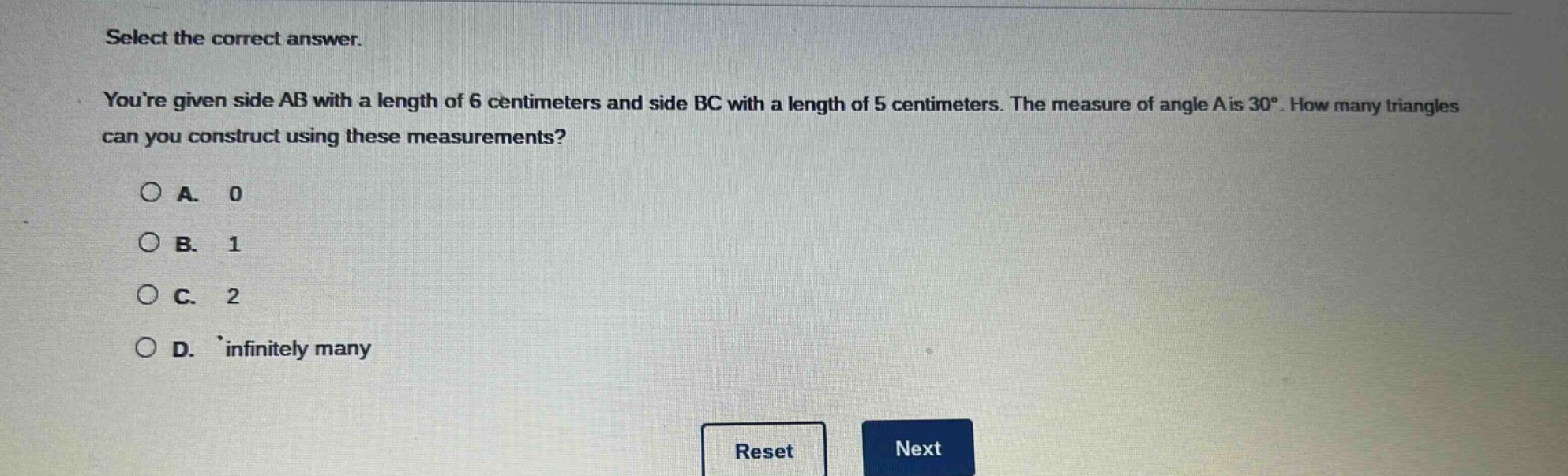
youre given side ab with a length of 6 centimeters and side bc with a length of 5 centimeters. the measure of angle a is 30°. how many triangles can you construct using these measurements?
a. 0
b. 1
c. 2
d. infinitely many
Step1: Recall the Law of Sines
The Law of Sines states that $\frac{a}{\sin A}=\frac{b}{\sin B}=\frac{c}{\sin C}$ for a triangle with sides $a,b,c$ and opposite angles $A,B,C$ respectively. Here, side $BC = a = 5$ cm, side $AB = c = 6$ cm, and angle $A=30^{\circ}$. We want to find angle $C$ (opposite side $AB$) or angle $B$, but first, let's try to find the height of the triangle with respect to angle $A$.
Step2: Calculate the height from $B$ to $AC$
The height $h$ from $B$ to $AC$ (let's call the foot of the perpendicular $D$) in triangle $ABD$ (right - triangle) is given by $h = AB\sin A$. Substituting $AB = 6$ cm and $A = 30^{\circ}$, we get $h=6\times\sin30^{\circ}=6\times\frac{1}{2} = 3$ cm.
Step3: Compare the length of $BC$ with the height
We know that side $BC = 5$ cm. Since $h = 3$ cm and $BC=5$ cm and $AB = 6$ cm. We also know that in the ambiguous case (SSA), if $a\lt c$ and $h\lt a\lt c$, then there are two triangles. But here, let's use the Law of Sines. From $\frac{a}{\sin A}=\frac{c}{\sin C}$, we have $\sin C=\frac{c\sin A}{a}=\frac{6\times\sin30^{\circ}}{5}=\frac{6\times\frac{1}{2}}{5}=\frac{3}{5} = 0.6$. The value of $\sin C = 0.6$ gives two possible angles for $C$: $C=\arcsin(0.6)\approx36.87^{\circ}$ and $C = 180^{\circ}-\arcsin(0.6)\approx143.13^{\circ}$. But we need to check if these angles are valid. For $C = 143.13^{\circ}$, then angle $B=180^{\circ}-30^{\circ}-143.13^{\circ}=6.87^{\circ}$, which is positive. For $C = 36.87^{\circ}$, angle $B = 180^{\circ}-30^{\circ}-36.87^{\circ}=113.13^{\circ}$, which is also positive. But wait, we made a mistake earlier. Wait, side $BC$ is opposite angle $A$? No, wait: in triangle $ABC$, side $a$ is opposite angle $A$, side $b$ is opposite angle $B$, side $c$ is opposite angle $C$. So side $BC$ is opposite angle $A$? No, vertex $A$, $B$, $C$: side opposite $A$ is $BC$ (length $a = 5$), side opposite $B$ is $AC$ (length $b$), side opposite $C$ is $AB$ (length $c = 6$). So using Law of Sines: $\frac{a}{\sin A}=\frac{c}{\sin C}\implies\sin C=\frac{c\sin A}{a}=\frac{6\times\sin30^{\circ}}{5}=\frac{3}{5}=0.6$. Now, since $a = 5$, $c = 6$, so $a\lt c$. And $\sin A=\sin30^{\circ}=0.5$, $a\sin C=5\times0.6 = 3$, $a = 5$, $c = 6$. We know that when $a\lt c$ and $a\sin A\lt a\lt c$ (wait, no, the correct ambiguous case rules: If we have SSA, with side $a$ opposite angle $A$, side $c$ adjacent to angle $A$. Case 1: If $a\gt c$, then one triangle. Case 2: If $a = c$, then one triangle. Case 3: If $a\lt c$: - If $a\lt h$ (where $h = c\sin A$), then no triangle. - If $a = h$, then one right - triangle. - If $h\lt a\lt c$, then two triangles. Here, $h=c\sin A=6\times\sin30^{\circ}=3$, $a = 5$, $c = 6$. Since $3\lt5\lt6$, so there are two possible triangles. Wait, but let's check the angle sum. For the first angle $C=\arcsin(0.6)\approx36.87^{\circ}$, then angle $B = 180 - 30 - 36.87=113.13^{\circ}$, which is valid. For the second angle $C = 180 - 36.87 = 143.13^{\circ}$, then angle $B=180 - 30 - 143.13 = 6.87^{\circ}$, which is also valid. So there are two triangles. Wait, but wait, the length of $BC$ is 5, $AB$ is 6, angle at $A$ is $30^{\circ}$. Let's think geometrically. We fix angle $A$ (30 degrees) and side $AB$ (6 cm). Then we draw a circle with center at $B$ and radius 5 cm. The number of intersection points of this circle with the ray $AC$ (forming angle $A = 30^{\circ}$ with $AB$) will give the number of triangles. The distance from $B$ to $AC$ is $h = AB\sin A=3$ cm. Since the radius of the circle (5 cm) is greater than $h$ (3 cm) and less than $AB$ (6 cm)? No, 5 cm is l…

Snap & solve any problem in the app
Get step-by-step solutions on Sovi AI
Photo-based solutions with guided steps
Explore more problems and detailed explanations
C. 2