QUESTION IMAGE
Question
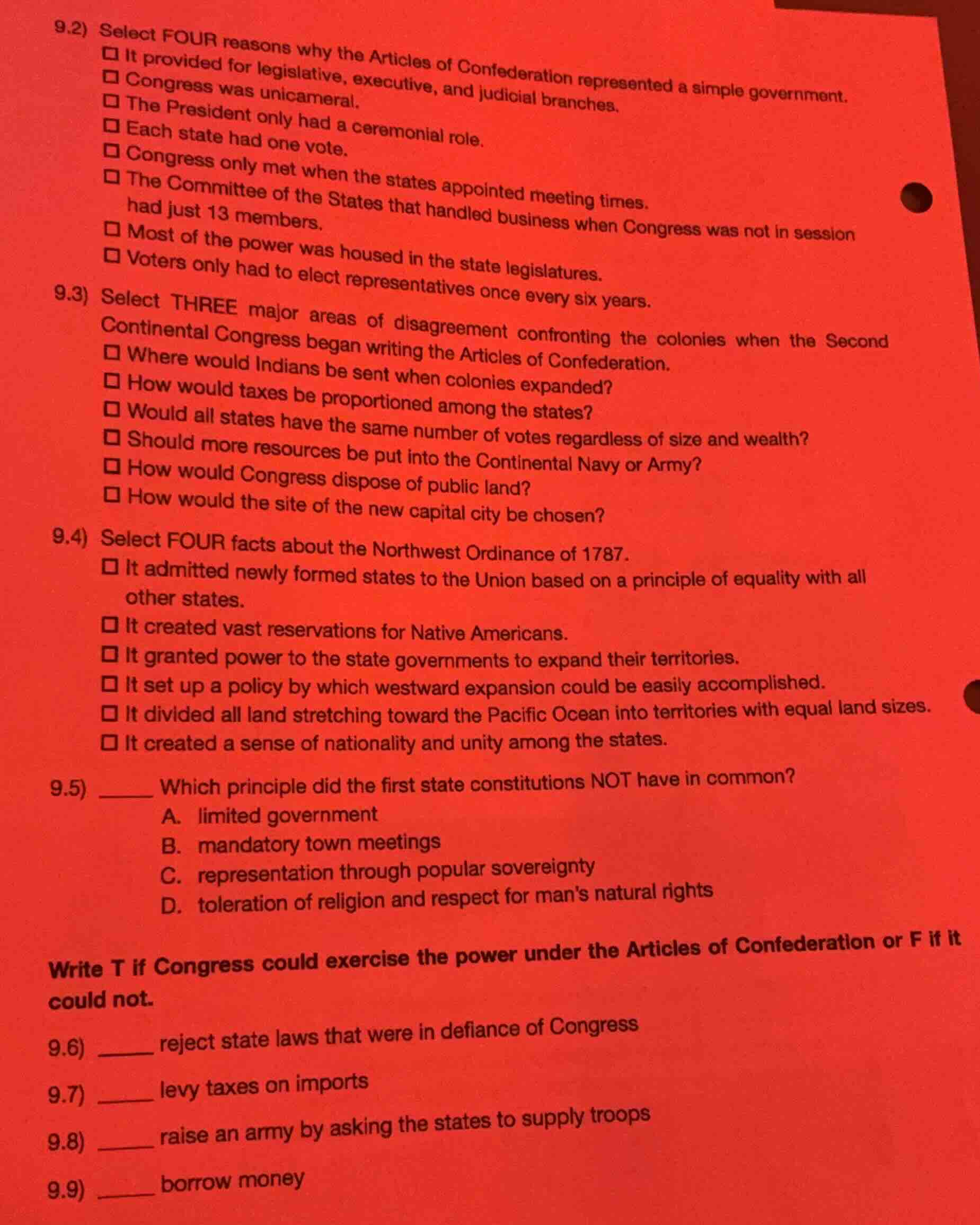
9.2) select four reasons why the articles of confederation represented a simple government.
□ it provided for legislative, executive, and judicial branches.
□ congress was unicameral.
□ the president only had a ceremonial role.
□ each state had one vote.
□ congress only met when the states appointed meeting times.
□ the committee of the states that handled business when congress was not in session had just 13 members.
□ most of the power was housed in the state legislatures.
□ voters only had to elect representatives once every six years.
9.3) select three major areas of disagreement confronting the colonies when the second continental congress began writing the articles of confederation.
□ where would indians be sent when colonies expanded?
□ how would taxes be proportioned among the states?
□ would all states have the same number of votes regardless of size and wealth?
□ should more resources be put into the continental navy or army?
□ how would congress dispose of public land?
□ how would the site of the new capital city be chosen?
9.4) select four facts about the northwest ordinance of 1787.
□ it admitted newly formed states to the union based on a principle of equality with all other states.
□ it created vast reservations for native americans.
□ it granted power to the state governments to expand their territories.
□ it set up a policy by which westward expansion could be easily accomplished.
□ it divided all land stretching toward the pacific ocean into territories with equal land sizes.
□ it created a sense of nationality and unity among the states.
9.5) ______ which principle did the first state constitutions not have in common?
a. limited government
b. mandatory town meetings
c. representation through popular sovereignty
d. toleration of religion and respect for mans natural rights
write t if congress could exercise the power under the articles of confederation or f if it could not.
9.6) ______ reject state laws that were in defiance of congress
9.7) ______ levy taxes on imports
9.8) ______ raise an army by asking the states to supply troops
9.9) ______ borrow money
9.2
Identifies key features of the simple government under the Articles of Confederation, which lacked separate executive/judicial branches, had a unicameral Congress, equal state voting, and concentrated power in state legislatures.
9.3
Cores disputes during the drafting of the Articles: tax apportionment, equal state voting, and public land disposal were major points of conflict between large/small and coastal/landlocked states.
9.4
Key provisions and impacts of the Northwest Ordinance: it admitted new states as equals, established a westward expansion framework, and fostered national unity.
9.5
First state constitutions shared principles of limited government, popular sovereignty, and religious tolerance; mandatory town meetings were a regional (New England) practice, not universal.
9.6-9.9
Under the Articles of Confederation, Congress had no power to override state laws or levy import taxes, but could request troops from states and borrow funds.

Snap & solve any problem in the app
Get step-by-step solutions on Sovi AI
Photo-based solutions with guided steps
Explore more problems and detailed explanations
9.2)
- Congress was unicameral.
- Each state had one vote.
- Most of the power was housed in the state legislatures.
- It provided for legislative, executive, and judicial branches. (Note: The executive/judicial were weak, ad-hoc bodies)
9.3)
- How would taxes be proportioned among the states?
- Would all states have the same number of votes regardless of size and wealth?
- How would Congress dispose of public land?
9.4)
- It admitted newly formed states to the Union based on a principle of equality with all other states.
- It set up a policy by which westward expansion could be easily accomplished.
- It created a sense of nationality and unity among the states.
- It granted power to the state governments to expand their territories.
9.5)
B. mandatory town meetings
9.6) F
9.7) F
9.8) T
9.9) T