QUESTION IMAGE
Question
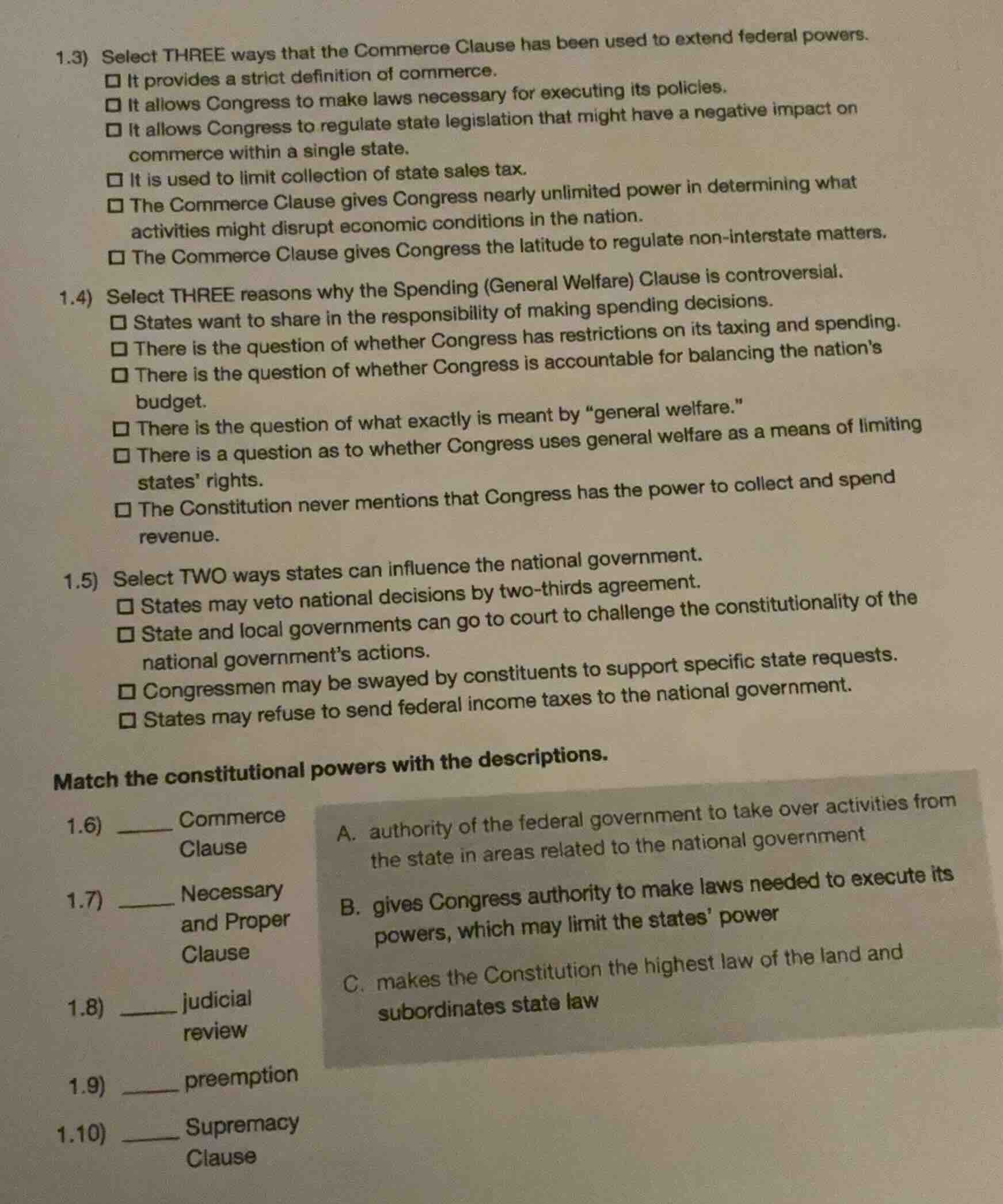
1.3) select three ways that the commerce clause has been used to extend federal powers.
it provides a strict definition of commerce.
it allows congress to make laws necessary for executing its policies.
it allows congress to regulate state legislation that might have a negative impact on commerce within a single state.
it is used to limit collection of state sales tax.
the commerce clause gives congress nearly unlimited power in determining what activities might disrupt economic conditions in the nation.
the commerce clause gives congress the latitude to regulate non - interstate matters.
1.4) select three reasons why the spending (general welfare) clause is controversial.
states want to share in the responsibility of making spending decisions.
there is the question of whether congress has restrictions on its taxing and spending.
there is the question of whether congress is accountable for balancing the nations budget.
there is the question of what exactly is meant by \general welfare.\
there is a question as to whether congress uses general welfare as a means of limiting states rights.
the constitution never mentions that congress has the power to collect and spend revenue.
1.5) select two ways states can influence the national government.
states may veto national decisions by two - thirds agreement.
state and local governments can go to court to challenge the constitutionality of the national governments actions.
congressmen may be swayed by constituents to support specific state requests.
states may refuse to send federal income taxes to the national government.
match the constitutional powers with the descriptions.
1.6) ______ commerce clause
1.7) ______ necessary and proper clause
1.8) ______ judicial review
1.9) ______ preemption
1.10) ______ supremacy clause
a. authority of the federal government to take over activities from the state in areas related to the national government
b. gives congress authority to make laws needed to execute its powers, which may limit the states power
c. makes the constitution the highest law of the land and subordinates state law
1.3
- The Commerce Clause has been interpreted to let Congress regulate intrastate activities that impact interstate commerce, grant broad authority over national economic conditions, and regulate non-interstate matters tied to commerce.
1.4
- Controversies stem from vague definition of "general welfare," debate over congressional taxing/spending limits, and questions about accountability for national budget balance.
1.5
- States can challenge national government actions in court, and their constituents can influence congressmen to support state priorities.
1.6-1.10
- Commerce Clause: Regulates activities affecting national economic conditions, including non-interstate matters tied to commerce.
- Necessary and Proper Clause: Lets Congress make laws to execute its powers.
- Judicial Review: (No matching option provided, but standard definition is courts reviewing government actions for constitutionality; not listed in options here)
- Preemption: Federal government takes over state activities in relevant areas.
- Supremacy Clause: Establishes Constitution as highest law, superseding state law.

Snap & solve any problem in the app
Get step-by-step solutions on Sovi AI
Photo-based solutions with guided steps
Explore more problems and detailed explanations
1.3
- It allows Congress to regulate state legislation that might have a negative impact on commerce within a single state.
- The Commerce Clause gives Congress nearly unlimited power in determining what activities might disrupt economic conditions in the nation.
- The Commerce Clause gives Congress the latitude to regulate non-interstate matters.
1.4
- There is the question of whether Congress has restrictions on its taxing and spending.
- There is the question of whether Congress is accountable for balancing the nation's budget.
- There is the question of what exactly is meant by "general welfare."
1.5
- State and local governments can go to court to challenge the constitutionality of the national government’s actions.
- Congressmen may be swayed by constituents to support specific state requests.
1.6-1.10
1.6) (No direct match in options; the core function is regulating commerce, but from provided options, it aligns with the broad regulatory scope implied in 1.3)
1.7) B. gives Congress authority to make laws needed to execute its powers, which may limit the states' power
1.8) (No matching option provided in A-C)
1.9) A. authority of the federal government to take over activities from the state in areas related to the national government
1.10) C. makes the Constitution the highest law of the land and subordinates state law