QUESTION IMAGE
Question
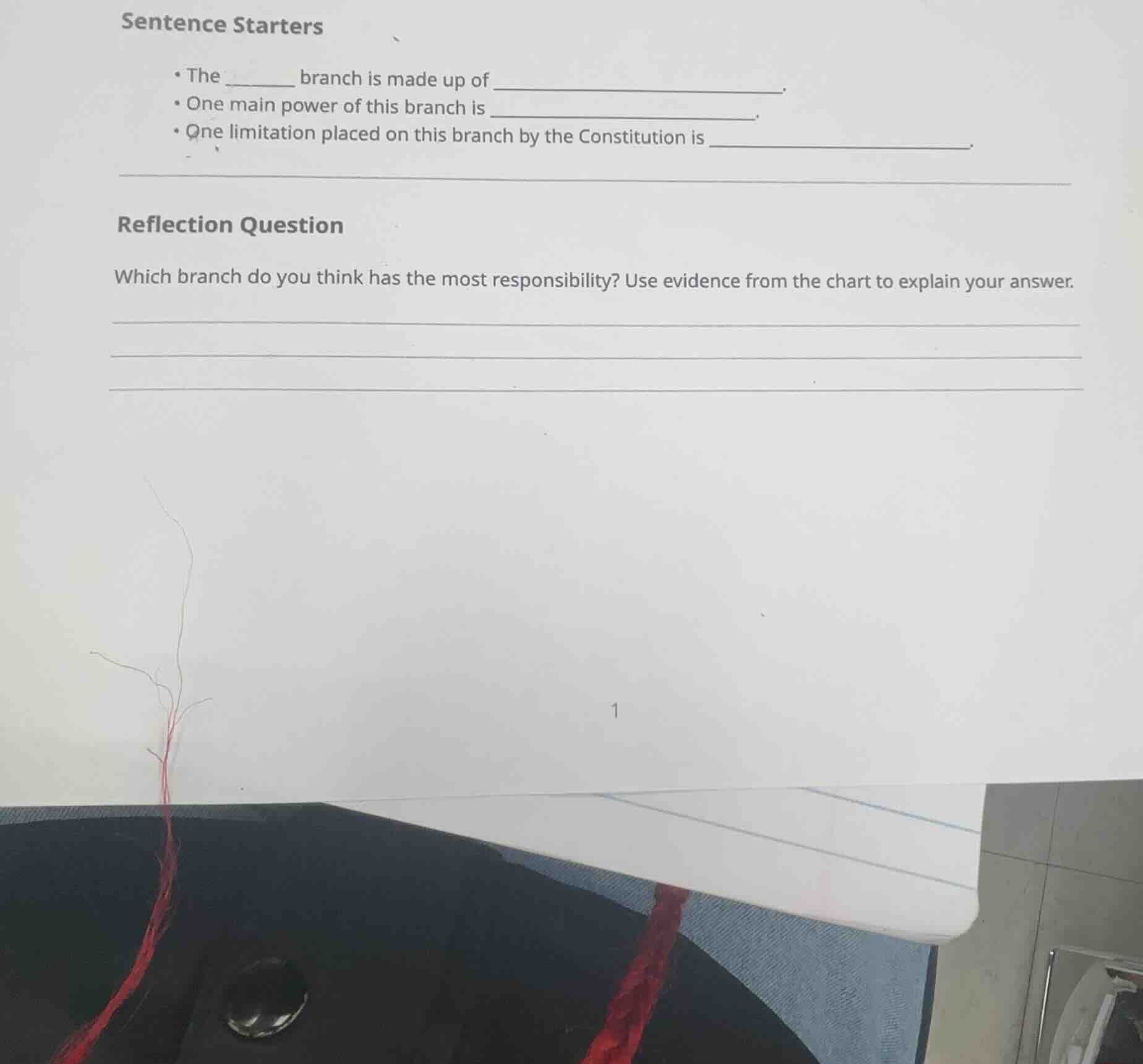
sentence starters
- the ____ branch is made up of ____________.
- one main power of this branch is ______________.
- one limitation placed on this branch by the constitution is ______________.
reflection question
which branch do you think has the most responsibility? use evidence from the chart to explain your answer.
To answer the reflection question, we can consider the three branches of government (legislative, executive, judicial) and their responsibilities. For example, the legislative branch (Congress) makes laws, the executive (President) enforces them, and the judicial (courts) interprets. If we take the legislative branch, its responsibilities include creating laws that affect all citizens, overseeing the budget, and declaring war (in the case of the House and Senate). Evidence from a typical chart on government branches would show its broad law - making powers that impact every aspect of society, from economic policies to social regulations. Another angle: the executive branch has the power to enforce laws, manage foreign relations, and command the military. The judicial branch ensures laws are constitutional and resolves disputes. A strong case for the legislative branch: it initiates the law - making process, which is fundamental as laws guide the actions of the other branches and the public. Without laws, the executive has nothing to enforce, and the judicial has nothing to interpret. So, if we choose the legislative branch, we can explain that it has the most responsibility because it creates the legal framework that the other branches operate within. For example, it can pass laws on healthcare, education, and national security, which have far - reaching impacts on the nation's well - being.

Snap & solve any problem in the app
Get step-by-step solutions on Sovi AI
Photo-based solutions with guided steps
Explore more problems and detailed explanations
I think the legislative branch has the most responsibility. The legislative branch (Congress, made up of the House of Representatives and the Senate) is responsible for making laws. These laws cover every aspect of American life, from how taxes are collected to what environmental regulations exist. For example, if we look at a chart of government branch responsibilities, the legislative branch's law - making power is foundational. Without the laws created by Congress, the executive branch would have no laws to enforce, and the judicial branch would have no laws to interpret. Its ability to set the legal framework for the entire country, along with its powers to oversee the budget and declare war (in the case of the Senate's role in approving military action), means it has a broad and far - reaching set of responsibilities that impact all citizens and the functioning of the other two branches.