QUESTION IMAGE
Question
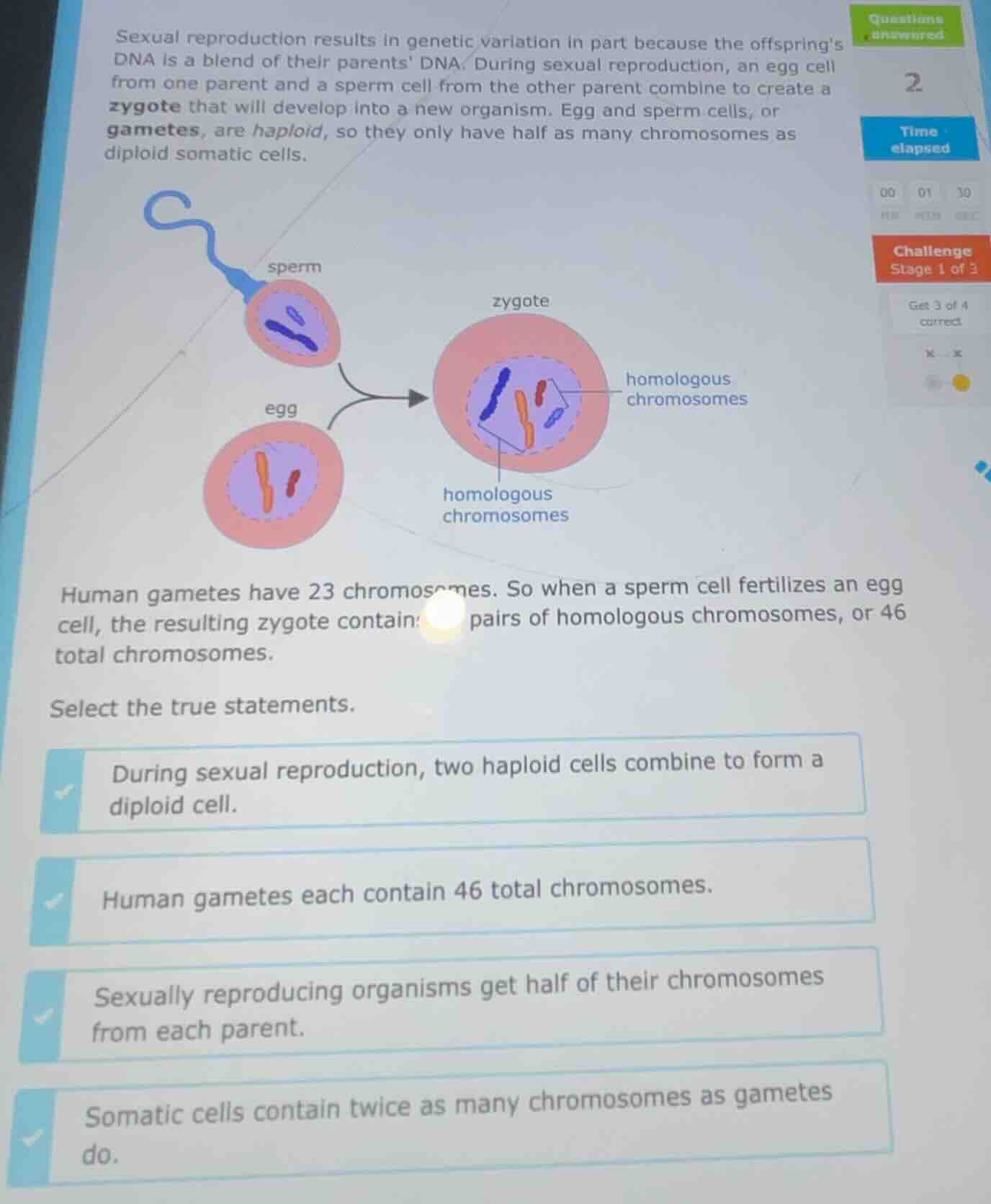
sexual reproduction results in genetic variation in part because the offsprings dna is a blend of their parents dna. during sexual reproduction, an egg cell from one parent and a sperm cell from the other parent combine to create a zygote that will develop into a new organism. egg and sperm cells, or gametes, are haploid, so they only have half as many chromosomes as diploid somatic cells. human gametes have 23 chromosomes. so when a sperm cell fertilizes an egg cell, the resulting zygote contains pairs of homologous chromosomes, or 46 total chromosomes. select the true statements. during sexual reproduction, two haploid cells combine to form a diploid cell. human gametes each contain 46 total chromosomes. sexually reproducing organisms get half of their chromosomes from each parent. somatic cells contain twice as many chromosomes as gametes do.
Step1: Analyze first statement
Gametes (haploid, $n$) fuse to form a diploid ($2n$) zygote. This matches the text and diagram, so it is true.
Step2: Analyze second statement
The text states human gametes have 23 chromosomes, not 46. This statement is false.
Step3: Analyze third statement
Zygote gets 1 set of chromosomes from each gamete (parent), so offspring gets half from each parent. This is true.
Step4: Analyze fourth statement
Gametes are haploid ($n$), somatic cells are diploid ($2n$), so somatic cells have $2n = 2\times n$ chromosomes relative to gametes. This is true.

Snap & solve any problem in the app
Get step-by-step solutions on Sovi AI
Photo-based solutions with guided steps
Explore more problems and detailed explanations
- During sexual reproduction, two haploid cells combine to form a diploid cell.
- Sexually reproducing organisms get half of their chromosomes from each parent.
- Somatic cells contain twice as many chromosomes as gametes do.