QUESTION IMAGE
Question
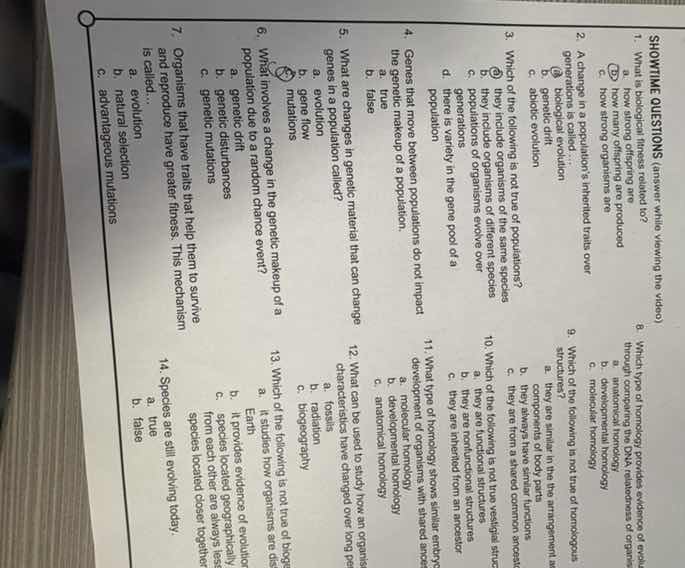
showtime questions (answer while watching the video)
- what is biological evolution?
a. how many offspring the organism produced
b. how many organisms are produced
c. a change in a population’s inherited traits over generations
d. genetic drift
- which of the following is true of populations?
a. they are the smallest unit of evolution
b. populations of organisms evolve over generations
c. populations of different species do not interbreed
d. there is variety in the gene pool of a population
- genes that move between populations do not impact the genetic makeup of a population.
a. true
b. false
- what are changes in genetic material that can change a population called?
a. gene flow
b. mutations
c. natural selection
d. genetic drift
- what involves a change in the genetic makeup of a population due to a random chance event?
a. gene flow
b. genetic drift
c. genetic mutations
d. natural selection
- organisms that have traits that help them to survive and reproduce have greater fitness. this mechanism is called...
a. gene flow
b. natural selection
c. advantageous mutations
d. neutral evolution
- which type of homology provides evidence of evolution?
a. anatomical homology
b. developmental homology
c. molecular homology
d. all of the above
- which of the following is not true of homologous structures?
a. they are similar in the arrangement of bones
b. they are similar in body part function
c. they come from a common ancestor
d. they are not always similar in function
- which of the following is not true of vestigial structures?
a. they are functional structures
b. they are nonfunctional structures
c. they are homologous with shared ancestry
d. they are examples of evolution
- what type of evidence shows similar embryonic development?
a. anatomical homology
b. developmental homology
c. molecular homology
d. analogous structures
- what can be used to study how long ago two organisms shared a common ancestor?
a. fossils
b. embryology
c. biogeography
d. molecular clocks
- which of the following is not true of biogeography?
a. it provides evidence of evolution.
b. earth’s surface has changed over time.
c. species located closer together are less related than species located far apart.
d. species located closer together are more related than species located far apart.
- species are all evolving today.
a. true
b. false
To solve these biology - related multiple - choice questions, we analyze each one:
Question 1
- Explanation: Biological evolution is about the change in inherited traits of a population over successive generations. Option a is about how traits are acquired (not evolution), option c is genetic drift (a part of evolution but not the definition), option d is a genetic shift (not the main definition of evolution).
- Answer: B
Question 2
- Explanation: Genetic drift is a random change in allele frequencies. Option a is about a change in traits (not drift), option b is natural selection (different from drift), option d is a genetic shift (not drift).
- Answer: C
Question 3
- Explanation: Populations of the same species can have different gene pools (so option d is wrong). Organisms of different species can have common ancestors (so option a is wrong). Organisms do evolve over generations (so option b is wrong). The gene pool of a population has variation.
- Answer: C
Question 4
- Explanation: Gene flow is the transfer of genetic material between populations. Option a is about a change in genetic material (not gene flow), option c is mutation (different), option d is a rate (not gene flow).
- Answer: B
Question 5
- Explanation: A change in the genetic makeup of a population over time is evolution. Option a is gene flow (a mechanism), option c is mutation (a mechanism), option d is a gene pool (the set of genes in a population).
- Answer: B
Question 6
- Explanation: A random change in the genetic makeup of a population due to chance is genetic drift. Option a is gene flow (transfer between populations), option c is genetic mutations (changes in DNA, not random chance in population), option d is genetic differences (not the process).
- Answer: B
Question 7
- Explanation: Organisms with traits that help survival and reproduction having greater fitness is natural selection. Option a is evolution (the overall process), option c is neutral evolution (no selection), option d is advantageous mutations (part of natural selection but not the mechanism).
- Answer: B
Question 8
- Explanation: Anatomical homology shows evolutionary relationships. Option a is molecular homology (at the molecular level), option b is developmental homology (during development), option d is analogous structures (convergent evolution, not homology).
- Answer: C
Question 9
- Explanation: Analogous structures are not from a common ancestor (convergent evolution). Option a is about homology (common ancestor), option b is anatomical homology (common ancestor), option d is about the arrangement (not the key point of analogous structures).
- Answer: C
Question 10
- Explanation: Vestigial structures are leftover from ancestors. Option a is about functional structures, option b is about homologous structures (common ancestor, not vestigial), option c is about analogous structures (convergent, not vestigial).
- Answer: D
Question 11
- Explanation: Gene flow is the transfer between populations, so populations with gene flow are not independent. Option a is about population size (not the factor), option b is about genetic variation (not the factor), option d is about mutation rate (not the factor).
- Answer: C
Question 12
- Explanation: Radioactive dating can tell how long ago organisms lived. Option a is about traits (not dating), option b is about evolution (not dating), option d is about habitats (not dating).
- Answer: C
Qu…

Snap & solve any problem in the app
Get step-by-step solutions on Sovi AI
Photo-based solutions with guided steps
Explore more problems and detailed explanations
To solve these biology - related multiple - choice questions, we analyze each one:
Question 1
- Explanation: Biological evolution is about the change in inherited traits of a population over successive generations. Option a is about how traits are acquired (not evolution), option c is genetic drift (a part of evolution but not the definition), option d is a genetic shift (not the main definition of evolution).
- Answer: B
Question 2
- Explanation: Genetic drift is a random change in allele frequencies. Option a is about a change in traits (not drift), option b is natural selection (different from drift), option d is a genetic shift (not drift).
- Answer: C
Question 3
- Explanation: Populations of the same species can have different gene pools (so option d is wrong). Organisms of different species can have common ancestors (so option a is wrong). Organisms do evolve over generations (so option b is wrong). The gene pool of a population has variation.
- Answer: C
Question 4
- Explanation: Gene flow is the transfer of genetic material between populations. Option a is about a change in genetic material (not gene flow), option c is mutation (different), option d is a rate (not gene flow).
- Answer: B
Question 5
- Explanation: A change in the genetic makeup of a population over time is evolution. Option a is gene flow (a mechanism), option c is mutation (a mechanism), option d is a gene pool (the set of genes in a population).
- Answer: B
Question 6
- Explanation: A random change in the genetic makeup of a population due to chance is genetic drift. Option a is gene flow (transfer between populations), option c is genetic mutations (changes in DNA, not random chance in population), option d is genetic differences (not the process).
- Answer: B
Question 7
- Explanation: Organisms with traits that help survival and reproduction having greater fitness is natural selection. Option a is evolution (the overall process), option c is neutral evolution (no selection), option d is advantageous mutations (part of natural selection but not the mechanism).
- Answer: B
Question 8
- Explanation: Anatomical homology shows evolutionary relationships. Option a is molecular homology (at the molecular level), option b is developmental homology (during development), option d is analogous structures (convergent evolution, not homology).
- Answer: C
Question 9
- Explanation: Analogous structures are not from a common ancestor (convergent evolution). Option a is about homology (common ancestor), option b is anatomical homology (common ancestor), option d is about the arrangement (not the key point of analogous structures).
- Answer: C
Question 10
- Explanation: Vestigial structures are leftover from ancestors. Option a is about functional structures, option b is about homologous structures (common ancestor, not vestigial), option c is about analogous structures (convergent, not vestigial).
- Answer: D
Question 11
- Explanation: Gene flow is the transfer between populations, so populations with gene flow are not independent. Option a is about population size (not the factor), option b is about genetic variation (not the factor), option d is about mutation rate (not the factor).
- Answer: C
Question 12
- Explanation: Radioactive dating can tell how long ago organisms lived. Option a is about traits (not dating), option b is about evolution (not dating), option d is about habitats (not dating).
- Answer: C
Question 13
- Explanation: Biogeography is not a line of evidence for evolution. Option a is fossil record (shows evolution), option b is comparative anatomy (shows relationships), option c is embryology (shows relationships).
- Answer: D
Question 14
- Explanation: Species are still evolving today (e.g., antibiotic resistance in bacteria). So the answer is false.
- Answer: B
Final Answers (in order of questions 1 - 14)
- B
- C
- C
- B
- B
- B
- B
- C
- C
- D
- C
- C
- D
- B