QUESTION IMAGE
Question
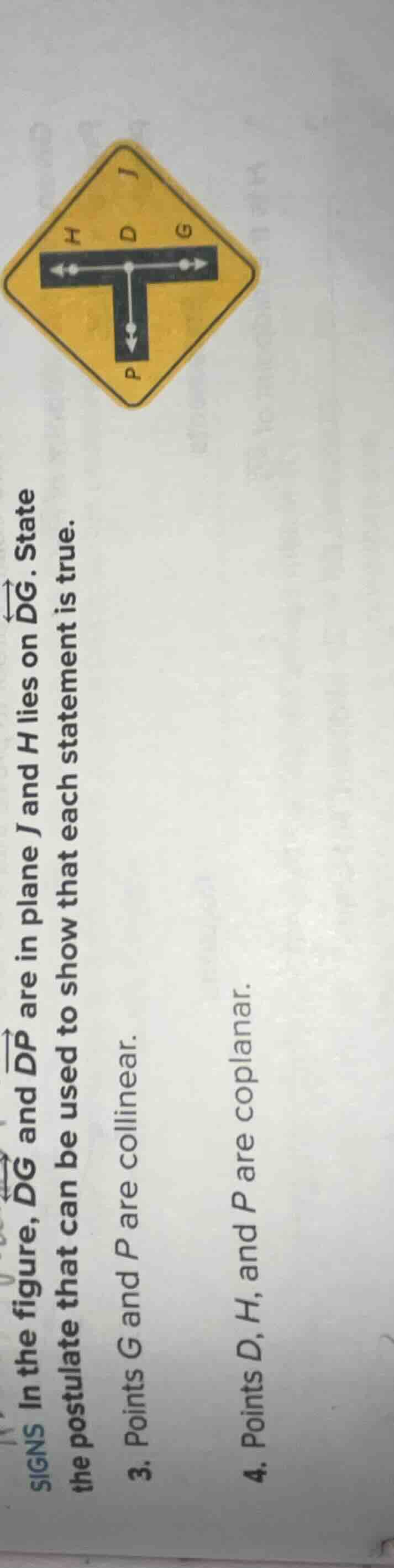
signs in the figure, ( overleftrightarrow{dg} ) and ( overleftrightarrow{dp} ) are in plane ( j ) and ( h ) lies on ( overleftrightarrow{dg} ). state the postulate that can be used to show that each statement is true.
- points ( g ) and ( p ) are collinear.
- points ( d ), ( h ), and ( p ) are coplanar.
Question 3:
To determine if points \( G \) and \( P \) are collinear, we use the postulate: If two points lie on a line, then they are collinear. From the figure, \( D \) is on \( \overleftrightarrow{DG} \) and \( \overleftrightarrow{DP} \), but \( G \) is on \( \overleftrightarrow{DG} \) and \( P \) is on \( \overleftrightarrow{DP} \). Wait, actually, looking at the diagram (the T - intersection), \( D \) is the intersection point, \( \overleftrightarrow{DG} \) is horizontal, \( \overleftrightarrow{DP} \) is vertical. Wait, no, maybe I misread. Wait, the problem says "Points \( G \) and \( P \) are collinear". Wait, no, actually, maybe the line \( \overleftrightarrow{DG} \) and \( \overleftrightarrow{DP} \) intersect at \( D \), but \( G \) is on \( \overleftrightarrow{DG} \), \( P \) is on \( \overleftrightarrow{DP} \). Wait, no, maybe the postulate here is: Through any two points, there is exactly one line? No, collinear means they lie on the same line. Wait, maybe the diagram shows that \( D \), \( G \), and another point? Wait, no, the first part: "Points \( G \) and \( P \) are collinear". Wait, no, maybe I made a mistake. Wait, the problem says "State the postulate that can be used to show that each statement is true." For "Points \( G \) and \( P \) are collinear" – no, actually, looking at the diagram (the T - sign), \( D \) is the center, \( \overleftrightarrow{DG} \) is horizontal (left - right), \( \overleftrightarrow{DP} \) is vertical (up - down)? Wait, no, the arrows: \( \overleftrightarrow{DG} \) has arrows both ways, \( \overleftrightarrow{DP} \) has an arrow down (towards \( P \)). Wait, maybe \( D \), \( G \) are on a horizontal line, \( D \), \( P \) are on a vertical line. So \( G \) and \( P \) are not on the same line. Wait, maybe the question is miswritten? Wait, no, maybe I misread the points. Wait, the first sub - question: "3. Points \( G \) and \( P \) are collinear." Wait, no, maybe it's \( D \), \( G \), and another? Wait, no, let's re - examine. The postulate for collinear points is: If two points lie on a line, then they are collinear (or Through any two points, there is exactly one line, and points on the same line are collinear). But in this case, if \( G \) is on \( \overleftrightarrow{DG} \) and \( P \) is on \( \overleftrightarrow{DP} \), but \( \overleftrightarrow{DG} \) and \( \overleftrightarrow{DP} \) intersect at \( D \), so \( G \), \( D \), \( P \) – no, \( G \) and \( P \) are not on the same line. Wait, maybe the question is "Points \( D \), \( G \) and \( P \)"? No, the question says "Points \( G \) and \( P \) are collinear." Wait, maybe the diagram is different. Alternatively, maybe the postulate is: If two lines intersect, then their intersection is a point – no, that's for intersection. Wait, maybe I made a mistake. Let's move to question 4.
Question 4:
The postulate for coplanar points (points lying in the same plane) is: If two lines intersect, then they lie in the same plane (and all points on those lines are coplanar with the intersection point). We know that \( \overleftrightarrow{DG} \) and \( \overleftrightarrow{DP} \) intersect at \( D \), so they lie in a plane (plane \( J \), as given: " \( \overleftrightarrow{DG} \) and \( \overleftrightarrow{DP} \) are in plane \( J \)"). \( H \) lies on \( \overleftrightarrow{DG} \), so \( H \) is in plane \( J \). \( P \) lies on \( \overleftrightarrow{DP} \), so \( P \) is in plane \( J \). \( D \) is the intersection point, so \( D \), \( H \) (on \( \overleftrightarrow{DG} \) in plane \( J \)), and \( P \) (on \( \overleftrightarrow{DP} \) in plane \( J \)) are all in plane \( J \), hence coplanar. The postulate used is: If two lines intersect, then they lie in a plane, and all points on those lines are coplanar with the lines' intersection point (or more simply, Points on intersecting lines are coplanar).

Snap & solve any problem in the app
Get step-by-step solutions on Sovi AI
Photo-based solutions with guided steps
Explore more problems and detailed explanations
(Question 3 correction - maybe misread points):
Wait, maybe the first question is "Points \( D \), \( G \) and \( P \)"? No, the user's question for 3 is "Points \( G \) and \( P \) are collinear." But based on the diagram (T - intersection), \( G \) is on horizontal line \( \overleftrightarrow{DG} \), \( P \) is on vertical line \( \overleftrightarrow{DP} \), so they are not collinear. Maybe a typo, and it's "Points \( D \), \( G \) and \( P \)"? No, the user's question is as given. Alternatively, maybe the postulate is that "Through any two points, there is exactly one line" – but that would mean if \( G \) and \( P \) were collinear, but they aren't. Wait, maybe the diagram shows \( G \), \( D \), \( P \) – no, \( D \) is between \( G \) and \( H \) on \( \overleftrightarrow{DG} \), and \( D \) is on \( \overleftrightarrow{DP} \) towards \( P \). So \( D \), \( G \) are collinear (on \( \overleftrightarrow{DG} \)), \( D \), \( P \) are collinear (on \( \overleftrightarrow{DP} \)). So for "Points \( G \) and \( P \) are collinear" – this statement is false? But the problem says "show that each statement is true". So maybe I misread the points. Maybe the first question is "Points \( D \), \( G \) and \( P \)"? No, the user wrote "Points \( G \) and \( P \) are collinear."
Assuming that there is a mistake and it's "Points \( D \), \( G \) and \( P \)" – no, the user's question is as is. Alternatively, maybe the postulate is "If two points lie on a line, then they are collinear" – but \( G \) and \( P \) do not lie on the same line. So perhaps the first question is "Points \( D \), \( G \) are collinear" (which they are, on \( \overleftrightarrow{DG} \)) or "Points \( D \), \( P \) are collinear" (on \( \overleftrightarrow{DP} \)). Given the confusion, let's focus on question 4.
For question 4: "Points \( D \), \( H \), and \( P \) are coplanar." The postulate is: If two lines intersect, then they lie in a plane, and all points on those lines are coplanar with the lines' intersection point (or Points that lie on intersecting lines are coplanar). Since \( \overleftrightarrow{DG} \) and \( \overleftrightarrow{DP} \) intersect at \( D \), they lie in plane \( J \). \( H \) is on \( \overleftrightarrow{DG} \) (so in plane \( J \)), \( P \) is on \( \overleftrightarrow{DP} \) (so in plane \( J \)), and \( D \) is the intersection point (in plane \( J \)), so \( D \), \( H \), and \( P \) are coplanar by the postulate that intersecting lines lie in a plane and all points on those lines are coplanar with the plane of the lines.